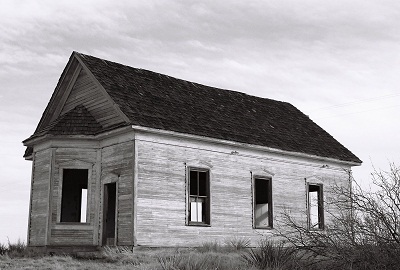
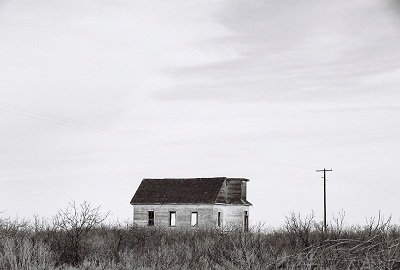
Let’s start the New Year by departing Yeso and traveling Highway 60 east, past Fort Sumner, final resting place of Billy the Kid (we’ll return to Fort Sumner…eventually), to the unincorporated town of Taiban, New Mexico. Taiban is known for its old Presbyterian Church, a lonely, gutted house of worship visited by photographers and the traveling faithful. The church, once part of a neighborhood which included homes, businesses, and the two-story Taiban High School, now sits by itself out on the prairie. Not a single business remains in Taiban. But it was not always this way.
Like Yeso, Taiban was named for a nearby creek. The source of Taiban Creek was Taiban Spring, originally known as Brazil Spring after a Portugese immigrant, Manuel Brazil, who arrived in 1871, the first recorded settler in the area. The meaning of the word “Taiban” is obscure, although it’s thought it might be a Navajo or Comanche word for “horsetail,” a reference either to a local plant or to three small tributaries that flowed into the creek. It’s said that Billy the Kid watered his horse at Taiban Spring.
Also like Yeso, Taiban owed its existence to the railroad. Taiban was founded in 1906, when the Belen Cut-off was laid across the eastern plains of New Mexico, re-directing rail traffic from the mountainous north. A school was built and contracts were drawn for the construction of fifty homes. By 1907, there was a bank and a hotel. In 1908, the Atchison, Topeka, and Santa Fe Railroad began actively encouraging settlement of the region. Over 1,300 trains passed through the plains bringing homesteaders from across the country. But the vast majority of emigrants did not settle in Taiban and, in 1909, the town’s population peaked at 400 residents. These were mostly farmers and sheepherders, already veterans of conflict with both the landscape and established ranching interests.
In the fall of 1908, construction began on the First Presbyterian Church of Taiban. It was completed on December 22, 1908 at a cost of $250, less than $100 of which could be covered by the congregation, necessitating loans from the ladies of the Baptist Church, as well as the Taiban Savings Bank. The first sermon, given by Reverend John R. Gass, was sparsely attended due to cold weather.
Shortly after Taiban was founded a heated controversy erupted over the construction of The Pink Pony Saloon and Dancehall, which, in addition to selling alcohol, was to hold cockfights and house a snake den in its basement. Opened amidst great consternation, the Pink Pony became the only one of 40 businesses operating in Taiban in 1908 to survive into the latter part of the 1930’s.
A settler, Vane Outias, describes his experience arriving in Taiban: "There we were. Piling down off the steps of the jerk-water train at Taiban, New Mexico; Pa, Ma, and the kids. After counting the suitcases, the packages, and the bundles, Ma called the roll. All were present. The bunch of us with Ma herding started for the hotel. We had come out here to file on some land: make a living farming; and when we had proved-up, sell out and go back east (rich).
"On the way to the hotel I made observations for my own particular benefit, namely, there were two places in town which would have thrown Carrie Nation into a frenzy if she had been one of our party, Watch me hurry, as I had come from a dry state. Just as soon as I could find an excuse I was admitted to the bar of the first emporium. I meant to say; when I found an excuse that the Missus would accept.”
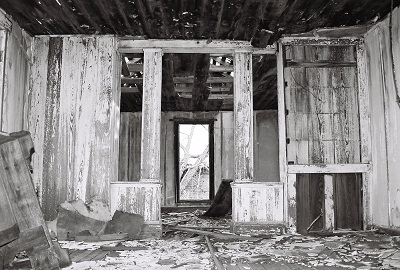
Thus alcohol and religion squared off, vying for the soul of Taiban, whose heart was being broken by the farming of an inhospitable and increasingly barren land. Some years the church won out and Taiban was dry. Other year’s, those laws were overturned and Taiban was once again wet. Into the 1930’s, as the Depression and drought deepened, families left the area. Following Prohibition, it was largely liquor that kept Taiban from blowing away entirely. For nearly all of the town’s existence the Taiban Presbyterian Church had played a vital role in the spiritual life of the community, serving Methodists and Baptists, as well, but, with congregations dwindling, the last service was held in 1936.
After WWII, only seven businesses operated in Taiban, which now had a population of 50. The bars were most successful and customers from dry counties in west Texas and Oklahoma came out for a drink. The town even had an airfield, Taiban International Airport, and the wealthy would fly in to purchase liquor. People as far away as western Oklahoma knew Taiban’s reputation as the “bootlegging capital” of eastern New Mexico and west Texas.
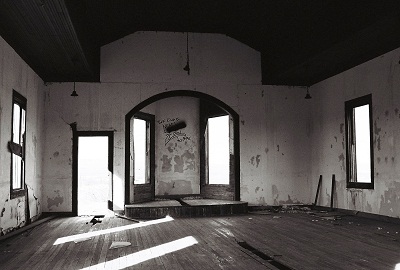
But alcohol isn’t enough to save a town that has lost all hope of real prosperity. Passenger and express train service had ceased in Taiban in 1933, the same year telegraph service was discontinued. New highways and decades of difficult-to-impossible dry farming drove nearly all the residents of Taiban elsewhere until, by 1960, only one business remained; a bar. And now there are none.
While the battle between God and alcohol played out for many years in Taiban, walking the town site now it appears there was no clear winner. The bars are all gone and turned to dust. The little church stands vacant and exposed, the bell tower removed in 1960, the baby grand piano sold, the doors and windows destroyed by vandals. So, let’s call it a draw…for now. Visitors are starting to leave prayers in the alcove of the church, behind where the old walnut pulpit used to be, so perhaps it will have a new life yet. In the meantime, if you want to see such a fight for yourself, this same battle continues to be played out in towns all across America. Maybe your town is one of them.
Information for this post came from Highway 60 & the Belen Cutoff, by Dixie Boyle. The great quote from Vane Outias was found at THIS De Baca County website. Oddly, although almost no internet sources recount Taiban’s history, one that does offers an incredibly detailed account. Compiled in an attempt to get the Taiban Presbyterian Church on the state Register of Cultural Properties, THIS was my major source for this post. I don’t believe the effort to get the church listed was successful. For once, Philip Varney gave me nothin’.
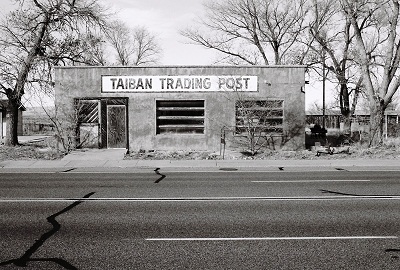
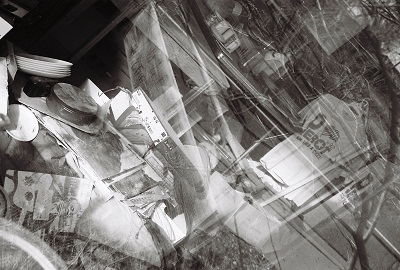
I'd be thrilled if anyone could confirm that there's a Blind Willie McTell record in the window of the trading post pictured above. It's on the opposite side of the picture from the Ross Perot shirts. It would have to be a later period photo, sometime around the "LAST SESSIONS" recording. Anyone? (MAY 2015 UPDATE: It's not Blind Willie McTell, but his former classmate at the Georgia Academy for the Blind, Rev. Pearly Brown, shown on the cover of Wet Willie's "Keep on Smilin'" LP. Thanks Cox family!)
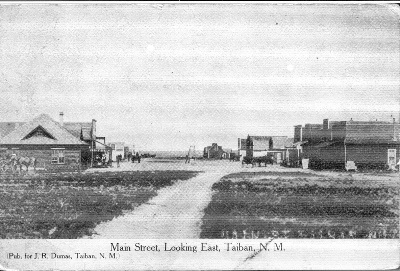
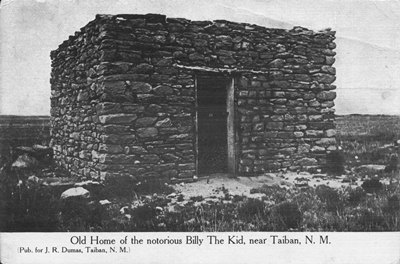
SEPTEMBER 2012 UPDATE: Below are two fantastic postcard images of Taiban. The first is of Main Street, taken from the east. Based on the 1908 postmark, the photo can be from no more than two years after Taiban's founding in 1906. The second is of Billy the Kid's hideout in the area, which has been reduced to nothing more than a foundation now, if even that. Both were submitted by Dave S. Here's what Dave had to say about the postcards, as well as Billy the Kid's capture at Stinking (aka Taiban) Spring in 1880:
"Thought you and some of your posters would like to see these images. I’m an inveterate postcard collector, and found these at one of my haunts. The first is postmarked Sept. 22, 1908 (can’t make out where it was postmarked). I also happen to be an uncrowned 'World’s Foremost Authority on Billy the Kid.' I snatched these up because BtK (and a few of his comrades) were captured at a rock house at Stinking Spring(s) (also called Cedar Spring, Brazil Spring, Taiban Spring, or just 'the spring') in the vicinity of Taiban, on Dec. 23, 1880. (He later escaped.) Frederick Nolan says the spot was first recognized as a strategic location by Kit Carson.
"There isn’t a whole lot of detail in the Taiban photo, but it’s very atmospheric. The scan ain’t the greatest, but you can make out the sign at middle left that says 'HOTEL.' That’s about as much detail as can be seen on the original. Much to my chagrin, I learned that the town wasn’t founded until 26 years later. As they say: Never ass.u.me. It cost me the better part of 40 bucks, but as great/rare cards go that’s not too terribly bad.
"The second image was clearly not BtK's 'home.' He was on the run and this was just an opportune hideout. And it is only 'said' to be the house where Billy was captured. The proof is not iron-clad. Although he provides no citation, Frederick Nolan avers in The West of Billy the Kid that, 'The rock house was a stark stone structure about thirty-feet long and twelve-feet wide, with a rough opening--no door--about ten feet from one end at the front. Inside were five men and the Kid’s horse; tethered to one of the viga poles outside were…three other horses.' Obviously, this description and the photo are not a great match. One could further cloud matters by noting that the nearby Wilcox-Brazil Ranch was of a similar stone construction. But whatever the location of the house, Billy was soon dispossessed of it, and so began his railroading to the gallows. This definitely occurred near Taiban, at a place called Stinking Spring(s). The “stink” at Stinking Spring(s) is said to be either: of a chemical nature, deriving from near-by geological formations, or caused by “decaying vegetation around it.” [Nolan] So are the twists and swirls around virtually everything Billy. There is no escape.
"I’ve been to Taiban, but don’t remember much about it except that there was very little left there. I didn’t try to find the foundation of the stone house, which is all that survives. As I recall, it was a matter of fatigue, and not feeling too terribly welcome there.
"So, anyway, I enjoyed reading your history of the place. I certainly don’t 'own' these images. They're forwarded along to you and yours for whatever purpose they might suggest."
These have to be some of the earliest photos from the Taiban area. I didn't come across them in my research and I imagine they're pretty obscure. So, many thanks to Dave for sending them to City of Dust. Much appreciated!
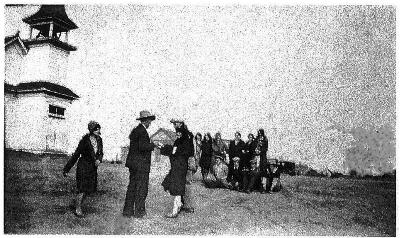
As a last update (for now), here's a 1925 photograph taken outside the Taiban Presbyterian Church when it was in its full glory. This is from the Application for Registration submitted to the New Mexico State Register of Cultural Properties on behalf of the church. The source of the photo is credited as Susanne Eldridge. So, thanks to her, whoever and wherever she may be.
FEBRUARY 2013 UPDATE: A reader recently sent in a wonderful family history of Taiban and a really excellent photo of the town from 1950. The view is looking north with recollections below.
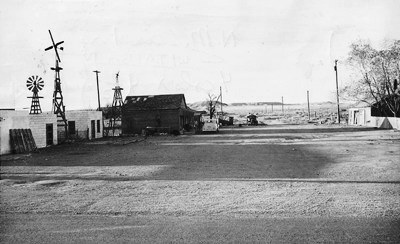
"I bumped into your Taiban, NM site today. My grandparents settled there in 1908. The "Trading Post" was built in 1915 and used by my grandparents in the mid-'50s. The picture credited to Susanne Eldridge is of the church, which is also owned by her. Mac's Bar was just across the street from my grandfather's store and we would watch the cars come and go. Many were bootleggers headed east. My grandfather, J.S. Phillips, came stringing wire for Western Union as the railroad came though. He married my grandmother and settled in Taiban, the "City of the Future." Or at least he thought. He sold Fords and groceries and drilled water wells. He also sold Atwater Kent radios, ran a machine shop, sold gas, and fixed cars. He was very religious and took care of the Church, which was owned by the Presbyterian and Methodist churches. He and my grandmother, Anne Bordeaux, married in 1913. They had seven children and lost a child. I can go on and on. You can go to Facebook and there is a new page, "Remembering Fort Sumner".
David B., Fort Sumner, NM"
Thanks, David! Your contribution really adds a lot to this post. JM
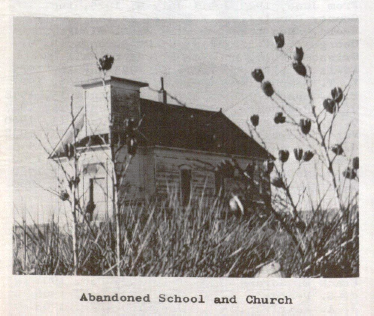
AUGUST 2013 UPDATE: While digging through the dusty corners of the Zimmerman Library at the University of New Mexico a photo of the First Presbyterian Church was unearthed. It's from a rare book titled, "Roosevelt County: History and Heritage," edited by Jean M. Burroughs. Note that the church is actually in De Baca County, about two miles west of the Roosevelt County line. The book was published in '75, so the picture has to be older than that. I'd never seen this spooky shot before, so I thought I'd post it here.
MARCH 2014 UPDATE: Here's something interesting sent in by Rob G. of southwestern Missouri. He found this wrought iron fork at an estate sale and estimates it to have been made between the late 1910's and early 1920's. While it might be hard to read in the photo, it clearly says "TAIBAN" on the back. There aren't many Taiban's in the world, so I have to think this fork might well have come from the little town. I'd love it if someone knew something about this piece.
Thanks to Rob G. for submitting this most intriguing find! JM
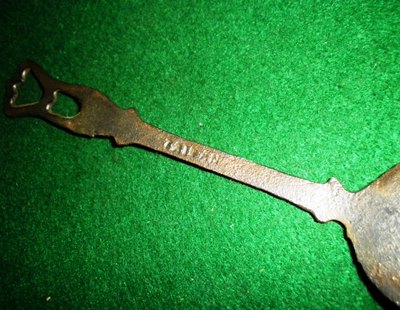
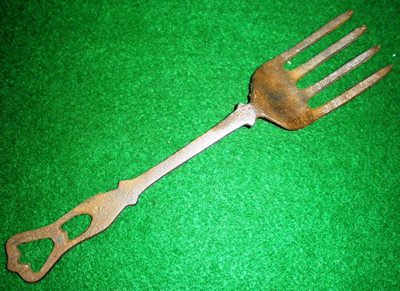
JANUARY 2016 UPDATE: D. Burge has submitted a treasure trove of Taiban-related photographs and scans, including the best (only?) shots I've ever seen of the Taiban school and international (?!) airport. Who knew the two were so close to each other? D. Schuyler also offered some information pertinent to the school and J.S. Phillips Garage. See below for these fantastic photos and descriptions. Thank you very much, Mr. Burge and Ms. Schuyler!
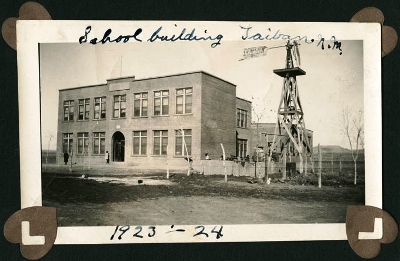
Above is the two-story Taiban school, of which virtually no trace remains. It seems awfully large for a town the size of Taiban and, indeed, only the first floor was used. One room contained grades 1-4, while a second room was for grades 5-8. Beyond that, students went to the high school in nearby Ft. Sumner.
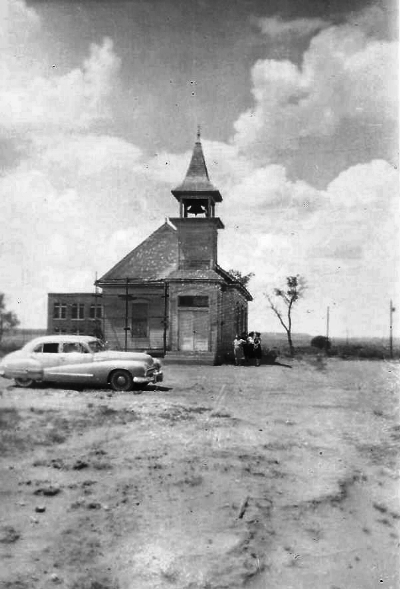
Shown in the wonderful photo above is, of course, the First Presbyterian Church of Taiban in its full glory. Well, aside from the scaffold. Interesting to note is the bit of the school that is also in the frame, just behind the church, pinning down its exact location pretty definitively.
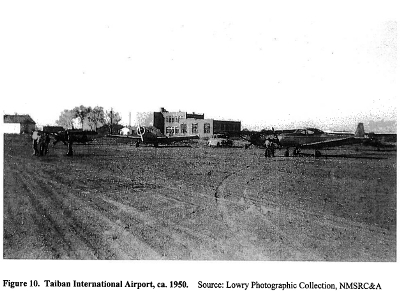
Judging from the scene above the Taiban International Airport was simply the open ground just to the east of the school and church. Perhaps this is how some folks from dry counties in Texas arrived in Taiban to re-stock their liquor supplies. The photo dates from around 1950.
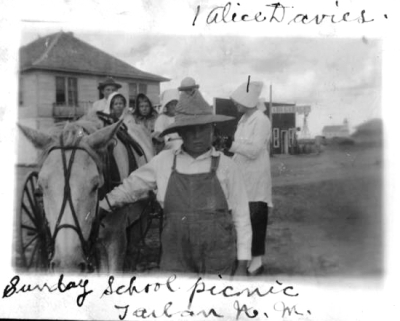
The picture above captures a Sunday school picnic with Alice Davies and her students. Note the Taiban church in the far background. The street immediately behind the picnickers is unrecognizable today.
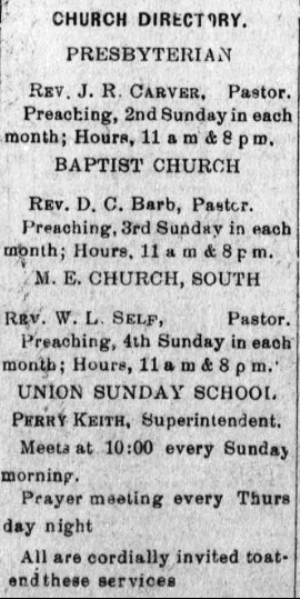
Speaking of Sunday school, the church schedule shown is from the Taiban Valley News and dates to 1917.
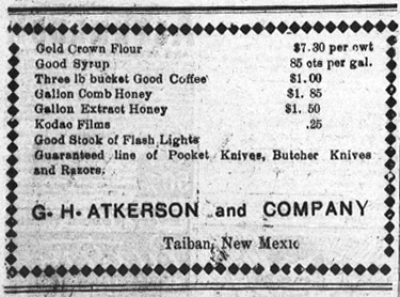
G.H. Atkerson and Company was one of the businesses supplying the items that settlers in the region around Taiban might need or want. Like a gallon of comb honey! Yum! And Kodac Films. I'd like to try shooting some of those films, even if they'd be expired by about 100 years. This is another clipping from the Taiban Valley News of 1917.
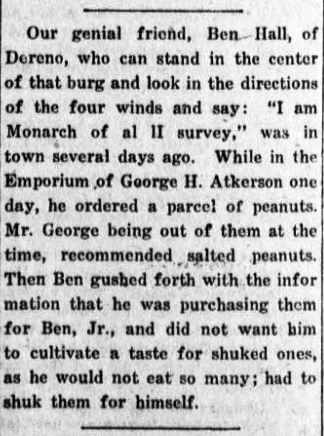
Another thing we know was sold by G.H. Atkerson and Co. were peanuts. And we also know that Ben Hall of Dereno (and founder of the Canyon Blanco Ranch) would purchase them for his son, Ben, Jr. However, not those salted ones! The story above is all the more amusing for its reference to Dereno, a very obscure place in De Baca County that was 12 miles south of Tolar. The post office operated from 1907-1933, but now even the origin of the town's name is lost to the mists of time. This little tale of the dangers of shuked (sic) peanuts is from the Taiban Valley News circa 1921.
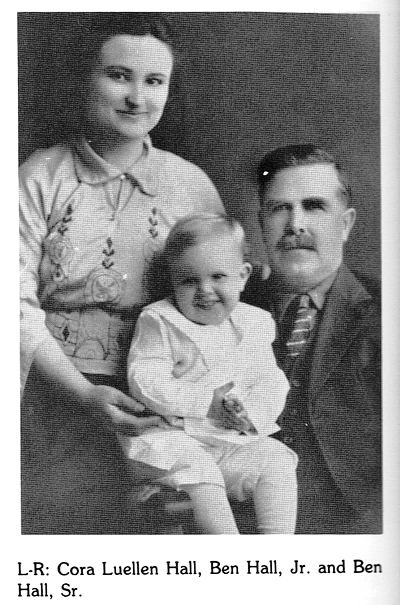
Above is a picture of the monarch of Dereno, NM himself, Ben Hall, Sr., and future peanut connoisseur, Ben Hall, Jr. Mrs. Hall is clearly quite proud! This photo comes from "Living Water: Our Mid-Pecos History: The Families & Events from Fort to Future," a now-rare tome chronicling De Baca County. The book was compiled by Bob Parsons and eight others in 1981 and issued in an edition of 5,000.
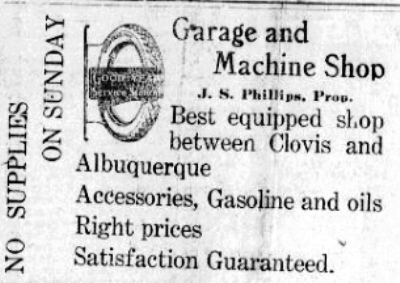
The J.S. Phillips Garage wanted everyone to know that there wasn't much between Clovis and Albuquerque around 1917-1918. They seem to have been well-stocked; you just didn't want to break down on a Sunday. The garage was on the east end of town, one of three open in Taiban by the late-1940's. Descendants of the Phillips family now own the First Presbyterian Church.
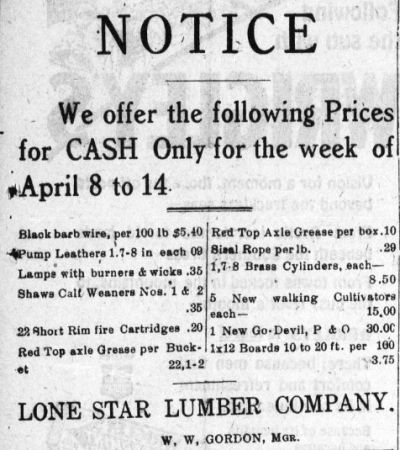
The ad above is for Lone Star Lumber, which supplied a variety of goods, pulled from the Taiban Valley News circa 1918.
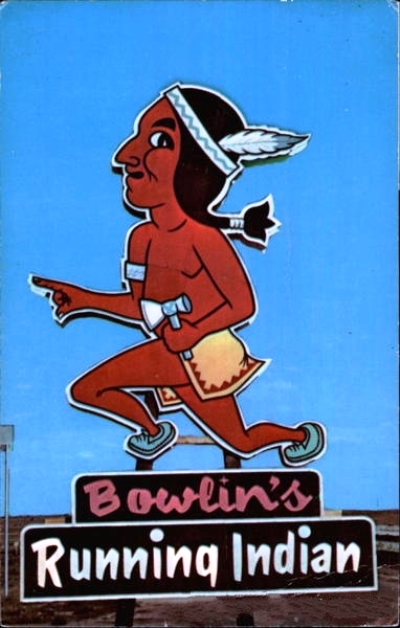
The Pink Pony Saloon and Dancehall was purchased by the Bowlin's family, who were famous for their trading post empire in New Mexico. The Pink Pony became the Running Indian, but may not have lasted long.
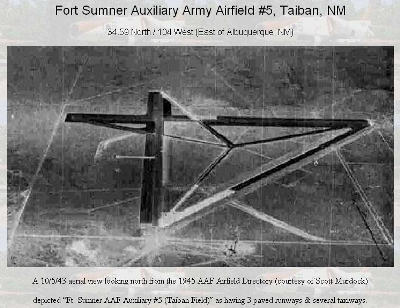
The airfield shown above is different than the one near the top of this update. It was probably located on the caprock just west of Highway 252, which leads north to HOUSE, NM, and used by the military as an emergency landing area back when the Fort Sumner Army Air Base was in operation. The M & M Cattle Company out of Amarillo, TX owned the land going back to the 1970's, but I've not heard who owns it now. It's said that for a long time you could see the outline of the runways, but nature finally reclaimed the place. The photo was taken on October 5, 1943, and comes from an interesting webpage called, Abandoned & Little Known Airfields: Eastern New Mexico.
I'm thrilled to add these rare photos to this archive of Taiban history. Again, many thanks to D. Burge and D. Schuyler for their generous contributions. JM
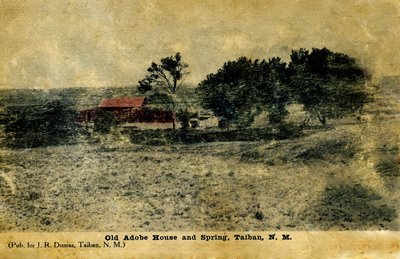
JANUARY 2018 UPDATE: Another postcard featuring Taiban has been kindly submitted by Dave S., who says, "There’s not a ton of there there, granted, but it does purport to show the actual site of the spring." Also of note is that this is the third postcard Dave has obtained bearing the inscription, "Pub. for J. R. Dumas, Taiban, N.M." One can't help but wonder how many images of Taiban were put on postcards for this Dumas person.
Thanks again, Dave S.! JM


105 comments:
I apologize I haven't visited your site in awhile. Your black and white images here are beautiful! What a fun road trip!
I like reading about small towns I never knew existed. I love your photos and the history of Taiban.
Thanks for your comments, Lynne and Adsila. I always appreciate your kind words. And I'm going to *try* to post more in 2012. I've got a large backlog of photos and locations just waiting. JM
Good one. Great pics.
I cain't see nothin' in that tradin' post window.
Hmm, well, maybe you gotta up the contrast on your screen. Actually, it *is* pretty hard to make anything out in there. Can you see the Ross Perot shirts?
Thanks for the kind words! JM
Just found our blog. LOVE IT!
I've recently traced my Great Great Grandfather to Taiban in 1910 through the U.S. Census. Any ideas on how I might be able to find any more information on the town and it's residents? Thanks for any information you might be able to provide!
StevenDMaxwell76@aol.com
Hi Steven,
Thanks for your comment! That's really interesting that your great, great grandfather lived in Taiban. There is one book on the town, which I have never read, called "The Taiban (New Mexico) Story" by F. Stanley, published in 1969. Amazon is showing one copy at a very reasonable price and it's even signed. It's a pretty rare book, so if you don't want it I think I'll get it! That's surely going to be the most comprehensive source for historical information. I'd also recommend the couple books and links I mentioned in my post.
As for specific information on your great, great grandfather, that's more difficult. There's not much left of Taiban and I can only assume the best place to look for documents and such would be the De Baca County Courthouse in Ft. Sumner.
If it's at all possible, I'd also recommend a trip out to Taiban sometime. I think the landscape still looks much as it would've to your great, great grandfather and you couldn't help but get a feel for what his life there must've been like.
Thanks again for your comment. Let us know if you find anything and maybe someone reading this post will be able to pass on more info to you. (By the way, you aren't related to the rather famous Maxwell family of NM, are you? They were very prominent in the Taiban/Ft. Sumner area and played a big role in the Billy the Kid story, too.)
Best Regards, JM
I am new to this. I jst posted a comment. Now I have something new. I remember that in l984 or so a family from Arkansas had purchased the Taiban market and wee trying to make a life there. Theiy may have put up the poster you have been wondering about. There was also a bank building which only had tghe safe part in tact. It was a very solid red brick, several bricks thick in an igloo shape. I'm afraid I don't have any idea where those pictures are now.. marilyn
Very interesting. I wonder if the bricks and safe are still to be found. Maybe I'll take another look around Taiban sometime and see what I can see.
Even in 1984 Taiban was probably a hard place to make a go of it. But Ross Perot ran for prez in 1992, so the trading post was at least operating then and probably much later. It seemed pretty defunct when we visited though.
Thanks for the info, Marilyn. Feel free to leave as may posts as you like! JM
I have lived in Taiban an went to school in Ft. Sumner. Growing up in Taiban there was the Mac bar, Pal an Pats liquor store an the Pink Pony. I have been in that little church many times as a kid for community affairs. Use to have a old pot belly stove in it that kept us all warm. It was a really neat church for such a small town. I see the old church now an makes me sad, but also happy to know I was a part of that church. For the little church to stand this long speaks highly of the people that built the church. I see the church now an see it has alot of character an will to keep standing.
Thank you so much for the post. I really enjoyed reading this. My mother was raised around Taiban and went to school in the one room school house. Her father worked for the railroad and the story goes she had an Aunt and Uncle who owned a dude ranch not far from Taiban. I haven't found any evidence of it but have not stopped looking.
I remember Taiban from the 1950's . I lived in another ghost town further east, Grier. We always drove by Taiban and I remember the infamous Pink Pony Saloon! It was the only place for miles where people came for alcohol since Curry County was a dry county. When Curry County voted in alcohol The Pink Pony went down hill and faced its demise. I think that my mother knew a Maybelle Chandler that lived in Taiban and she and her husband farmed and may have run either the post office or a general store. My mother did not approve of Taiban as she was a teetotaler and I was always glad to pass Taiban because that meant we just had Melrose to drive through and we would be home. Ann
I just want to say thanks for all the great recollections of Taiban. This is becoming one of my most popular posts, so there is clearly a lot of affection for the place. Keep the stories coming! (And I may have to pay Grier a visit soon, too.) JM
My great-grandparents went to Taiban from Harlan County, KY with her brother and sisters' families, and my grandmother, who was a baby. My great-grandfather had a pension from the Spanish American war. They tried to farm for about 3 years, then one of the sisters' husband died of heatstroke. Two of the families went back to KY, but my g-grandfather traded his lots for land in OK that turned out to be non-existent! I visited Taiban a few years ago and photographed the church. I can't imagine the shock they must have felt when they saw what they had bought!!
Thanks for your message, Cate! I love to hear from people with a connection to Taiban. It does sound like it was a tough go for many folks who moved there. I suppose that's why most eventually left.
My grandfather had land in Idaho which was real but that he rented to someone who managed to steal it out from under him. Sort of the opposite problem to your great-grandfather. Land deals seem to have been particularly dicey back then.
As a random aside, there's a song about Harlan County that I'm quite fond of by a group called Freakwater. You can hear it HERE. It might remind you of your great-grandparents.
Thanks again! JM
My great-grandfather Noblitt settled south of Taiban in the 1910's. My grandparents, Lewey and Narcissus Noblitt, along with their four children, moved to the same property from Belen in about 1925. Grandpa worked for the Santa Fe and Grandma was a Harvey Girl. I have a picture of the family home on my wall. I was told it had been a four room schoolhouse. My mother and her brother would dig up rattlesnakes for fun, swam in the stock tank, had quail in their biscuit school lunch sandwiches. the family moved to CA with the Southern Pacific Railroad in 1930. I understand that greatgrandpa is buried in Taiban. I must get there sometime. We donated the coal scuttle from the Taiban school to the Ft. Sumner museum, along with copies of small books about Taiban and Yeso a few years ago.
That's very cool. I'm fascinated by the stories coming in about Taiban. I never would've thought that so many people would have a connection to the town. I think it would definitely be worth your time to have a look sometime. I can't think of where the cemetery is off-hand, but it can't be too hard to find.
You know, there aren't many books that I've come across on either Yeso or Taiban. In fact, I can only think of one. I'll have to stop by the museum next time I'm in Ft. Sumner and look for them. Would this be the Billy the Kid Museum just off US Hwy 60?
Thanks very much for sharing some family history, Christine! JM
I gave the scuttle and books to Mrs. Bowlin.
Christine
Hmm, I don't know Mrs. Bowlin, but there's no reason not to try both Billy the Kid Museums next time I'm in Fort Sumner!
Thanks! JM
Hahaha - this is crazy. When I posted a photo of mine from Duran to my blog a couple of weeks ago, I found a post you'd written about the murders there. .... and now here I am again after doing a search on Taiban in preparation for doing a post on the old church! At any rate, I'm enjoying stumbling on your well-told stories - thanks. Mzuri @ Living Rootless. ... BTW, I am also drawn to architectural decay - more so than ancient ruins, perhaps. Rustavi, Georgia is a wondrous place for same.
Thanks for your comment, Mzuri! Glad you're getting some use out of City of Dust. I enjoyed your posts on Duran and Taiban, as well. Those eyes painted on the general store weren't there last time I was through.
I'd visit Rustavi, Georgia in a heartbeat. City of Dust actually started in Georgia, but the one with red dirt not the one that was part of the former Soviet Union.
Love your blog title, too. Thanks again for your message and keep in touch. JM
I went through Taiban and at the suggestion of a friend of mine in Santa Fe, stopped to take some photos of the church in Taiban. It looked like maybe a half dozen homes in need of repair were still inhabited, but at mid-day last Tuesday (10-8-13) I didn't see another soul. Wish I had read your Taiban post before then or I would have given the Trading Post a closer look. I had even parked beside it. I knew it had to be a railroad town as a very busy BNSF line is just a block or two south of the highway. Thanks for the background information and including the photos in your post.
Thanks for the comment, Anonymous. Yeah, I sure could've used an update on the state of Ross Perot paraphernalia in Taiban! Ah, well.
For my money, Taiban and its church make for one of the most photogenic places in NM. And that's saying something.
Incidentally, the long shot of the church at the bottom of this post will appear on the cover of an album by Spindrift that's being released next week. So, Taiban continues to get attention, even if people don't always know it's Taiban!
Thanks again, JM
My mother was born in Taiban in 1910. One of the earlier posts (a second cousin?) gave the history of our family coming from Harlan, KY. They left the discouraging coal mines of eastern KY for the hopes of a brighter future in NM. But, this was not to be. I will visit there thanks to your blog.
Larry, thanks for your comment. Learning about someone's personal connection to the places I write about is always special to me.
Taiban is a unique and evocative place. It's windswept and lonely yet soulful. If I've helped you decide to visit, then I'm happy about that.
Keep in touch. JM
My grandfather owns all of that land Taiban and Tolar NM
Interesting, Anonymous. Does your grandfather own the church in Taiban? Someone just mentioned to me that the church would make a nice restoration project. Not that I personally have the means...
Thanks for your comment! JM
My greatgrandfather and grandfather Prince moved to Taiban in early 30's. Nathan and Ivan Prince. Nathan was a minister and I was wondering if he might have ministered in this church.
Anonymous, was Nathan a Presbyterian minister? If so, it would be likely that he did minister in this church. However, my understanding is that the Taiban Church didn't have a resident minister but instead a traveling one stopped by every month or so. There was also a Baptist Church in town. Is it possible that Nathan ministered there?
Thanks for your comment. That's family history that I find quite interesting! JM
My grandparents and their children settled in Taiban after moving from Old Fort, North Carolina in 1908. They homesteaded there until 1925 and then moved to Texas. I have my father's graduation announcement from Taiban High School. There were 8 students graduating from the class of 1924.Would like to know more about Taiban.
Thanks for the history, VJH! A 1924 graduating class of eight, eh? Well, it never was a very big place.
I'd also like to know more about Taiban, but there isn't too much out there. To that end, I welcome submissions of Taiban ephemera. Old photos, obscure facts...even graduation announcements! I think we're well on our way to having the most extensive Taiban archive available on-line. Not that there's much competition.
Thanks again! JM
Great reading!!
I came across this sight while researching an old wrought iron fork that is hand stamped on the back "TAIBAN". I didn't read anything about industry in Taiban and wondered if it might be a relic from the hotel. Would be glad to post a pic if there is a way to do so.
That is very interesting, Rob. Thanks for your comment! I don't suppose there is any reason to think a wrought iron fork WOULDN'T have been made in Taiban. I'd love to see a photo. The easiest way is to e-mail me at the address you'll find if you click "View My Complete Profile" above. Then click "E-Mail" under "Contact Me" and that'll do it.
Thanks again and I look forward to seeing this fork! JM
My earlier post about great-grandpa's burial place was wrong. He is either in NC or TX. The Noblitt, Emma Laura, at the Blanco Cemetery, 11 miles south of Taiban, is a great-aunt I never knew I had until about a month ago. She was born in NC in 1907 and died in 1908. I was able to get to Ft. Sumner, Taiban, and Portales last month and picked up information on the family property south of Taiban and also a copy of Grandma and Grandpa's marriage license application and certificate, 1917. Grandpa was living near Dereno and Grandma near Canton, both now completely gone. They were south of Tolar. Grandpa was a farmer, Grandma the daughter of a Methodist circuit-riding preacher. Fascinating area of the state.
Christine, thanks very much for the update! I'm happy that you finally got a chance to visit the eastern plains of NM. It sounds like it was a rewarding trip. It really is a fascinating area and I hope to make a fairly extensive visit myself in a couple weeks. Portales is on the itinerary, as is Nara Visa, Melrose, House, and a couple other very small towns near the TX border. Your message has stoked my enthusiasm even further.
Once again, thanks for checking back!
Best, JM
I am excited to find your post. My great grandparents, Floyd "Mutt" and Gertrude Cater lived south of Taiban on a little ranch in a half dugout. The top of which was made from the wagon that they drove to Taiban from Post, TX. They sold the place to my grandparents, Pecos and Eleanor Finley, who later bought the ranch just south of Mac's bar. My grandparents then bought the general store (late 1940's I believe) and my grandma ran the post office out of the store. She was the post master for over 35 years. My great granddad "Mutt" worked at Mac's bar, when they moved into Taiban. The old house that sets just off the road to the west of the current post office is where they lived. The general store used to be where the current post office is. I can remember the old wood floors and jumping up on the Coca-Cola box to get a pop. My mom grew up in Taiban and I think she went to school there until the 3rd grade, then they bussed them to Ft. Sumner. It was a desolate place to visit, but we enjoyed it and the family that made their living there. There is so much more I could write, but I will leave it at that. Thanks for writing about these places. We are proud of where we came from.
Thanks for your recollections and family history, Ms. Howard. Posts like yours, which describe personal connections to places like Taiban, are my favorites.
Is there any chance that parts of the wagon your great-grandparents rode out in might still exist as the half dugout? Some of that stuff can persist for quite awhile in the desert!
As for Mac's Bar, you might know that it burned down. I'm not sure of the year. I guess it happened while Mac was fishing. A sign advertising Mac's Bar-B-Q Sauce is still standing.
Perhaps you can verify that the stone building which would've been adjacent to Mac's, I believe, and is now a private residence was once the Pink Pony Saloon and Dancehall. I was recently told it was, but that's the first time I'd heard that.
I can't quite place the house west of the post office, but I'll be sure to have a look next time I'm through.
There's something pretty special about Taiban that is hard for me to put a finger on. It remains a lovely place to spend some time, particularly in the evening as the sun sets behind the western plains.
Thanks again for your comments. Feel free to leave more anytime! JM
What a cool site! My great grandparents "The Caudles from KY" moved to Taiban around 1906 and my Grandmother was born in Taiban in 1910. Do you have more history on the town?!?
Chris
Chris, thanks very much for your comment. That's very interesting that your great-grandparents moved to Taiban around 1906. That was when Taiban was just starting on its upswing.
As for more history, there is very little out there on Taiban. I daresay City of Dust now offers the most extensive background to be found in print or on-line. I'd be happy to be proven wrong though!
There is only one "book" about Taiban, by F. Stanley. It's kind of rare and is basically a compendium of happenings in town, some large, many small, often culled straight from newspapers, but it's the only publication specifically about Taiban that I know of. You can see a picture of it HERE. I skimmed through my copy and could find no mention of any Caudles.
I have to ask: Is there any chance the spelling of your forebears name was changed to Caudill? That family lived in western NM, in Pie Town, but still on Highway 60, oddly enough. There are a number of well-known photos of them taken during the Dust Bowl. Just thought I'd throw that out there!
Thanks again for stopping by! JM
JM,
Thanks so much for the speedy reply! Depending on where you see them written down it has been spelled a number of different ways. It has been spelled Caudill some places. I did see those other folks from Pie Town, but by that time my grandparents were living in OK. My great-grandparents names were: Samuel Patton Caudill and Dora Cornett from Harlan, Co KY and my grandmother that was born in Taiban, NM was Etoile DeFrance Caudill born in 1910.
Chris
Chris, it could be worth reading that F. Stanley book on Taiban if you can find it. You might come across a name you recognize. I know there are libraries that have copies. For example, UW-Madison has all 38 volumes F. Stanley published on New Mexico. All Stanley's publications are short and more like pamphlets.
As for Harlan County, KY, I can't say I know much about the place, but it's been the subject of many songs, THIS ONE being my favorite. JM
JM, I am familiar with that library at UW, matter of fact I used them a lot when I was in college doing research. Thanks for the heads up on the book, I will try to locate it locally!
Chris
Best of luck, Chris! F. Stanley's books are very unique, to say the least. The "F." stands for "Father," but the name itself is a pseudonym for Father Stanley Francis Louis Crocchiola. He recorded things no one else did and you just might find a name you recognize in his publication on Taiban. He signed every copy of every volume, as well, so it's worth checking the inside front cover to see that.
JM
Hello my name is Jeff. My grandmother was born in Tolar , in 1902. Before she passed she was the oldest born resident of Roosevelt co. born Marvie Jeeter then married to a man named Cline
Thanks for your comment, Jeff. That's quite interesting that your grandmother was at one time the oldest person born and living in Roosevelt Co.
If you ever want to read more about Roosevelt County, the book I mention in an update above, "Roosevelt County History and Heritage," has suddenly become easier to find and is not too expensive. You can find some copies on Amazon.
Just this week I picked up a signed copy for less than $10, but I haven't had a chance to start it yet. Otherwise, I'd give you some idea of its contents. At first glance, it seems to be...a little bit of everything.
Thanks again, JM
Hi,
Thanks for your article and all of the comments. My Grand-Uncle was the "Mac" in "Mac's Bar". His last name was McMillan and it seems that everyone called him and his brother (my Grandfather) Mac.
I visited once when I was a boy. He was a tough hombre, and pretty mean. I came back through years later on my first solo road trip (would have been '83 I think). Stopped in to say hi, Mac was gone, but his wife was there. She wasn't thrilled at all to see me, so I was just in and out. Never been back.
That will change this weekend: I am in Santa Rosa for a few weeks, and I'll head down to take a look.
If I can dig up some old family photos of Mac or the bar I will scan them and forward them to you.
Thanks for the comment, Anonymous! It sounds like your granduncle Mac was a rough customer indeed, and maybe his wife was a little ornery. too. Even if not entirely pleasant, your visits strike me as wonderfully evocative Taiban vignettes, and would seem to fit the country. That said, I think you'll find things a little more...laid-back this time.
If you can uncover any old photos of your family or the bar I would *absolutely love* to see them!
Thanks again, and, if you get a chance, let us know how you find Taiban after 30+ years. JM
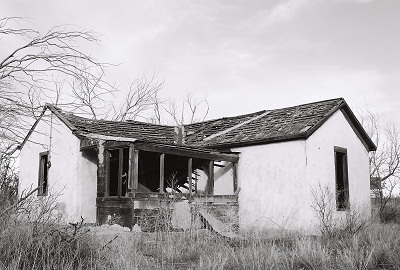
We just drove through Taiban a couple of hours ago. I love this site and the history it provides. Does anyone have any information about the abandoned house on the main road? It seems as though it was a nice house at one time.
Thanks for the kind words for City of Dust, Keiko Alvarez. I'm glad you enjoy it! As for the house, are you referring to the stone house on the north side of Highway 60, next to the vacant Taiban Trading Post? That *is* a nice house and, in fact, is still occupied. A few people do still reside in Taiban. If that's not it, give me a few more clues and maybe we can track some information down.
Thanks again! JM
That's the house! I thought it might have been occupied but was not sure. Unfortunately we whizzed past it despite the fact that I begged everyone to stop (there were four cars headed south). That highway is a collection of seemingly sad places - closed business, abandoned houses, rusting farm equipment, etc.
Yeah, Highway 60 is quite a stretch of road. Probably my favorite to explore in the entire country, actually. I've done posts on many Highway 60 towns, including Encino, Vaughn, Negra, Lucy, and Yeso. There are probably one or two I'm forgetting! It's a fascinating piece of asphalt.
Coincidentally, I have a standing invitation to visit the man that lives in the stone house. He's been there many years and knows a lot about the area. I hope to be able to accept that kind offer very soon. I've got some decent pictures of that house, too. I should post 'em somewhere, probably. JM
Your readers might be interested in an album we received recently. It was compiled by Alice Davies (and her sister Flodel) who taught in Taiban in the early 1920s. We've scanned a few of the images for our online catalog, and you can see them at http://econtent.unm.edu/cdm/search/collection/acpa/searchterm/taiban/order/title
Thank you for these photos. I have a question - is the school still standing? The photo looks like it is an abandoned building already. Haunting pictures. I am fascinated by photos like these. We have a lot of similar places here in Texas.
Yes, the Taiban church is still standing. It may well have sometimes functioned as a school, but it is/was mainly known as a church. Anyway, I saw it again in June. Every time I pay a visit it's a little more weathered, but it's hanging in there. The church is privately-owned, so not abandoned. But it is open to the elements.
I'm glad you like the photos, Keiko Alvarez. "Haunting pictures" is quite a nice compliment in my book! And I do need to spend some time photographing in Texas soon...
Best, JM
Those are some incredible shots, POG photo! I've never seen a picture of the Taiban school. It was much bigger than I would've guessed. Hard to believe that was ever there. Also, the Halloween photograph of the students with bags over their heads is priceless.
Many thanks for passing the link along. CoD readers will most definitely be interested in seeing that album. JM
If you follow the road directly in front of the Taiban church, going east, the road will turn north. 1 mile more and your there. I just catalogued all the markers today with notes and pictures.
Could you tells your grandpas name? I just catalogued all the markers today with pictures and notes. If it hasn't worn away, ypu could email me at logan3m@hotmail.com and I can send you a picture of his marker.
Thanks for that info, Andrew & LeeAnn! I haven't seen the cemetery myself and I'd like to visit. From your description I've been very close.
As for the potential grave of a family member, are you referring to the comment left by "Christine in Santa Clara, NM" whose great-grandfather is buried in Taiban? The last name should be Noblitt, I believe. Did you find a marker with that surname? I'd be curious to know. Perhaps "Christine in Santa Clara, NM" will read this and also be curious!
Thanks again for your comment. I'm glad you've cataloged all the markers in the Taiban Cemetery. That's important work to do while it's still somewhat possible! JM
I worked at a nursing home in farwell,Tx in 2004. There was a man named Bill Crenshaw that lived there with his wife Mildred. He was the sweetest old man ever. He always was walking around with his Cowboy hat and boots talking to who ever would listen about Taiban, NM. Every time I drive by I think about him.
I'm sure there would be a lot to say if someone had really known Taiban! I'd like to hear those stories myself.
Mr. Crenshaw stayed on Highway 60 if he just went down the road to Farwell, eh?
Thanks for your comment, Anonymous! JM
Bill Crenshaw passed away a few years back but his son and daughter in law (Billy and Sylvia) still run the family ranch several miles south of Taiban. I worked for them on Saturdays back in the early 1960s. Great people!
jmhouse, I have several photos of the Taiban area if you're interested in posting. I grew up in Fort Sumner and left there in 1970. We have a Facebook group page "Remembering Fort Sumner" and one of our members (Missy Terry) is a professional photographer from Clovis. She has some outstanding photos of the Presbyterian Church and has shared them with us. If you're interested, let me know and I will email them to you. Really enjoy all of the posts and information!
Thank you for writing this article. I am a local photographer and have captured many beautiful images of this historic landmark. www.facebook.com/missylynnstudios
My uncle Herschel Thurston was a Methodist preacher at the church in Taiban in the mid 1920s. He was possibly there in 1927. The Phillips family (related to my husband) knew my uncle and attended services at that church.
My great granddady was Chester C McMillan (Mac) his bar was burnt down while he was fishing around 1986, and the building next to his bar was the Pink Pony. Thank you for the post brings back great memories.
Mac is my great grand father. He was neverarried to Sally but did call her his wife. I even meet my great uncle Mac once.
Thanks for the comments, everyone. Desertdog1, I'd love to see those photos of the church. You can e-mail them to me at: jmhouse(at)cityofdust(dot)com. I'm glad you enjoy the posts!
Brandon Baker, I didn't realize that Mac's bar was next to the Pink Pony. For some reason I thought it had been closer to the Taiban Trading Post. I think that's because of that old sign that's still standing which says, "Mac's Bar-B-Q Sauce." I *finally* took a picture of it on my visit last month, but, for now, HERE is one by someone else (which I know you've seen because of your comment on it, Brandon!).
Thanks again! JM
The original Pink Pony built by Jack Hitson was located about 3 miles east of Taiban where the curve is going into Tolar. It was closed down for awhile and then Joe Bowlin opened it as a "Running Indian". I understand that a veternarian/horse trainer lives there now.
Jmhouse, was it your family who founded House, NM?
I tried to follow the FaceBook link but it was not available. Too bad. I love your blog!
Ah, I didn't know the Pink Pony was a Bowlin trading post for a while. That's great info! The Pink Pony is indeed now used by a horse trainer/vet. It's even still pink, as I recall. Also, I got the photos of Taiban you sent and there are some real gems. I'll be in touch about them soon. Thanks, Desertdog1!
As for House, Anonymous, nah, the only person in my family that has ever even been close to House, NM is me! My last name actually isn't House, but that's another story. However, I did do a post on House. You can find that HERE. It's a very interesting place out there on the Llano Estacado!
Keiko Alvarez, the City of Dust Facebook page was coming up as not available? That's weird. It's still going strong! Try HERE.
Thanks everyone! JM
OK-it is working now.
Glad to hear it, Keiko Alvarez. I just got notification that you "liked" City of Dust. Thanks! JM
I read some comments that said the Pink Pony was across the street from Macs bar. It wasn't. It has always been farther east. There were rooster ( that's what we called cock ) fights at the Pink Pony into the 1960s. My family lived in the rock house across the street from Macs bar, at one time it was the post office for Taiban. When we lived there the old hotel was in ruins but you could go inside and see all of the neat old ceiling and other old embellishments that were stil there. There were community gatherings and 4-H meeting held in the old church and it was pretty much kept up. When we lived there there weren't many people living in Taiban. Mr and Mrs Phillips who had run a store ( I don't think it was open then), Mr and Mrs Finley the postmistress, JD and AdaMae Fox, CW and Jeneane Grissom and us, Wildhorse and Yvonne Edwards & family. Jack Hitson at one time had owned the Pink Pony bar, a farm/ranch south of it and the rock house across the street from Macs bar. Wildhorse bought the rock house and farm/ranch. Jack kept the Pink Pny for a while longer. I'm not sure if he sold it to the Bowlin's or if they bought it from someone else.
Linda Fallon, so Mac's bar was in the location indicated by the arrow on the still-standing sign which says, "Mac's Bar-B-Q-Sauce"? That does make some sense. Was it called simply "Mac's Bar" or something else?
There's a flier for the cockfights (every Saturday?) at the Pink Pony Dancehall and Saloon in the Billy the Kid Museum in Fort Sumner. The one on Highway 60, I think.
Interestingly enough, I received an invitation from the brother of the man that lives in your old stone house to come and visit and hear about all kinds of area history. I hope to eventually take him up on that kind offer.
I wish both the hotel and the school behind the church were still standing, but there isn't a trace of them left.
Anyhow, thanks for your comment! It's great to hear from someone that lived in the rock house. I'm also glad to learn it was once the post office. That explains the remains of the phone kiosk outside! JM
I love this site! Thanks for putting it together! Do you or anyone know anything about Melrose NM? I live in a really old house here (1906) haven't found too much on the internet.
Thank you for the kind words, Anonymous. They're much appreciated! While I haven't done a blog piece on Melrose yet (I hope to eventually!), I have posted some photos with a bit of history on the City of Dust Facebook page. You can find shots of Melrose HERE, HERE, HERE, and HERE! Be sure to read the comments too, as I think you'll find them interesting.
Thanks again! JM
I can't to see a post on Melrose! Thank you for the great links!
In the early 50s I used to visit Taiban frequently with my step father to pick up booze for distribution for the Clovis bootleggers. I was a pre-teen. Mac's Bar was originally "Rita's and Mac's Bar". Complimentary ash trays used to read "42 miles over,30 miles back, meet your friends at Rita's and Mac's" (not sure about the miles). Jack's Bar later became the pickup point for Clovis bootleg liquors and for a period was named "Jack and Bills"
"42 miles over, 30 miles back, meet your friends at Rita's and Mac's"? Hmm, that is a little cryptic! Taiban certainly was known for its bootlegging! You and your stepfather didn't happen to be among the folks that flew in for liquor, were you? Ha!
Thanks for sharing your recollections, Jake Madril. That's great stuff! JM
Negative, my Step Dad drove to Taiban routinely, employed by a Clovis Big Shot who also provided the vehicle, picked up the liquor and distributed to Clovis booleggers. The bars in Taiban were licensed, Clovis was dry from 1939 until the 60s.
I have recently moved to NM and drive through Taiban on my way to Lubbock and have always noticed the building (now finding out church) and always wanted to take a stop and look. Yesterday I finally had my chance. I don't know if it was the sun setting and the chillbess in the air, but it was such a site. Thank you including the history of Taiban in your blog, without it, I don't think I would have such luck finding so much about this place. I am hoping next time to see about walking where the school used to be and possibly explore further.
Thanks for your comment, Faith L. There's something really special about the Taiban church, isn't there? Particularly at a certain time of day and with certain weather. It remains my favorite place to photograph in New Mexico.
As for the ruins of the school behind the church, there are some bricks still stacked on top of each other, the outline of the foundation...and not much else. Still interesting to imagine how lively that little corner of Taiban would've been once upon a time.
Thanks for stopping by City of Dust! Glad you found it useful! JM
Can you tell me if anyone owns the Presbyterian Church in Taiban, NM
Hi Doris,
Yes, the church in Taiban is owned and has been in the same family for many years. I *might* be able to put you in touch with the current owner if you're interested. However, it's been sometime since I've corresponded with them and I may or may not get a response. But just let me know if you're interested.
Thanks for stopping by! JM
So does my grandfather Johnny Eastwood
My grandfather Johnny Eastwood of Clovis owns all of Tolar and most of the surrounding areas. He donated the railcar undercarriage that's sitting at the historical marker
A couple of years ago I stated that "Mac's Bar" was previously named "Rita's and Mac's" Bar. Rita's same was removed when she apparently ran off with another. Also, I stated that the Pink Pony was initially "Jack's" Bar and later became "Jack and Bill's"
Ms. Fallon's statement is one that speaks from first hand knowledge. The Pink Pony was not next to Mac"s bar, it was about three to five miles East of Taiban. My statements are factual based actual experience.
Hi Jake Madril,
Good to hear from you! Yes, the Pink Pony was a few miles east of Taiban. In fact, it still is, technically. The property is owned by horse trainers, I believe (and ironically enough), and I'm pretty sure the structure that still stands there is the Pink Pony itself. I'd love to have been able to photograph it. At first I wasn't sure where it was myself and some people thought it was next to Mac's, but I think we've got it straightened out now, thanks to folks like you and Ms. Fallon.
Thank you for your message and happy Thanksgiving! JM
Hey,
I have some ties with Taiban. My Grandparents met at a dance there, my first girlfriend (Dixie Finley) was from there. My family bought the old high school and tore it down for lumber. I still have some school books from it as well as the bell and the marble monument with the school board members names.
I remember Ben Hall and he was a friend of my fathers. My parents are buried at Fort Sumner and I spent a lot of time there.
The school bell is at my ranch in Alamo NM and is still being used.
Jim Nance
Thanks for your comment, Jim Nance. That's some great family history! I'd sure love to see pictures of the school bell and the marble school board monument. If you're ever able to send any photos this way, my e-mail can be found in the "View My Complete Profile" link at the upper right of the page. I'd be thrilled to add them to the post, as well. I'm glad that bell is still being used!
Thanks again! JM
I have a hard time remembering dates, but I lived in Taiban, for a few years, in 96-98 or so, I was living in a trailer behind my employers house, was rebuilding a restaurant in Ft. Sumner, as well as home renovations for employer's house in Taiban, I made a few friends while there, had amazing walks in the mesas and desert, it was a magical place to me, as a half breed Cherokee, it really spoke to my ancestral memories, at least this is how it felt. it was a happy time in my life and i think of it often, thank you so much for this blog and all the time you have put into researching and preserving the history. if you would like to ask me anything about my time there feel free, I will respond as best as I can.
Hi IanMerovingian,
Thank you for your comment! I'm very glad you shared your memories of Taiban and that it was a happy experience. Most of the time—though not always—people have very fond recollections of growing up in the places I write about, but your story is a little different as you moved to Taiban and it sounds like you were only passing through, as it were. So that's a bit of a unique perspective.
As for questions, do you remember how many people were living in Taiban at the time? Was it close-knit? Also, what condition was the Taiban church in? I really love that building.
Thanks again, and very best regards! JM
We drove through Taiban last week and the stone house on the north side of Highway 60 seems to be closed up. In fact, it seems to be wrapped up in some kind of rubber! You once said it was still occupied. Do you have any more recent information? Taiban itself seem more desolate than the last time we went through a couple of years ago. Love your blog.
That's right, Keiko Alvarez, not only was someone living there, but their brother invited me out for a visit with both of them. Unfortunately, I was never able to take them up on that, and your update is the first I've heard about the house being shuttered. And wrapped in rubber! That's very odd indeed. Maybe someone will read this and can tell us more.
On that note, I wish I could tell *you* more, but this is news to me. Thanks for the update, sad as it is, and I'm glad you like City of Dust! JM
Would this be Willa Bowlin? I'm working on a history of the Bowlin family in New Mexico. They first arrived in New Mexico near Taiban in 1906.
mochi, yes, the purchasers of the Pink Pony would be Willa Bowlin and her husband, Claude. However, the sale would've been sometime well after it first opened in 1908. I'm afraid I don't know the exact date.
If you're working on a history of the Bowlin's, it might be worth contacting Never Quite Lost at their Facebook page. Blue Miller, who runs that page, has told me more about trading posts in the Southwest than anyone else, and has a book coming out this month titled, "Abandoned Route 66 Arizona: Where the Road Came to an End." I am almost certain there will be something about the Bowlin's in there.
Thank you for your comment, and please keep us posted on your work! JM
Found my dad’s 1940 Taiban High School yearbook- fascinating to me
My grandfather is the one whose name is on that marker, Jess Brown.
My mom and I drove past that church a few years ago on our way to Clovis. We were so taken by the "scene" of it, we had to turn around and go up to take pictures of it.
Just a few days ago, (9/17/2022) I saw a painting of that same church in the main Fine Arts building at New Mexico State Fair. (The painting, by a Thomas Popp.)
I couldn't for the life of me remember the name of the town, and so I just scrolled along the highway between Santa Rosa and Clovis on Google Maps curiously trying to find any towns in-between.
I finally found it. Taiban! Of Course!
I told my mom that someone submitted a "painting of that church we saw way out there" to the State Fair this year, and she found this historical recounting of Taiban, NM for me to read....ie. your website!
Thanks to everyone who wrote up/submitted to this website for more historical context of this tiny town! It's all very fascinating!
I'm from Clovis, justcame through Tiaban, was there a restaurant back in the 60, that was close to the railroad side that burned down and was reopen then burned down again. There was a lady named Kitchen that worked there. She told my dad that had the franchise H&Block in Clovis that the reason kept burning down it was haunt.
I grew up in Ft. Sumner in the 1970s, then moved to Melrose in 1984. We drove through Taiban weekly to get to Clovis for groceries. We knew a sweet old man that owned land in Taiban adjacent to the Presbyterian Church. He was a full-blooded German, born in 1902 and he was some rank of officer in the military (I believe German). He had guns, memorabilia, and uniforms from WW I and WWII and belonged to the VFW in Roswell. Looking back now, I wonder if he was hiding in Taiban. I don't know. His name was Freeman Nevins. We used to go play on his property, which consisted of a mobile home and outbarns. We also entered and prayed in the presbyterian church and played in the school house, which I remember had a decent basketball gym and well-preserved floor and we even found an orignal, old misshapen stitched leather basketball in there. We left it there. I don't think the school is there anymore. But Mr. Nevins took us to see the Taiban springs, and I remember clearly where they are. If you look at Google Maps closely, you can make out the shadows of the salt cedar that surround them on the south side of the tracks toward the east. There is an old indian legend Nevins told us (his parents were early settlers) that a wagon train with a family of 4 passed through Tiaban and the little girls were dying of thirst, so the parents gave them to drink of the springs. They got very sick and died and are buried just north of the highway near Tolar. There is a cement and metal marker on the grave. The legend goes that when the family had to leave after burying their daughters, they asked the local natives to watch over the graves. When the new highway was being put in, the natives required the highway construction workers to bend it's course so as to not disturb the grave site. It's said that if you stand at the top of the hill in Tolar and look down the highway to ward the east, you can see where the highway bends southward slightly around the grave site.
Ben Hall was my mother’s Uncle. At one point he ran a store in Tainan. My mom talks about going to visit them. She said they lived in the back of the store.
My mom’s Uncle ran the store in Taiban in the late 40’s. Ben Hall was his name. She talks of going from Floyd, NM to Taiban to visit. Her name was Joyce Tipton.
Post a Comment