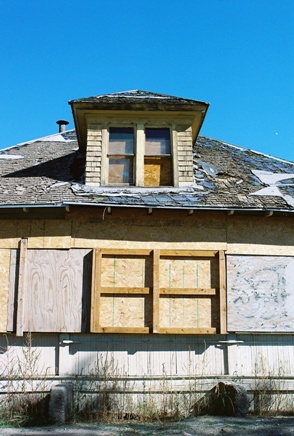
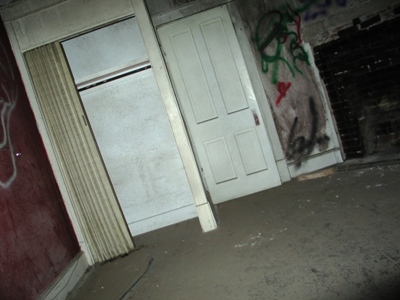
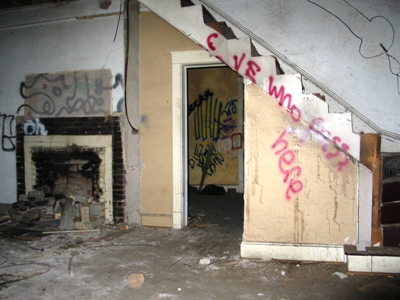
 I'd hoped to get inside but the house was boarded up tight. Apparently it had often been wide open, but when I got there thick plywood covered every entrance. All I could do was walk around the outside and take in some of the remaining architectural features. The back shed was accessible but uninteresting and a homeless person had recently taken up residence. After awhile I laid a hand on the 103-year-old house to pay my last respects and then headed home. On Monday, following a whim, I decided to stop by once again and saw that there would now be no problem getting inside. The house was already dark due to the boarded-up windows and the sun was setting, so I didn't have much time, but I tried to get a few decent shots. By the time you read this, the Werner-Gilchrist house will be no more, living on in a few photos and, of course, that episode of Breaking Bad in which it appeared as a drug den. So, here's its story.
The tale of the Werner-Gilchrist house begins with Colonel D.K.B. Sellers. Apparently a bit of a character, he was not actually a colonel. In the very early 1900's, it was Colonel Sellers that petitioned to give Railroad Avenue, which he believed to be a poor name for a street that extended beyond the rail line, a new name, Central, as he began to sell commercial lots in Albuquerque. Quickly successful in his name-change bid, the Colonel continued developing, moving into what is now the University Heights Addition, a square-shaped collection of streets just south of the University of New Mexico campus. In Nob Hill, he would go on to build a rather nice log cabin and a gravity-based water tank that is now a house. In 1912, the Colonel was even elected Mayor of Albuquerque, but, a few years earlier, in lieu of financial compensation, Colonel Sellers had paid his secretary, Laura Werner, by giving her half of an undeveloped block on what is now Cornell Drive.
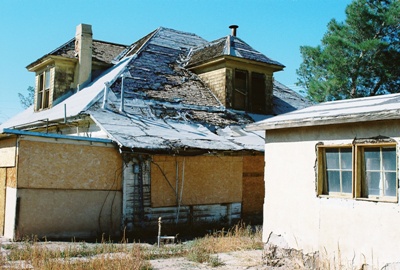
Ms. Werner and Ralph Gilchrist, her son-in-law, built the house in 1908 on the corner of what is now Cornell and Silver. Based on a layout used for officer's homes in Territorial forts following the Civil War, the design, known as "hipped box," incorporated a wood-framed hip roof with dormer windows on each side. The load-bearing walls were made of 16" thick adobe bricks and the foundation was stacked stone. The doors, window frames, and trim were all wood and a wide entrance hall ran the full length of the first floor. The second floor was a single large room. At the time, this style of construction was in favor among the upper classes. I was impressed to see that every room aside from the kitchen had a fireplace.
Ms. Werner's reclusive daughter, Nora, occupied the house until she died in 1981, having lived into her nineties. The house had been vacant since about that time. In 1982, it was added to the National Register of Historic Places, but, as we've seen, that designation does not necessarily confer any real protection. In 2006, in response to a blocked attempt at demolition the year before, the house was officially named an Albuquerque landmark, a title which also could not save it.
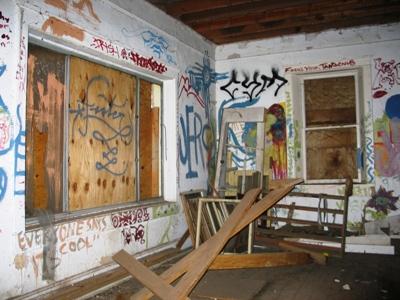
Much as with the recently demolished Aztec Motel (it's been a tough year for historic buildings in ABQ), no one ever said they wanted the Werner-Gilchrist house torn down. There was an effort to preserve and restore the house which spanned 30 years, but continued neglect caused extensive damage and the current owner of the property was eventually cited for housing code violations. That owner, Jim Trump, executive director of Build New Mexico, stated that he had initially hoped to restore the home. But times are tough and money is tight and the house was too far gone. Thus, the Werner-Gilchrist house is no more.
Meanwhile, across town, Albuquerque is finally getting a Chipotle Grill.
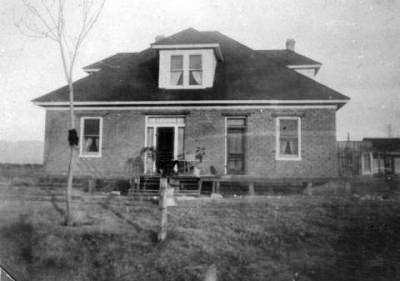
I grabbed the information for this post from the aforementioned Alibi article and the house’s short Wikipedia entry. The photo of the house just after construction in 1908 comes courtesy of the City of Albuquerque, although they don’t know it.
I've got a ton of stuff lined-up for the future, from Billy the Kid's (controversial) grave to the haunted Shaffer Hotel and beyond. There’s plenty to keep busy for awhile.


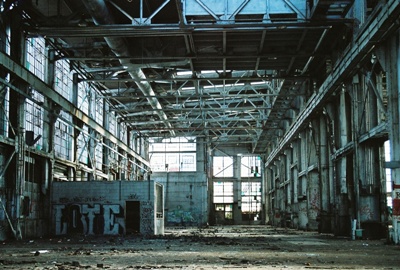
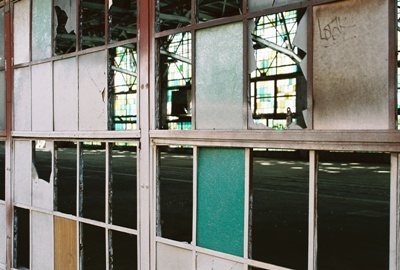
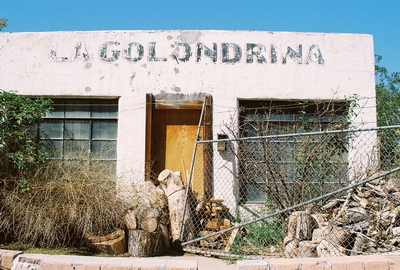
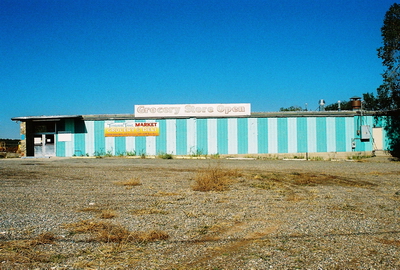
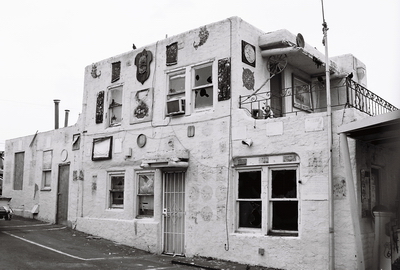
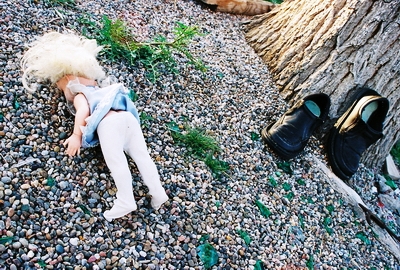
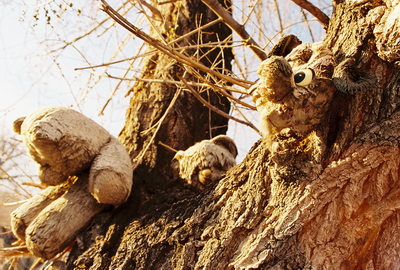
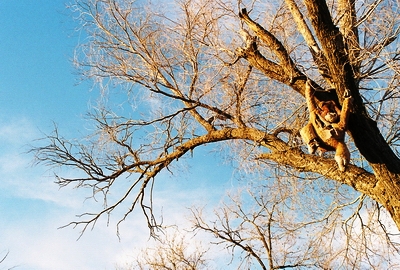
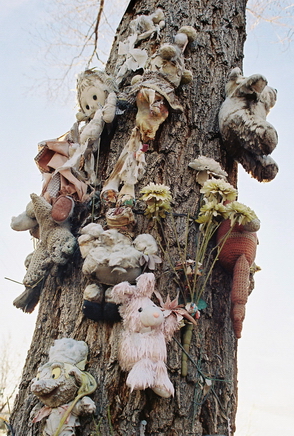 The stuffed toys began to lose their stuffing, with the gorilla bleeding badly out of a large hole in its side. Once I found a collection of CD’s stacked in a corner of the concrete fence. They were not in cases, but were carefully tucked away beside some beer bottles. The music wasn’t what I would have expected, but was better, more obscure, and included the likes of Captain Beefheart, which seemed perfect. In the end, all that remained were some last weather-beaten stuffed animals tied to the tree. The demolition team took down not just those ragged creatures, but the entire tree as well. I wonder what their thoughts were as they considered the last hours of the Aztec Motel.
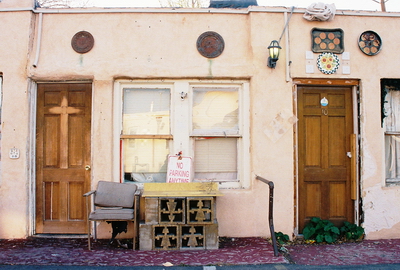
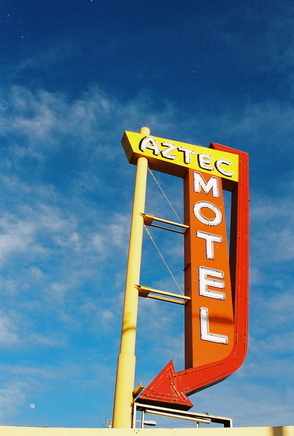 The Aztec Motel was actually the first motel built on East Central Ave. There seems to be some disagreement as to whether it was built in 1931, 1932, or 1933, but it certainly pre-dated Route 66, which was not designated until 1937. Built in a style known as “Southwest Vernacular” and originally called the Aztec Auto Court, the motel had 13 units and three carports. The carports were walled-in sometime in the 1950’s and turned into four additional rooms. This is also when the original neon sign was replaced with the one that can still be seen beside the now-empty lot.
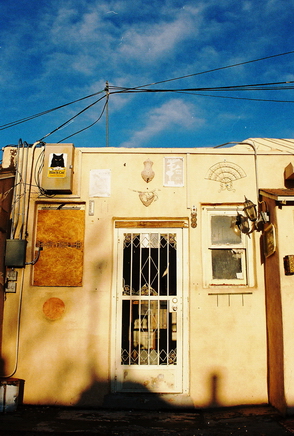 In any case, in 1991, Mohamed Natha bought the motel and worked to bring it back from the brink. In an effort to cut down on visits by hookers and their clients, as well as drug addicts and petty criminals, Natha began to rent only to long-term residents. A short time later the Aztec began to be extravagantly decorated with found items (of which I’ll say more next time) and underwent a kind of renaissance. The long-term residents were chiefly artists, free spirits, and assorted characters-about-town whose personalities became reflected in the motel itself as a genuine community developed.
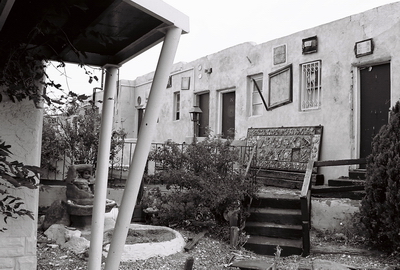
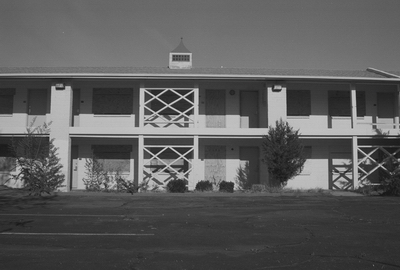
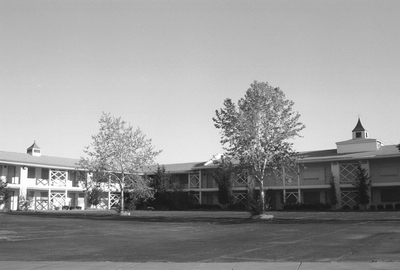
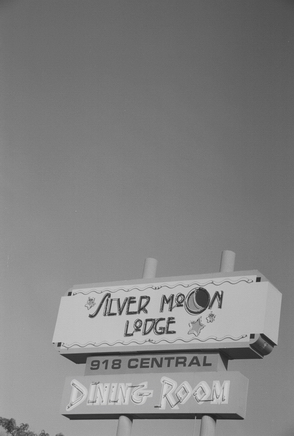
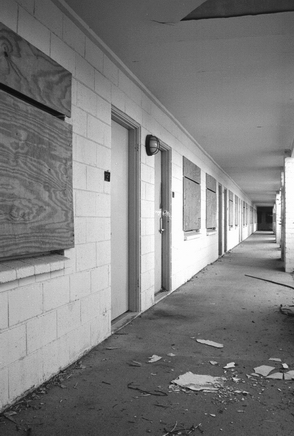 The Silver Moon Lodge, built in 1953, was at 918 Central Ave. SW., not too far from Old Town. The Silver Moon and the Central Park Deli, which was also located on the premises, closed for good on October 15, 2007 after a 54-year run. Then, in the absence of a development plan, the entire complex sat vacant until July of this year. Originally, the place was known as the Desert Skies Motor Hotel. After that, it became the Desert Inn Motor Hotel. Here is (UPDATE: was) a cool POSTCARD from that era. By the 1980’s, a third name change found the hotel billed as the Grand Western Motor Inn. Clyde and Goldie Taylor, who ran the Desert Inn in Santa Fe, owned the business around this time. Here’s one
 “You can't expect very much from cheap motels, but this place was pretty bad (and not super inexpensive). Everything in our room seemed like it was broken -- the bathroom lights, locks, closet hanger rod, toilet, and curtain rod. On top of that, our towels and all the chairs in the room had mysterious stains on it. The only reason why this place gets two stars instead of one is because the staff was so nice and responded quickly when we phoned about broken lights and busted locks. They also provide free shuttling to and from the airport.”
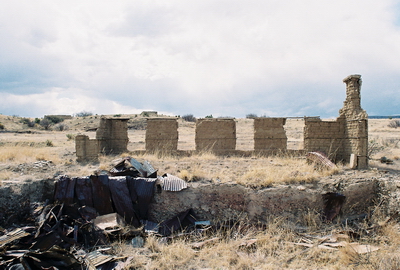
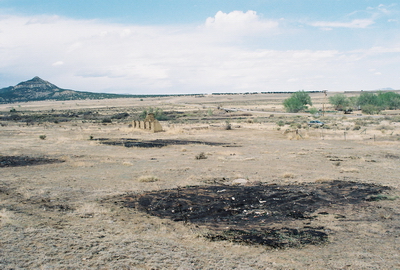
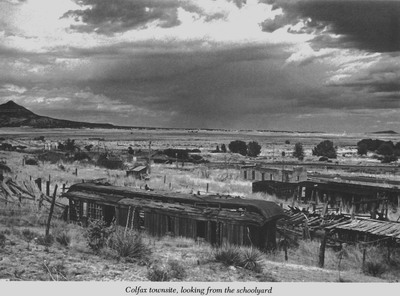
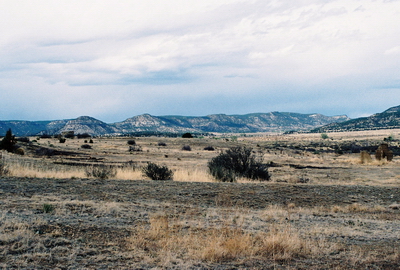
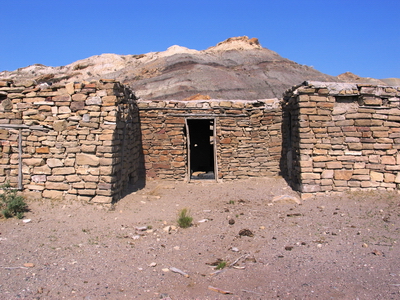
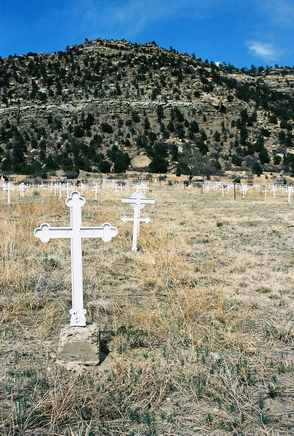 Then, on October 22, 1913, an explosion in Stag Canon Mine No. 2 sent fire spitting 100 feet out of the mouth of the mine. A dynamite charge had been mistakenly set, in breach of safety protocol, and ignited airborne coal dust. A massive rescue effort was undertaken with crews arriving from as far as El Paso, Texas, but only 23 miners survived. The final death toll numbered 263, making the Stag Canon Mine No. 2 disaster the 2nd worst in U.S. history. Two rescue workers were also killed in their efforts. Special white crosses were erected in the Dawson cemetery to mark the graves of those that lost their lives.
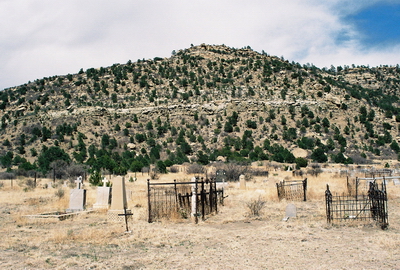
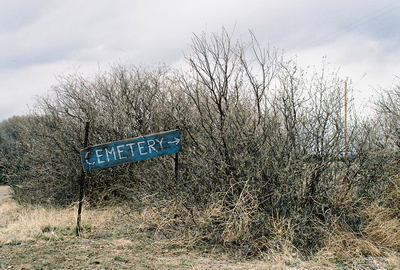
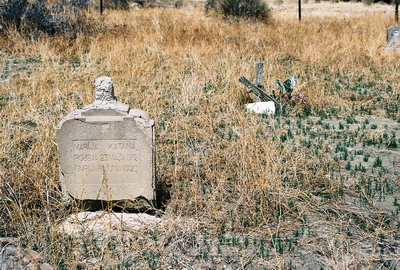
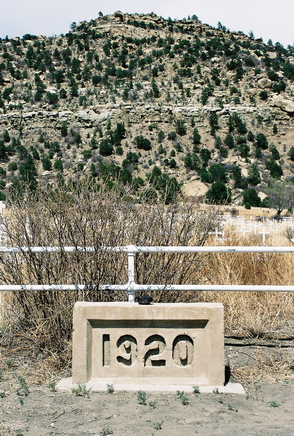 In that time things have changed a bit and I was not about to climb the gate, heavily posted with “No Trespassing” signs, and possibly try my luck with a ranch hand. But the cemetery, which was once just outside of town, is open to the public and is now the only visible remnant of Dawson. Family members still gather at the cemetery to reminisce and remember their loved ones. A number of the graves are well-kept with recently-placed flowers. But other graves are broken and forgotten. There are row upon row of names. Polish, Czech, Italian; many written in the native tongue. One lonely grave is of Marck Zamponi, a member of the “Wagoner 9 Engrs.” The stone simply says “Minnesota” (my home state) and there is an accompanying date of death: June 11, 1927. Did this man leave his family up north behind? Did they even know he was dead, let alone buried below a hill in a sooty coal town in northern New Mexico? After all these years, his story, like so many others, is forgotten and will never be told again.
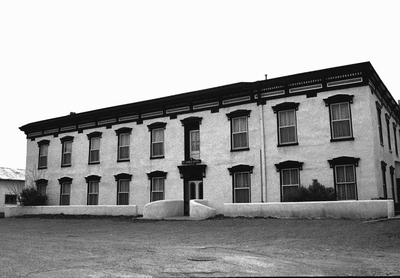
 It’s been said that Lambert was Abraham Lincoln’s personal chef, but there is no hard evidence of this. On the other hand, it probably is true that, while living in Elizabethtown, Lambert was presented with a severed head. More on that grim tale can be found
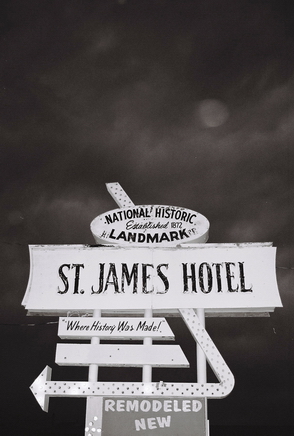 and thus there’s reason to suspect that Buffalo Bill never stayed at the hotel either. On the other hand, Buffalo Bill was said to be a personal friend of the Lambert’s, so the jury might still be out on that one. Legend has it that the Earp brothers and their wives spent three nights at the St James on their way to Tombstone and, you know, that just might be true. Clay Allison most certainly stayed many times, leaving the bodies behind to prove it. Bob Ford, the guy who shot Jesse James? Maybe. Ford is credited with shooting a man named Bob Curren in the St. James in 1882, the same year he shot Jesse. But I wouldn’t doubt that he actually came through later, on his move to Las Vegas, NM in 1884. In the early 20th century, Zane Grey definitely spent time at the hotel, writing some of Fighting Caravans in room 22. Other figures like Black Jack Ketchum and Doc Holliday? They were at times nearby, but your guess is as good as mine as to whether they really visited the St. James.
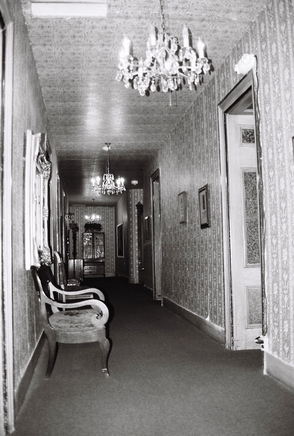
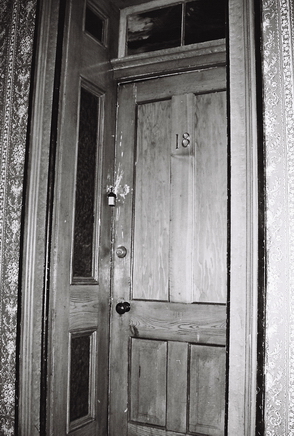 Perhaps the most interesting spectral figure at the St. James is Thomas James (T.J.) Wright. T.J. Wright was reportedly killed upstairs in the card room, following an evening of gambling. One story has Lambert himself shooting Wright in the back as Wright walked away after Lambert had gambled (and lost) his entire hotel to T.J. I doubt that’s accurate, but, whatever the case, Wright was dead at the age of 22. Now, Wright’s violent spirit is said to occupy his old room, number 18. So many guests have reported being tormented by Wright’s ghost, some being physically hurt, that room 18 is now padlocked and guests are not allowed in. Our bartender said that he sometimes goes up to the room and has a glass of whiskey, leaving one behind for Mr. Wright.