 I first started City of Dust in August 2004 specifically to share some of the few hundred photos I'd taken over the previous two years while living in Augusta, Georgia. I had never even owned a camera prior to living there and hadn’t given a whole lot of thought to history, either. But something about Georgia’s second-oldest city really resonated with me. If you want to know more about that period, have a look at The First Post. I don’t know that I’ve ever felt so compelled to photograph a city as I did Augusta. Some have said I’ve done my best work there, which I prefer to take as evidence that there’s something unique about what I see in that town rather than an indication that I haven’t managed to improve over the years.
So, I’m honored to have been invited to participate in the 2012 Augusta Photography Festival, which runs this fall from October 27-November 4. A “real world” version of City of Dust is being created for display in the Main Branch of the Augusta Library and will feature photos and stories from some of my favorite Central Savannah River Area (CSRA) locations. Hopefully this fairly large installation will travel to other venues when the festival ends. Also, I’ll be participating in photo safaris that will visit several historic downtown buildings that I’ve always wanted to explore. And I won’t even have to sneak in! Then, at 10 AM on Saturday, November 3, I’ll be giving a presentation at the library that will include lots of photos and tales from throughout the region. Oh, and I’ve written an article on photographing the John S. Davidson School in advance of the fest for Verge, Augusta’s free arts weekly, which can be found on page 14 this week. A second piece will be published in September.
The Augusta Photography Festival’s website is HERE. Below is the schedule of events. If you’re a photographer, don’t forget to enter the photo competition! The cash prizes are very nice and you don’t have to attend to win. The closing date for submissions is August 15, so you might need to hurry. Many, many thanks to those working very hard in Augusta to make this happen, particularly Tricia and Peter Hughes.
I first started City of Dust in August 2004 specifically to share some of the few hundred photos I'd taken over the previous two years while living in Augusta, Georgia. I had never even owned a camera prior to living there and hadn’t given a whole lot of thought to history, either. But something about Georgia’s second-oldest city really resonated with me. If you want to know more about that period, have a look at The First Post. I don’t know that I’ve ever felt so compelled to photograph a city as I did Augusta. Some have said I’ve done my best work there, which I prefer to take as evidence that there’s something unique about what I see in that town rather than an indication that I haven’t managed to improve over the years.
So, I’m honored to have been invited to participate in the 2012 Augusta Photography Festival, which runs this fall from October 27-November 4. A “real world” version of City of Dust is being created for display in the Main Branch of the Augusta Library and will feature photos and stories from some of my favorite Central Savannah River Area (CSRA) locations. Hopefully this fairly large installation will travel to other venues when the festival ends. Also, I’ll be participating in photo safaris that will visit several historic downtown buildings that I’ve always wanted to explore. And I won’t even have to sneak in! Then, at 10 AM on Saturday, November 3, I’ll be giving a presentation at the library that will include lots of photos and tales from throughout the region. Oh, and I’ve written an article on photographing the John S. Davidson School in advance of the fest for Verge, Augusta’s free arts weekly, which can be found on page 14 this week. A second piece will be published in September.
The Augusta Photography Festival’s website is HERE. Below is the schedule of events. If you’re a photographer, don’t forget to enter the photo competition! The cash prizes are very nice and you don’t have to attend to win. The closing date for submissions is August 15, so you might need to hurry. Many, many thanks to those working very hard in Augusta to make this happen, particularly Tricia and Peter Hughes. Finally, let me add that I don’t know how many people from the CSRA are still following what I’m doing, but it used to be that most of my readership was from Georgia and South Carolina. So, if you’re still paying attention…thanks! And maybe you’ll be able to come out to some of the festival’s events. Also, if you’ve ever left a comment at City of Dust regarding some of those earliest posts, many of those are being incorporated into the above-mentioned display. The memories shared were just too unique and poignant not to give them a wider audience. We did mask the identity of those commenting, but you’ll know yours if you see it. It was impossible to contact most people for permission, so hopefully no one minds having their thoughts (and, in one case, photo) re-used. In fact, the historical and personal insight provided by these comments might be the most important part of the whole project. Thanks for continuing to provide them over the years. Perhaps I’ll see some of you in the November. If you want to know more about how the comments are being incorporated, leave a message here or contact me through the e-mail associated with my profile.


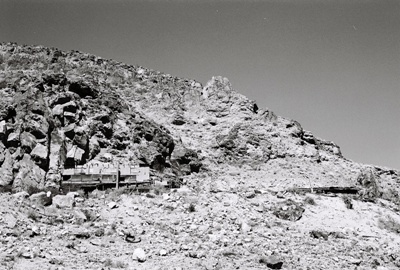 It’s been awhile since I’ve posted about a place that I know absolutely nothing about. But I used to do it all the time. Back in 2004, I wrote about this great
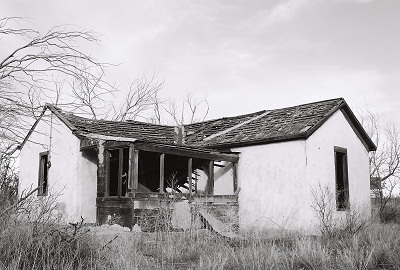
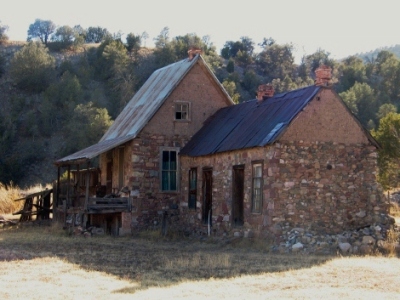
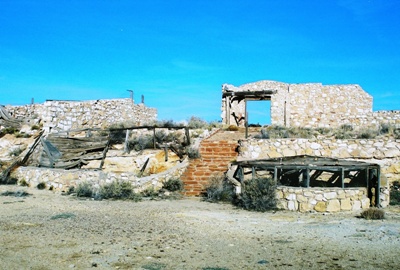
 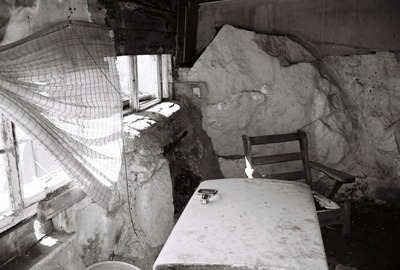 One thing I do know is that this was clearly someone’s living space, a hand-built home on the side of a rocky hill in the middle of nowhere, way out in the Chihuahuan Desert. Judging from the date on a
 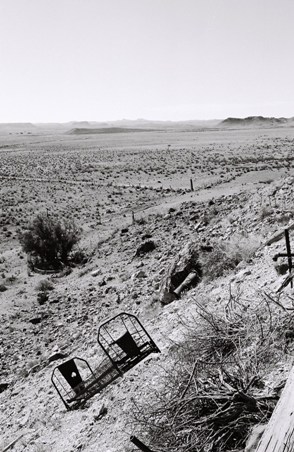 If that’s HOW it was built, perhaps a better question is WHY it was built. I assume it was used as lodging for ranch hands back when the entire area was being grazed, but, if so, it was far more sophisticated (not to mention higher off the ground) than it needed to be, with cupboards, stone fireplace, two bedrooms with curtained partition and even a second story, which has partially collapsed. Perhaps it was built simply because the view out the front is stunning. Desolate and forbidding, maybe, but if you like that kind of thing, as I certainly do, and aren’t much for food, water, or company, you couldn’t do better than to build yourself a home out here.
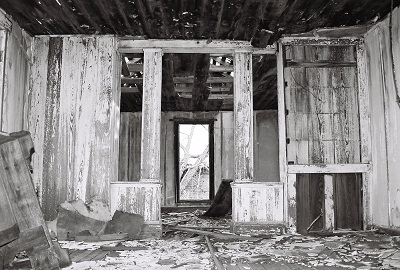
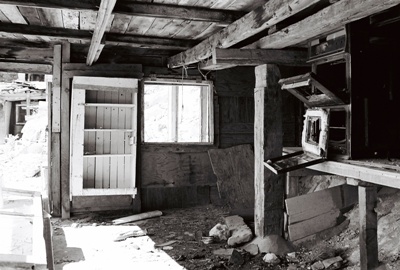 There are actually two structures, the main living space with entryway and fireplace, kitchen, bedrooms and a bathroom with tub, sink and toilet, and an adjacent building that is much smaller and contains only a stove and sink. I’m assuming this second structure was just a kitchen. Maybe it was too hot to cook much inside the living area. Or too dangerous. Both structures are backed up to exposed rock, which provides quite a nice effect. Small shelves were constructed wherever a natural rock formation lent itself to such a thing, and some of the rock walls were painted green or yellow or white and, as I alluded to, there are also paintings done right on the rock. One, signed
 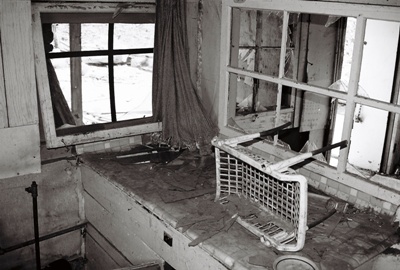 The thing that strikes a person again and again is the remoteness of this house and how at odds it is with its construction. How did they get water out here? There is indoor plumbing and faucets and that tub and it all seems like more than a cistern would be likely to collect most of the year. And how did they get electricity? That refrigerator didn’t run on firewood. But to have pulled a chair up out front to watch the sun go down (or rise, for that matter) must’ve been quite a reward for a hard day of cow-punching. If you’d like to visit…well, don’t! Trust me, you’ll never find your way out here and it’s probably better for both you and your vehicle that way.
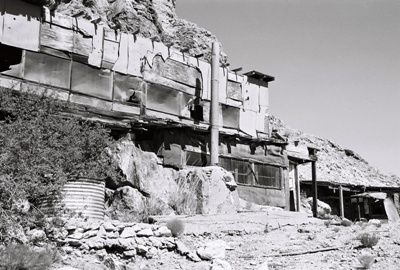 Next time we’ll check out another place in Socorro County I know almost nothing about. These posts sure are easier to write when they contain no historical information. Probably easier to read, too.
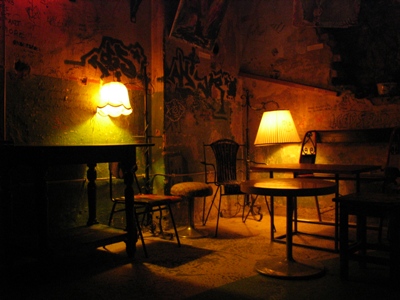 Don’t worry, with the next post we’ll be heading back out to the desert. Even in the searing heat I’ve managed to check out a few new locales. But these are so remote and mysterious that I’ve been able to find very little to say about them, historically speaking. So, while I consider how to present these lost gems, we’ll make a short stop in Budapest to visit an abandonment that is a decidedly un-lost gem, the Szimpla Kert "ruin pub."
Romkocsma, which translates literally as “ruin pubs,” seem to be a phenomenon somewhat unique to Budapest. Having emerged from Nazi occupation and subsequent Communist rule with numerous poorly-maintained buildings, Budapest found itself without the resources to restore them properly or tear them down.
Don’t worry, with the next post we’ll be heading back out to the desert. Even in the searing heat I’ve managed to check out a few new locales. But these are so remote and mysterious that I’ve been able to find very little to say about them, historically speaking. So, while I consider how to present these lost gems, we’ll make a short stop in Budapest to visit an abandonment that is a decidedly un-lost gem, the Szimpla Kert "ruin pub."
Romkocsma, which translates literally as “ruin pubs,” seem to be a phenomenon somewhat unique to Budapest. Having emerged from Nazi occupation and subsequent Communist rule with numerous poorly-maintained buildings, Budapest found itself without the resources to restore them properly or tear them down.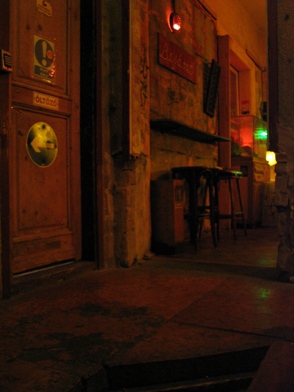 Many of these buildings were once apartments and are located in residential neighborhoods, sometimes sandwiched between occupied buildings, and, from the outside, all you usually see is a run-down façade. But inside it’s a different story. By negotiating cheap rent and enlisting the help of anyone that can help make these places structurally sound, vibrant, lively pubs have sprung up amidst the ruins. Acting not just as watering holes, but as community gathering-places presenting music, film, and alternative arts and culture, you can’t help but hope this trend continues.
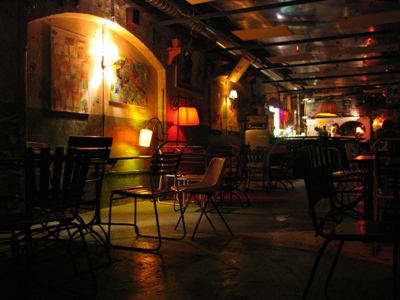
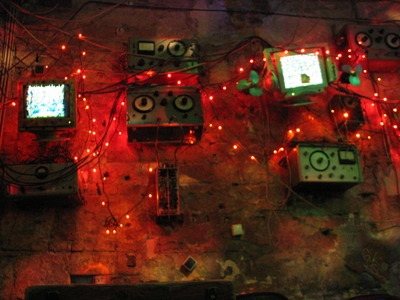 Of course, as with any concept that works this well, there has been growing discontent and early patrons of Szimpla Kert lament the international hipster crowd, the more expensive drinks, and the general popularity of the place. Szimpla was voted
 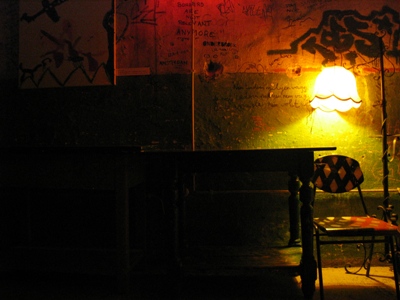 By the way, the graffiti in the photo above reads, "Borders are not relevant anymore," a lovely sentiment given the history of Hungary (and Eastern Europe, in general).
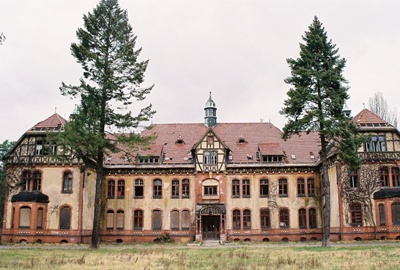 While southwestern New Mexico burns, covering much of the state in dingy smoke, I think we’ll stay overseas and visit Beelitz Heilstätten, a 200-acre hospital complex comprised of 60 buildings and located in the town of Beelitz, just a few kilometers south of Potsdam. Beelitz’s other claim to fame is its delicious white asparagus, but as pictures of asparagus aren’t always interesting, we spent all our time at the hospital.
The Beelitz Heilstätten complex (“Heilstätten” translates roughly as “a place of healing) was constructed in 1898 and designed by Heino Schmieden, partner in one of Berlin’s greatest architecture firms of the time. Aside from the numerous ornate buildings, rigorously separated by gender, the grand complex also contained its own generating station to produce power and heat. Below is the entrance to the men's sanatorium.
While southwestern New Mexico burns, covering much of the state in dingy smoke, I think we’ll stay overseas and visit Beelitz Heilstätten, a 200-acre hospital complex comprised of 60 buildings and located in the town of Beelitz, just a few kilometers south of Potsdam. Beelitz’s other claim to fame is its delicious white asparagus, but as pictures of asparagus aren’t always interesting, we spent all our time at the hospital.
The Beelitz Heilstätten complex (“Heilstätten” translates roughly as “a place of healing) was constructed in 1898 and designed by Heino Schmieden, partner in one of Berlin’s greatest architecture firms of the time. Aside from the numerous ornate buildings, rigorously separated by gender, the grand complex also contained its own generating station to produce power and heat. Below is the entrance to the men's sanatorium.
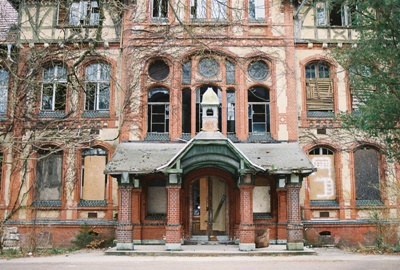 Conceived as a tuberculosis sanatorium by the Berlin Workers’ Health Insurance Corporation, the main treatments seem to have been “baths.” Water baths in pools, air baths on balconies, just generally taking it easy, I guess. There wasn’t much in the way of effective surgery at the time, of course, and the grounds appear to have mostly been designed with extended strolls in mind.
Then, at the beginning of WWI, the complex quickly became a military hospital for the Imperial German Army. Perhaps the most (in)famous patient to stay at Beelitz Heilstätten during this time was Adolf Hitler who, after being wounded in the leg at the Battle of the Somme, spent October and November of 1916 recuperating here.
Conceived as a tuberculosis sanatorium by the Berlin Workers’ Health Insurance Corporation, the main treatments seem to have been “baths.” Water baths in pools, air baths on balconies, just generally taking it easy, I guess. There wasn’t much in the way of effective surgery at the time, of course, and the grounds appear to have mostly been designed with extended strolls in mind.
Then, at the beginning of WWI, the complex quickly became a military hospital for the Imperial German Army. Perhaps the most (in)famous patient to stay at Beelitz Heilstätten during this time was Adolf Hitler who, after being wounded in the leg at the Battle of the Somme, spent October and November of 1916 recuperating here.
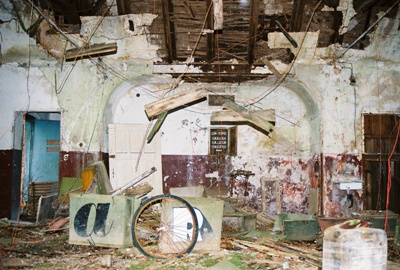 After being used as a Nazi military hospital during WWII, Beelitz Heilstätten was occupied by the Soviets in 1945 and, at its height, employed 1,000 people. Strangely, it remained a Russian-operated facility until 1995, a few years after German re-unification. In fact, shortly after the fall of the Berlin Wall, in December 1990, Erich Honecker spent time here. He had just been forced to resign as head of the suddenly non-existent East German government and apparently wasn’t feeling too good about things. I suppose the liver cancer probably didn’t help.
It was also during the unsettled period between the Wall coming down and re-unification that Die Bestie Von Beelitz or, The Beast of Beelitz, appeared. From the fall of 1989 to the spring of 1991, the Beast, a necrophiliac, terrorized the women of Beelitz, strangling or stabbing his victims and at least once leaving his own pink underwear behind.
After being used as a Nazi military hospital during WWII, Beelitz Heilstätten was occupied by the Soviets in 1945 and, at its height, employed 1,000 people. Strangely, it remained a Russian-operated facility until 1995, a few years after German re-unification. In fact, shortly after the fall of the Berlin Wall, in December 1990, Erich Honecker spent time here. He had just been forced to resign as head of the suddenly non-existent East German government and apparently wasn’t feeling too good about things. I suppose the liver cancer probably didn’t help.
It was also during the unsettled period between the Wall coming down and re-unification that Die Bestie Von Beelitz or, The Beast of Beelitz, appeared. From the fall of 1989 to the spring of 1991, the Beast, a necrophiliac, terrorized the women of Beelitz, strangling or stabbing his victims and at least once leaving his own pink underwear behind.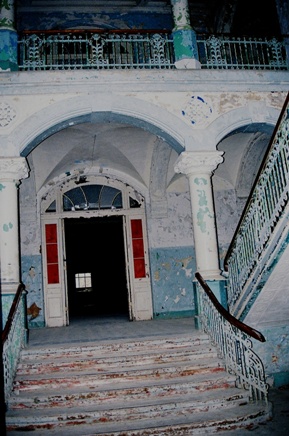 Most of the attacks occurred near the surgical block and women’s pavilion on the forested Heilstätten grounds and his victims included the wife and infant child of a senior physician. Before being detained by joggers while pleasuring himself in the woods, the Beast, whose real name is Wolfgang Schmidt, killed a total of six women and the infant. He was sentenced to 15 years detention in a psychiatric facility which seems a little, I don’t know, LIGHT to me. However, I believe he remains imprisoned now, 20+ years later. A
 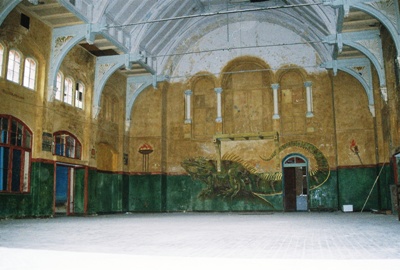 Recently, there have been some efforts to privatize the complex but bankruptcy has gotten in the way. The surgery, psychiatric ward, and rifle range (??) have been abandoned for some time and a supposedly functioning center for neurological research and a rehabilitation area for Parkinson’s sufferers were not obviously operating during our visit.
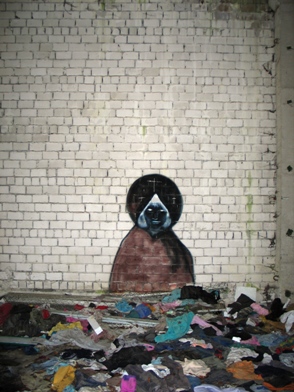 In fact, aside from the caretaker’s quarters and some random renovation here and there, we saw virtually no activity. Unfortunately for us—and in contrast to statements from a year or two ago—most of the buildings were locked-up, boarded-over, and totally inaccessible without more time and at least a rope or two. Still, it was quite an experience to wander the grounds on a damp, overcast day, take in the unusual Russian graffiti, and consider all the terrible goings-on that have occurred at Beelitz Heilstätten.
Although I had not heard of Beelitz Heilstätten before visiting, it turns out to be quite well known indeed. I found very good information and the Michael K. quote at
In fact, aside from the caretaker’s quarters and some random renovation here and there, we saw virtually no activity. Unfortunately for us—and in contrast to statements from a year or two ago—most of the buildings were locked-up, boarded-over, and totally inaccessible without more time and at least a rope or two. Still, it was quite an experience to wander the grounds on a damp, overcast day, take in the unusual Russian graffiti, and consider all the terrible goings-on that have occurred at Beelitz Heilstätten.
Although I had not heard of Beelitz Heilstätten before visiting, it turns out to be quite well known indeed. I found very good information and the Michael K. quote at 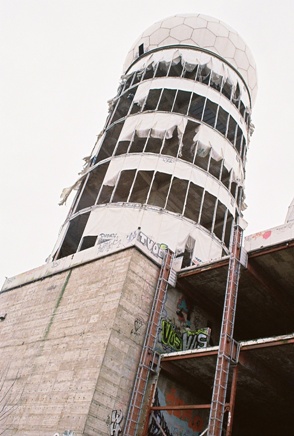 City of Dust is pretty much always on the road and occasionally we even manage to go international. Awhile back we visited the
 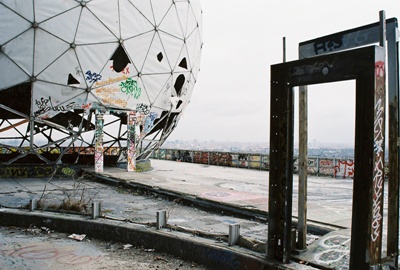 By the late 1950’s, the Allied Forces, and the United States, in particular, were trying to find a way to listen-in on nearby Communists from stations in West Berlin. Mostly they drove around the city in mobile units, trying to find the best reception from the East. Then, one day, some smart people decided to go to the top of Teufelsberg and found that from there they could hear the Reds very well indeed. Thus, the construction of several large radio domes was undertaken. Also, the mechanical lifts at the ski slope were removed because they interfered with reception. Just another sacrifice for the Cold War.
Once the proper infrastructure was in place, it was found that at a certain time of the year reception was fantastic, better than at any other time. After some investigating, it was discovered that the Ferris wheel used for the annual German-American Volksfest acted like a large relay antenna. From then on removal of the Ferris wheel was delayed for a bit at the end of each festival. Also, since no one really knew what was going on at the listening station, some strange rumors were born, including one involving emergency exit tunnels that ran deep down into the mountain of debris.
Of course, eventually the Cold War sort of went away and the listening station quickly became useless.
By the late 1950’s, the Allied Forces, and the United States, in particular, were trying to find a way to listen-in on nearby Communists from stations in West Berlin. Mostly they drove around the city in mobile units, trying to find the best reception from the East. Then, one day, some smart people decided to go to the top of Teufelsberg and found that from there they could hear the Reds very well indeed. Thus, the construction of several large radio domes was undertaken. Also, the mechanical lifts at the ski slope were removed because they interfered with reception. Just another sacrifice for the Cold War.
Once the proper infrastructure was in place, it was found that at a certain time of the year reception was fantastic, better than at any other time. After some investigating, it was discovered that the Ferris wheel used for the annual German-American Volksfest acted like a large relay antenna. From then on removal of the Ferris wheel was delayed for a bit at the end of each festival. Also, since no one really knew what was going on at the listening station, some strange rumors were born, including one involving emergency exit tunnels that ran deep down into the mountain of debris.
Of course, eventually the Cold War sort of went away and the listening station quickly became useless.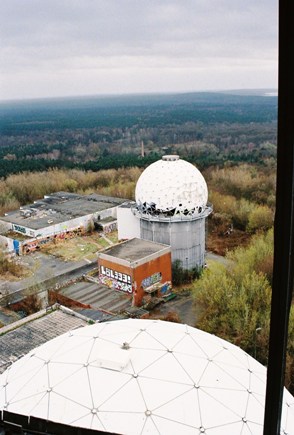 The land was purchased by investors soon after the fall of the Berlin Wall with the intention of building hotels, but there was already too much construction in the newly-reunified Berlin to make the venture profitable. For awhile there was also talk of turning the whole place into a spy museum. Now, new zoning regulations have ensured that this manmade “forestland” cannot be built upon and the only possible use for the listening station is as a Cold War Memorial. The rest of Devil’s Mountain remains a rather nice park.
During our visit, we had to work a bit to find an entrance, but once the easiest option was located, we, along with apparently many, many others before us, had free run of the place. Most of the outbuildings are uninteresting, but the real gems are the radio dome towers, which can be climbed all the way to the top by internal stairs. I’d recommend staying away from the dark, empty elevator shaft. The towers have no walls, so you can get out on whatever floor you like and have a look at the drop below. This day, the wind was howling, making getting close to the edge a pretty risky proposition.
The land was purchased by investors soon after the fall of the Berlin Wall with the intention of building hotels, but there was already too much construction in the newly-reunified Berlin to make the venture profitable. For awhile there was also talk of turning the whole place into a spy museum. Now, new zoning regulations have ensured that this manmade “forestland” cannot be built upon and the only possible use for the listening station is as a Cold War Memorial. The rest of Devil’s Mountain remains a rather nice park.
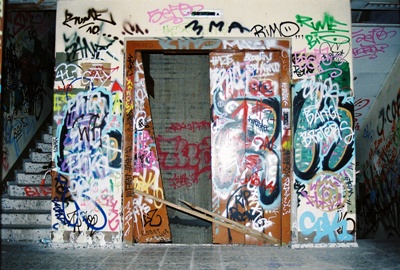
During our visit, we had to work a bit to find an entrance, but once the easiest option was located, we, along with apparently many, many others before us, had free run of the place. Most of the outbuildings are uninteresting, but the real gems are the radio dome towers, which can be climbed all the way to the top by internal stairs. I’d recommend staying away from the dark, empty elevator shaft. The towers have no walls, so you can get out on whatever floor you like and have a look at the drop below. This day, the wind was howling, making getting close to the edge a pretty risky proposition.
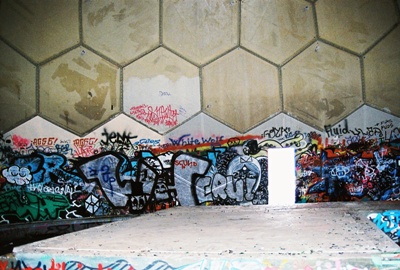
 Near the very top of the towers sit tattered domes which seem to have been made out of something like Masonite. The wind is slowly annihilating them and they made a lot of noise in the gale. Then, at the absolute top of the stairs, one emerges into a fairly intact dome where the acoustics are astounding. You can speak in one direction and hear your voice behind you. Every sound is amplified and bounces around the dome in all directions. Easily the coolest echo chamber I’ve ever been in. Ah, Cold War technology; fun for kids of all ages.
Covered with graffiti and rapidly decomposing—not to mention immensely dangerous to the clumsy or chemically-impaired—the most likely fate of the Teufelsberg listening station seems to be its eventual destruction. The area will then be planted with trees and it seems unlikely that the old Cold War relic will, like so many other wartime structures, become a permanent part of the Devil’s Mountain itself. But, if you ask me, it probably should be.
Near the very top of the towers sit tattered domes which seem to have been made out of something like Masonite. The wind is slowly annihilating them and they made a lot of noise in the gale. Then, at the absolute top of the stairs, one emerges into a fairly intact dome where the acoustics are astounding. You can speak in one direction and hear your voice behind you. Every sound is amplified and bounces around the dome in all directions. Easily the coolest echo chamber I’ve ever been in. Ah, Cold War technology; fun for kids of all ages.
Covered with graffiti and rapidly decomposing—not to mention immensely dangerous to the clumsy or chemically-impaired—the most likely fate of the Teufelsberg listening station seems to be its eventual destruction. The area will then be planted with trees and it seems unlikely that the old Cold War relic will, like so many other wartime structures, become a permanent part of the Devil’s Mountain itself. But, if you ask me, it probably should be.
 Obviously, it’s not easy to get information on what exactly was going on at the listening station. I got the basics from
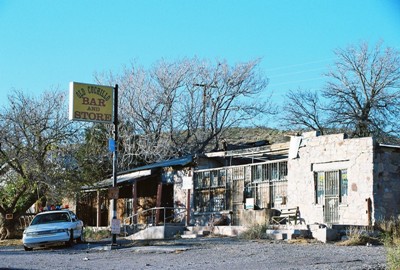
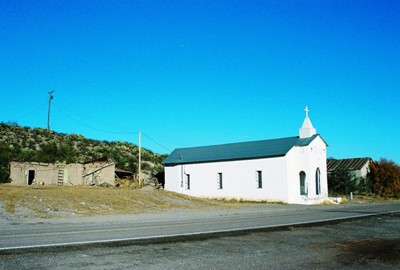
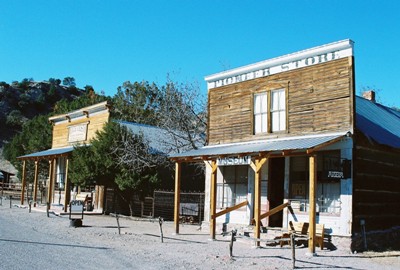
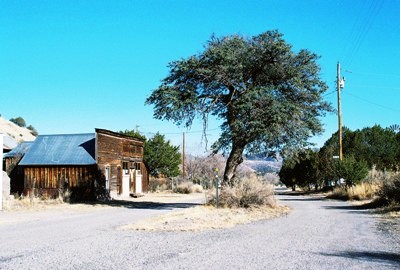
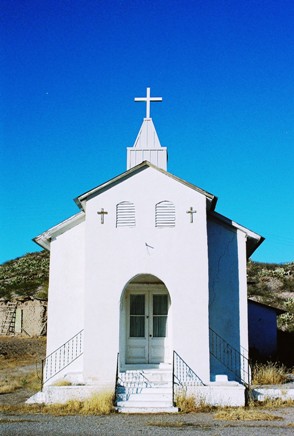 The creek was named for a Warm Springs Apache Chief, Cuchillo Negro (aka Baishan), from the Black Range who was raiding partners with Mangas Coloradas. Of course, Geronimo also frequented the area and, given the animosity between settlers and Apaches at that time, it’s perhaps no surprise that a creek so-named would continually threaten Cuchillo, destroying entire sections of the town, leveling the St. Joseph’s church twice, and occasionally flooding the current church, which was built in 1907 and is still used for mass.
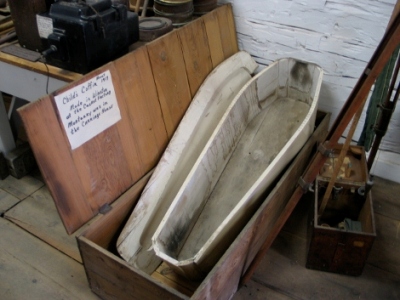
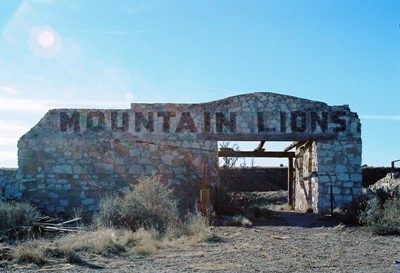
 Below this crack was a large cave where over 40 Apaches were hiding with their horses. Two Apaches, oblivious to the Navajos, stepped into the open and were quickly killed. Then the Navajos lit a fire at the mouth of the cave with brush and driftwood from the canyon floor. The Apaches tried to negotiate, but when the Navajos asked for the return of three small girls that had been taken hostage they were met with silence. Understanding that the girls had been killed, the Navajos piled on more fuel and eventually every Apache was either asphyxiated or burned alive. It took a full day for the walls of the cave to cool enough for the Navajos to enter to re-claim their stolen belongings. Inside they saw that the Apaches had tried to use the blood of their horses to douse the flames. The Navajo warned anyone who asked to stay away and consider the entire area cursed to this day.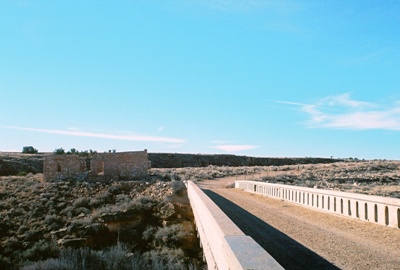
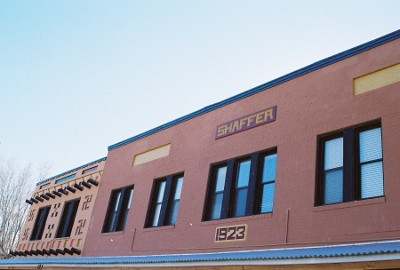
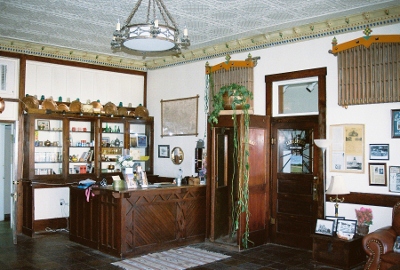
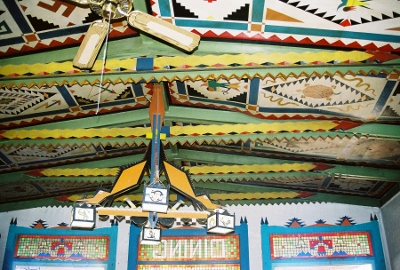
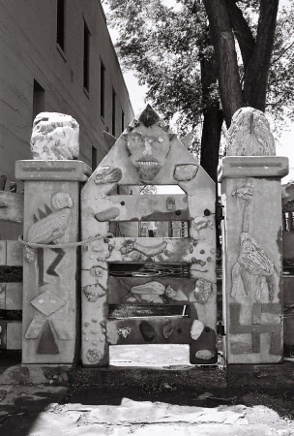 While loosely considered “Pueblo Deco,” Pop Shaffer’s vision is almost too singular and idiosyncratic to fit the term. While not exactly comforting, the hotel’s artwork, which includes painting, sculpture, and numerous things made out of rocks, all created by Pop himself, is pretty incredible. And, yes, it is jarring to see what appear to be swastikas scattered about. However, this is not the Nazi swastika, but a Navajo symbol, sometimes called "whirling logs," that represents healing and can face either left or right. Four large whirling logs that originally lined the top of the hotel have been covered over.