skip to main |
skip to sidebar
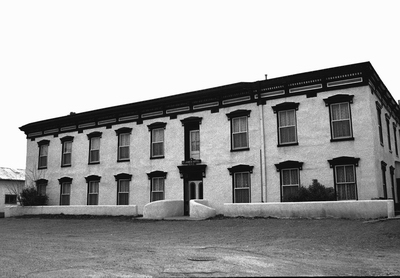
I’ve been trying to get back to the St. James Hotel in Cimarron, New Mexico for over five years now. In the fall of 2005 I was driving from Oklahoma to Taos via U.S. 64 and, on a whim, stopped for a few minutes at the old hotel. I immediately knew I wanted to spend some time there, but the road was calling and soon I had to get going. I bid the place adieu and vowed to return. Back then, I didn’t know that the St. James is considered one of the most haunted hotels in the United States. All I knew was what I’d just read in an article tacked to a wall; that the hotel was built in 1872, that 26 people had been killed in the saloon alone, and that everyone from Jesse James and Buffalo Bill to Clay Allison and Zane Grey had spent the night. As it turns out, not all of those claims are necessarily true, but there’s still more than enough verifiable history in the St. James Hotel to satisfy me.
When I posted about the ghost town of ELIZABETHTOWN, New Mexico awhile back, I mentioned Henri Lambert. Lambert, a Frenchman, had moved from Washington, D.C. to Elizabethtown in 1864 to try his luck at mining. Eventually he gave up on gold, however, and returned to his previous occupation as a chef.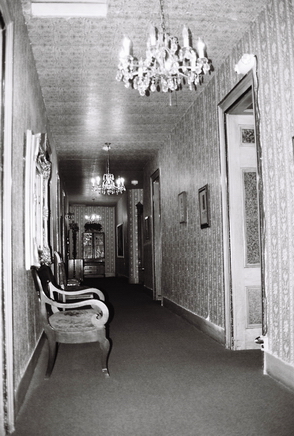 It’s been said that Lambert was Abraham Lincoln’s personal chef, but there is no hard evidence of this. On the other hand, it probably is true that, while living in Elizabethtown, Lambert was presented with a severed head. More on that grim tale can be found HERE. Lambert left Elizabethtown in 1871, moved to Cimarron (Spanish for “feral,” but also meaning “wild” or “fugitive”) and, in 1872, opened a saloon, which became known as Lambert’s Place. Not surprisingly, the saloon did a brisk business and, by 1880, Lambert had made additions, including hotel rooms and a restaurant. Lambert’s Place became the Lambert Inn and, eventually, was re-named the St. James Hotel.
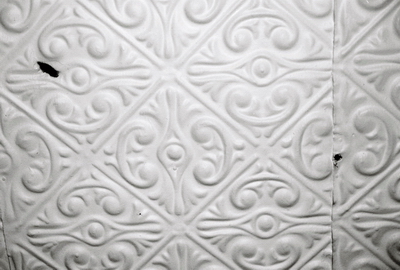
Cimarron was indeed a wild place and the names of most of the people killed in or around the hotel between 1872 and 1884 are known, as are the names of the killers. Henri Lambert himself shot two people and, in the mid 1870’s, it was apparently not uncommon to be asked, "Who was killed at Lambert's last night?" But it is worth considering that the notorious Texas gunfighter, rancher, and outlaw Clay Allison is credited with killing 11 people at the St. James Hotel, which means that, without Mr. Allison, the place would’ve been much less violent. Still, numerous bullet holes remain in the saloon’s tin ceiling to bear witness to the rough times.
If you believe what’s been written, you’d think that many (if not most!) of the major figures of the Wild West stayed at the St. James Hotel. Here it’s often difficult to separate fact from fiction, but I’ll try my best and, if anyone can further verify or deny these claims, please do so. First, it’s said that Jesse James stayed at the hotel, but that’s probably not true as there is no evidence that Jesse James ever came through northern New Mexico. Annie Oakley, also reported to have spent time at the St. James, never visited New Mexico at all. The story is that Annie Oakley was passing through with Buffalo Bill Cody while they worked on putting together a Wild West Show,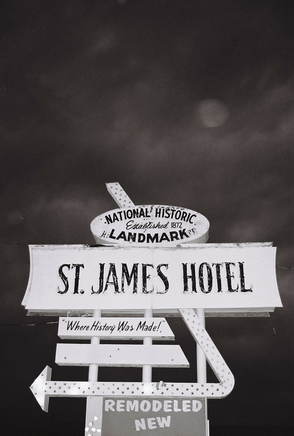 and thus there’s reason to suspect that Buffalo Bill never stayed at the hotel either. On the other hand, Buffalo Bill was said to be a personal friend of the Lambert’s, so the jury might still be out on that one. Legend has it that the Earp brothers and their wives spent three nights at the St James on their way to Tombstone and, you know, that just might be true. Clay Allison most certainly stayed many times, leaving the bodies behind to prove it. Bob Ford, the guy who shot Jesse James? Maybe. Ford is credited with shooting a man named Bob Curren in the St. James in 1882, the same year he shot Jesse. But I wouldn’t doubt that he actually came through later, on his move to Las Vegas, NM in 1884. In the early 20th century, Zane Grey definitely spent time at the hotel, writing some of Fighting Caravans in room 22. Other figures like Black Jack Ketchum and Doc Holliday? They were at times nearby, but your guess is as good as mine as to whether they really visited the St. James.
It’s useful to know who really stayed at the St. James Hotel so that, in the event of a haunting, you can better guess whose ghost you’re dealing with. Jesse James? Not likely. Henri’s wife, Mary Lambert? Quite possibly, especially if you’re in room 17 and there’s an overpowering odor of rose perfume. 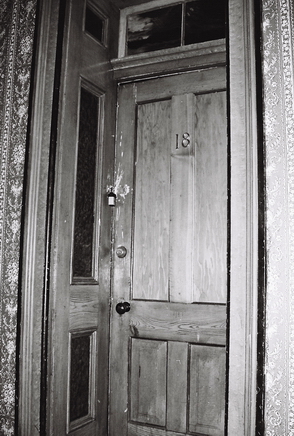 Perhaps the most interesting spectral figure at the St. James is Thomas James (T.J.) Wright. T.J. Wright was reportedly killed upstairs in the card room, following an evening of gambling. One story has Lambert himself shooting Wright in the back as Wright walked away after Lambert had gambled (and lost) his entire hotel to T.J. I doubt that’s accurate, but, whatever the case, Wright was dead at the age of 22. Now, Wright’s violent spirit is said to occupy his old room, number 18. So many guests have reported being tormented by Wright’s ghost, some being physically hurt, that room 18 is now padlocked and guests are not allowed in. Our bartender said that he sometimes goes up to the room and has a glass of whiskey, leaving one behind for Mr. Wright.
We spent the night in the Mary Lambert room, but I didn’t notice any essence of rose. Right across the hall was room 18, and my girlfriend reported hearing creaking floorboards from that direction that kept her up some of the night. She was pretty spooked, actually. Myself? I slept very well, thank you. In the morning I peaked through a crack in the door to get a look at room 18. I could see some torn wallpaper with holes showing through the plaster and plenty of dust. Whatever is going on, that room hasn’t been used for awhile.
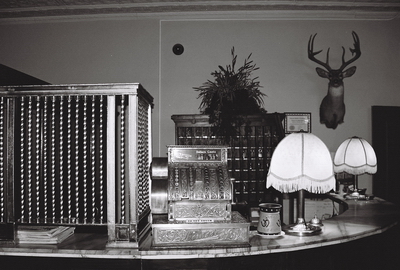
Finally, to wrap up this epic post, the St. James hit hard times when the railroad cut off traffic along the adjacent Santa Fe Trail and the mines began to close. The hotel was bought and sold many times and, by 1985, had fallen into disrepair. But, in 1985, the St. James Hotel was fully restored and now, with a modern wing (those hoping to be haunted shouldn’t stay in this section) and a large restaurant and bar, the place is once again the liveliest thing going in Cimarron. I’ll get back again sometime, I swear.
Wanna stay at the St. James Hotel? Go HERE. But note that they don’t take reservations on-line; you gotta call ‘em. Information from this post came from wherever I could dig it up; pamphlets, fliers, wikipedia, etc. But NOT Philip Varney’s ghost town guide. We’ll get back to that next time.
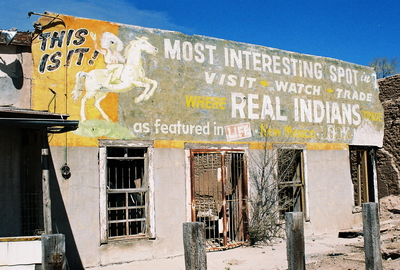
Just north of Albuquerque, a short distance west of I-25 and right off Historic Route 66, sits the old Santo Domingo Indian Trading Post, apparently waiting for its fate to finally be decided. Built by the Seligman Family in 1922, the trading post supplied authentic jewelry made by artists from the Santo Domingo (now Kewa) Pueblo to travelers on Route 66, as well as providing gas and Nehi orange soda. Being on the Atchison, Topeka, and Santa Fe line meant that the Southwest Chief, running between Chicago and Los Angeles, also stopped there, as did John F. Kennedy on at least one occasion.
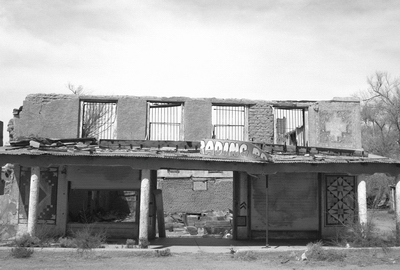
Considered to be of historic significance (“architecture/engineering, event”) and built in a vaguely Mission/Spanish Revival style, the trading post is #97001592 on the National Register of Historical Places. It was added to the New Mexico Register of Cultural Properties in 1997 and, when added to the national register on January 9, 1998, the current function of the building was listed as “commerce/trade.” Now, 13 years later (and 10 years after the building was gutted by fire), its current function is less obvious. However, in July 2010, the trading post received a one million dollar federal restoration grant from the Economic Development Administration to re-open and offer arts and crafts made by residents of the Kewa Pueblo. But clearly that money hasn’t been spent yet. Given the current economic climate, who knows what will happen to the trading post.
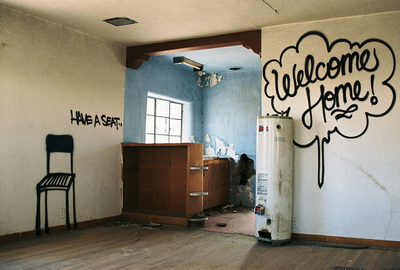
I have to say that I really love this building. For some time before I managed a visit I eyed it longingly from the Rail Runner, which stops just across the street, on trips to and from Santa Fe. A black and white photo of the façade hangs in my office, one of the very few photos which I’ve taken that are actually displayed in my home. I hope it gets rehabilitated someday soon and isn’t left to just collapse into the dust, as seems highly likely. Alas.
Next time...more ghosts.
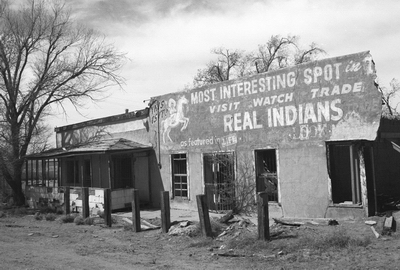
Information for this post came from Only In New Mexico, a blog by former Mayor of Albuquerque Jim Baca, and Route 66 News. The National Register of Historical Places listing can be found HERE. Thanks to Killbox for tracking down the historical register listing.
All photos taken around or inside the trading post and adjacent buildings.
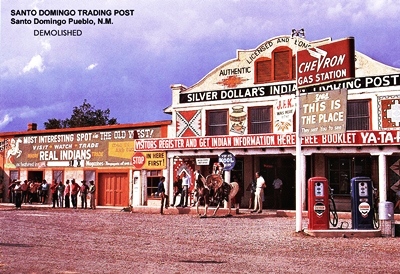
2013 UPDATE: Below is the best picture of the Santo Domingo Trading Post in its heyday that I've ever seen. Apparently it was once known as "Silver Dollar's Indian Trading Post." A sign above the gas pumps, on the left side of the pole, says, "J.F.K. was here. 12/7/62." It's great to put a date to the visit and, judging by the old-style pumps and people's clothes, the shot might well be pre-1970. Thanks to Matt for sending this one in.
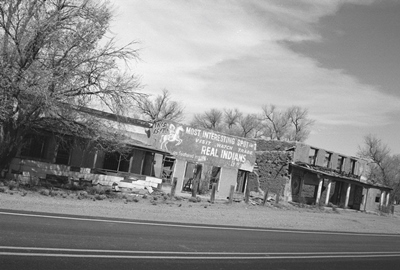
JULY 2014 UPDATE: Recently a comment was left by someone with the initials M.W., who said they had grown up in the adobe house to the right of the Santo Domingo Trading Post. They were six at that time and are 51 now. So, I looked through my photos for a shot of that house and, while I don't have a real good one, the house can just barely be seen at the very far right of the picture below. I believe it was torn down when restoration work began on the trading post a couple years ago.
An interview I did a few days ago with Alex over at The American Classic can now be found HERE. I'm flattered that Alex wanted to do an interview and honored that he gave me so much space. Take a trip through his very cool site(s) and learn how to look better and feel good about it.
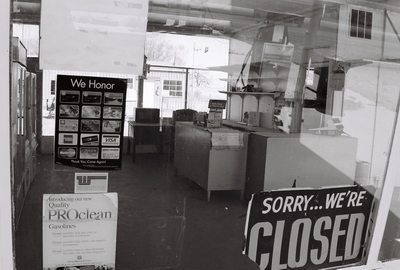
Photo taken at an abandoned gas station in Springer, New Mexico.
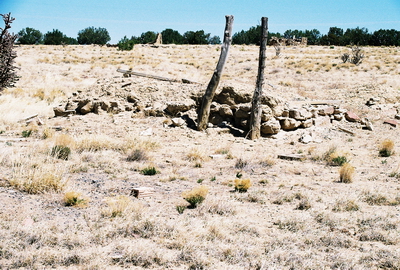
At this point, there’s not much anyone can say about the ghost town of Coyote, New Mexico, and there's even less to see. Like HAGAN, its neighbor just to the southeast, it’s located on land owned by the Diamond Tail Ranch. However, nearly a century after being abandoned, the town has been reduced to just a few piles of adobe behind a fence that it wouldn’t be real wise to try to climb over. But, Coyote is a bona fide ghost town, and so I’ll include it here.
Coyote is about three miles from HAGAN and its fate was very much tied to that town, which had been founded about two years earlier, in 1902. Workers from the Sloan Mine first established Coyote and then waited for the railroad to come through and connect the town with Hagan and other points of commerce. But, as I mentioned in the previous post, two efforts to get tracks to Hagan failed before a third was finally successful in 1924. The tracks eventually came within a half mile of Coyote but by then it didn’t matter because Coyote was already dead and gone. Now all that remains are a few foundations.
The only real historical source I found for Coyote was Philip Varney’s ghost town guide. Even Varney couldn't provide much information about Coyote and, whatever might have unfolded there during the town's brief existence, it seems it will never be known by the likes of us.
The next few posts will be similar to this one: short and sweet. There might be a bit of prose, too. But I’ve got quite a backlog of old New Mexican treasures and I’m accumulating more rapidly. The next post will be about one particular building along old Route 66. Stay tuned.
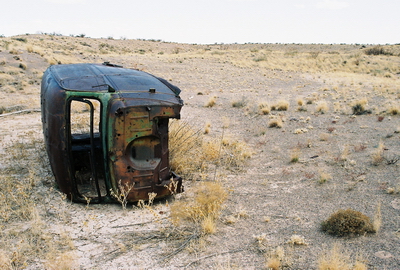
The top photo shows the remains of Coyote, but the truck was photographed literally in the middle of nowhere, Chihuahuan Desert, Socorro County, New Mexico. I dare you to try and find it.
East of I-25, beyond the San Felipe Casino north of Albuquerque and down a dirt county road heading towards Madrid, lay the ruins of Hagan, New Mexico. Established in 1902, Hagan was yet another New Mexican town brought to life by coal, taking its name from mining investor William Hagan. Coal deposits had been discovered along the Una de Gato (Cat’s Claw) Arroyo and, by 1905, about 60 miners were living in Hagan, adjacent to the base of operations.
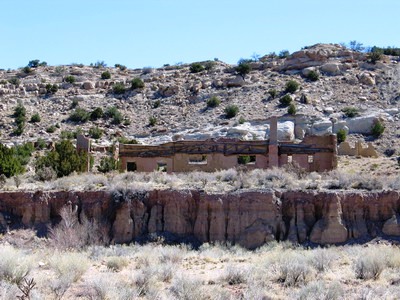
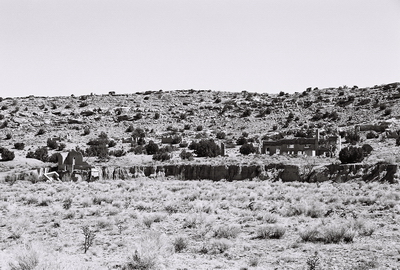
Hagan had to wait a long time for the railroad, the life’s blood of any mining town. Hauling coal by wagon was so expensive that the mines were shut down by 1910. After a line was finally run to the Atchison, Topeka & Santa Fe in 1924, following a couple failed attempts, the town’s population grew to about 500. Soon Hagan had running water, electricity, and toilets and some large structures were built, including Hagan Mercantile (shown above), then the largest adobe building in New Mexico. Cattle ranching and brick-making also became important ways of making a living in Hagan. However, the railroad had been running less than six years when the coal seam started to thin out around 1930. The town died quickly. A few folks stuck around until the very early 1940's, but the post office was already gone by 1931.
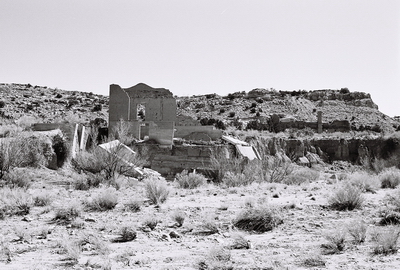
Not much remains of Hagan. There are a couple crumbling buildings, a few foundations, and a slowly capsizing railroad way station (pictured above). However, Hagan’s location is very picturesque and its apparent (if not actual) remoteness makes for some excellent atmosphere. But if you visit, don’t go beyond the overlook beside the road.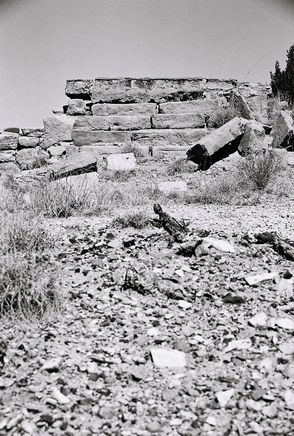 The Hagan property is owned by the sprawling Diamond Tail Ranch and posted as private. As none of our party was able to read the day of our trip, we crossed the arroyo and walked right into what was once the old town. But we got to spend only a few moments taking photos before a representative of NEW MEXICO JEEP TOURS arrived and asked us to leave. He was cordial enough (and, of course, he didn’t need to be) but made it clear that there was no way we were setting foot in Hagan without booking a jeep tour. The jeep tours look very interesting, actually, so perhaps NM Jeep Tours would like to provide me with a promotional discount. I’d certainly like to see a bit more of Hagan and check out the nearby petroglyphs, too.
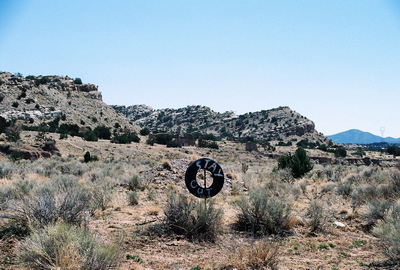
Hagan has almost completely sunk beneath the sands of time. There is very little information available on the town’s history and much of what is out there is repetitious or, in some cases, probably wrong. So, my synopsis is based on my trusty copy of New Mexico's Best Ghost Towns: A Practical Guide by Philip Varney (1981, Northland Press) and an excellent post (including better photos than I was able to get) by the Torrance County Archaeological Society.
The next City of Dust post will be on Hagan’s ghost town neighbor, Coyote. Also, a stay at the St. James Hotel in Cimarron, New Mexico has been booked. In addition to being one of America’s most haunted hotels, the St. James is rich with history and bullet holes. A post on it will be forthcoming.
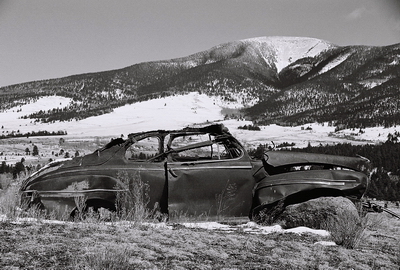
From what I can tell, people who read City of Dust are pretty much split between those who enjoy the historical content and those who prefer the fiction/prose. I like to mix them up myself, but for the next few posts we’ll be firmly in the former category, visiting a few ghost towns around New Mexico. Last post we stopped by Pinos Altos (not REALLY a ghost town) and this time we’ll head in the opposite direction and go to Elizabethtown, which is just north of Eagle Nest, on the "Loop of Enchantment," not too far from the Colorado border. If you aren’t a history buff, you can always just look at the photos. Those are the remains of a ’46 Mercury in the photo above, if you’re wondering.
Elizabethtown is fairly well-known, as far as ghost towns go, and there is even a museum on-site. However, there isn’t much left of the place. Like most ghost towns in New Mexico, Elizabethtown came into existence because of shiny rocks. In 1866, Captain John William Moore helped a wounded Indian get medical attention at Fort Union, near Las Vegas, New Mexico. Later, the Indian returned to Fort Union to trade and ran into Captain Moore whose previous kindness the Indian now repaid with a few decorative stones which Mr. Moore immediately realized bore copper. Moore asked to be taken to the source of the rocks, which turned out to be high on 12,441 foot Mt. Baldy, just across the Moreno Valley from Wheeler Peak which, at over 13,161 feet, is the highest point in New Mexico. Even better than copper, it turned out that the mountains and valleys were rich with gold. And thus another western gold boom began. That's Mt. Baldy in the distance in the shot below.
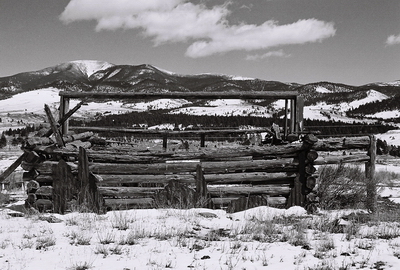
Elizabethtown, named after Captain Moore’s young daughter, was incorporated quickly, becoming the first officially incorporated town in New Mexico, and a post office opened before 1866 was out. By the time Elizabethtown celebrated its first birthday, the population had ballooned to 3,000. Or 5,000. Or maybe 7,000. No one really seems to know for sure, but a lot of people showed up in a short period. Just before 1870, E-town, as miner’s referred to it, boasted over 100 buildings, including a couple hotels, seven saloons (some 200 feet long), three dance halls, and a drugstore.
You don’t have to dig too deep into a town’s past to find something unsavory, and Elizabethtown is no exception. In late 1870, the Ute wife of Charles Kennedy, who lived on the road between E-town and Taos, entered a saloon bleeding and crying. She told those gathered around that her husband had been killing travelers. 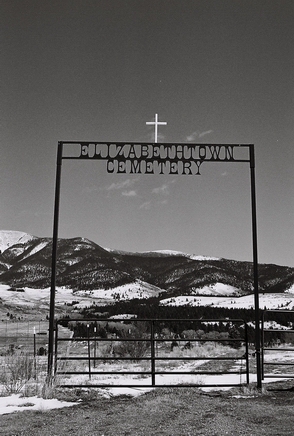 Depending on whom you believe, he may have killed up to fourteen people and might even have killed two of his own children after they got on his nerves. Whatever the case, the last of his kids truly did raise the old man’s ire when Kennedy lured a traveler into his home only to have the man ask if there were any Indians in the area. Kennedy’s son is said to have replied, “Can’t you smell the one papa put under the floor?”, a retort which displeased the boy’s father so much that he shot the traveler immediately and then bashed his son’s head against the fireplace. After that he threw the bodies in the cellar, locked his wife up, and started drinking. Eventually he drank so much that his wife was able to escape up the chimney.
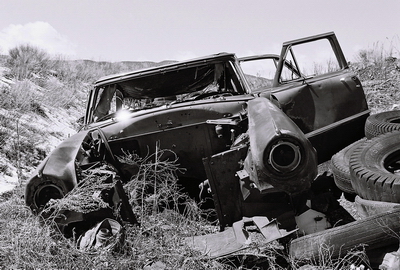
As seems to have happened fairly often in the Wild West, a mob quickly formed and went and found Kennedy drunk at his home, along with some bones, a human skull, and another eye-witness. The mob was led by the notorious (and dangerous) Clay Allison and Kennedy was summarily taken back to Elizabethtown and dragged through the streets with a noose around his neck for a very long time.
It has been said that Allison removed Kennedy’s head and gave it to Henri Lambert, owner of the Lambert Inn (later the St. James Hotel) in Cimarron, now considered one of the most haunted hotels in the U.S. Lambert apparently was told to hang the head outside his establishment as a warning and it eventually mummified on the corral fence before finally disappearing. The St. James Hotel is on the short list of future City of Dust destinations. But as much as I like stories about the St. James Hotel, Lambert was actually living in E-town when Kennedy was killed, not Cimarron, and so, if the story is at all true, the head would’ve surely been placed outside Lambert’s Elizabethtown saloon, not taken to Cimarron.
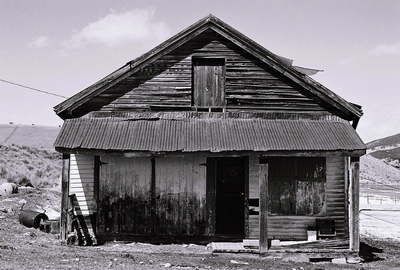
The building in the photo above is considered to be Froelick's Store, which survived a fire and, while slightly modified, is essentially the only original building left standing in E-town. Below is the final resting place of a Froelick.
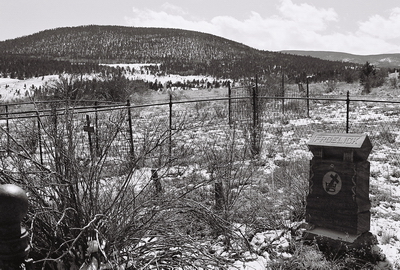
Aside from the Kennedy affair, E-town was a notoriously rough place. When one defendant was asked to be tried in a different city because he figured he couldn’t get a fair trial in Elizabethtown, some citizens just took the man from the sheriff themselves and hung him, pinning a note to his coat that read, “So much for change of venue.”
By 1875, Elizabethtown was basically abandoned, but the ATCHISON TOPEKA AND SANTA FE RAILROAD (and the newfound ability to both transport ore long distances and commence dredging operations) brought the town back to life. E-town became a musical hotspot, with people traveling from all around to hear fiddle playing on a Saturday night. In 1903, Remsberg’s store went up in flames and a large part of the town went with it. Dredging ended in 1905 and E-town’s massive dredger, named “Eleanor” was left to sink deeper into Moreno Creek with each passing year. It’s still in the creek, but entirely buried now. Then it was a long, slow fade until 1917 or so, by which time hardly anyone was left in E-town. The post office hung on until 1931.
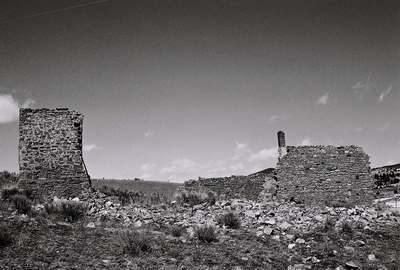
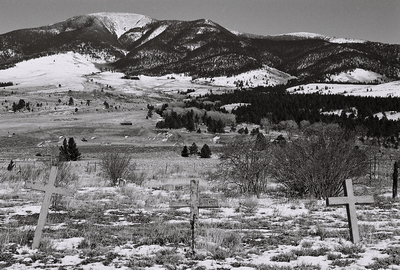
As I said, there’s not a whole lot to see nowadays. The above photo shows the remains of what was a two-story building which some say was the Mutz Hotel. However, Ofelia Barber, who was married in the building in 1872, stated that it was not the Mutz, but another facility, supposedly with rooms to rent on the first floor and a dance hall on the second. However, judging from other photos, even this ruin is a shadow of what it was 7 or 8 years ago. The Elizabethtown Cemetery, however, seems to still be quite active and not surprisingly. Who wouldn’t want their final resting place to be on a hill overlooking the Moreno Valley, with Mt. Baldy to the east and Wheeler Peak to the west? Mrs. Barber left not only her husband there but two daughters as well when she moved from E-town in 1936, one of its last remaining residents.
Once again New Mexico’s Best Ghost Towns: A Practical Guide by Philip Varney (1981, Northland Press) provided not just information but inspiration, as well. LEGENDS OF AMERICA has a pretty in-depth piece on Elizabethtown and some great historic photos, as well. I tried my best to separate fact from fiction based on the accounts I read, but things get hazy down through the ages. If anyone has anything to add, please do.
Next time we’ll go to Hagan. Or what’s left of it.
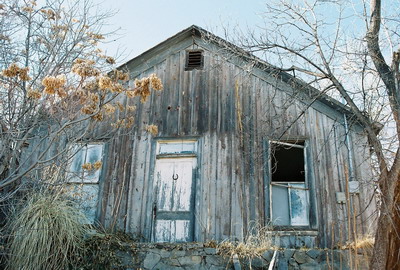
About seven miles north of Silver City, New Mexico, on Hwy 15, at the gateway to the massive Gila Wilderness Area (the brainchild of Aldo Leopold, created in 1924 as the first designated wilderness in the world), is the small mountain town of Pinos Altos (“High Pines”). Sometimes called a “ghost town,” it’s really not, although it owes its existence to an activity common to many true ghost towns: mining. In the case of Pinos Altos, gold was the metal that brought the town to life.
In 1860, Thomas "Three-fingered" Birch, who’d been looking for gold for years with no success, got a drink of water from Bear Creek and happened to see the very thing to which he’d-until then-fruitlessly devoted his life. The town that sprang up around this initial find, Birchville, bore Birch’s name and sat atop the Continental Divide at just over 7,000 feet.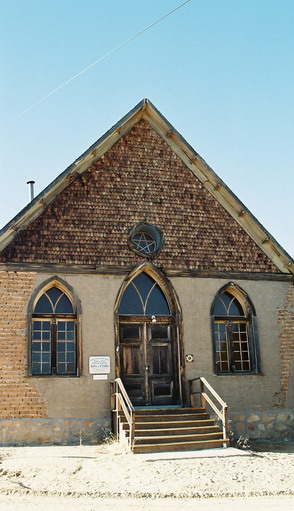 Later in the year a man named Captain Thomas Mastin established the Pacific Mine after discovering gold-bearing quartz in the area. Thomas sold the mine to his brother, Virgil, and a short time later Captain Thomas and three other miners were killed by a group of 400 Apache warriors led by Mangas Colorados (Red Sleeves) and Chief Cochise, Mangas Colorados’ son-in-law. (Seven years later Virgil Mastin would meet a similar fate.) Mangas Colorados lured other Birchville miners to their deaths by having Indian maidens brush out their hair and perform a bit of strip tease at the top of a hill. When the miners clamored up the hill to get a better look, the Apaches ambushed them, killing more than forty. It should be noted that some time earlier Mangas Colorados had been “invited” to the town, only to be tied to a tree and lashed with bullwhips. Thus, as was Chiricahua Apache custom, vengeance upon the miners was uppermost on Mangas Colorados’ mind for some time. The photo above is of the Gold Avenue Methodist Episcopal Church, dedicated in May, 1898.
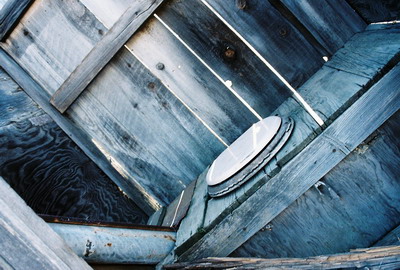
During the Civil War, Birchville’s population plummeted, mostly as there weren't many able-bodied men left to protect against Apaches. Upon resettlement a few years later folks reverted to an older name used by Mexican miners, Pino Alto, which became Pinos Altos. Interestingly, Birchville was under Confederate occupation from early 1861 until shortly after the Union prevailed at the Battle of Glorieta Pass, which occurred just outside Santa Fe in the spring of 1862. Virtually all the tall ponderosa pines for which the town got its name were cut down by the mining boom years of the late 19th century.
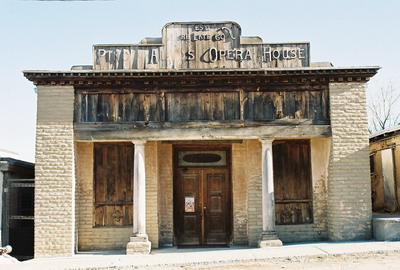
After the Civil War, Fort Bayard was built to protect miners from continued Apache attacks. The town of Pinos Altos received a post office in 1866 and became fully legitimate, featuring a saloon, general store and dueling ground (now the site of Saint Alexis Catholic Church). But Apache attacks continued to plague the area until 1874, when a deal was struck whereby, as long as a cross remained standing on an adjacent mountain, there would be no fighting. Both sides held to the deal and the cross was upgraded a total of three times, just to be on the safe side. The above photograph is of the Pinos Altos Opera House, which was built in 1969 from original material salvaged from various buildings.
Mining booms came and went in southwestern New Mexico, but the region around Pinos Altos also contained silver, copper, lead, and zinc, so the town continued to prosper. It wasn’t until the 1920’s that mining began to wind down for good, at which point over eight million dollars worth of minerals had been removed from the surrounding mountains.
Today, Pinos Altos is home to a few hundred friendly souls and is a pleasant place to spend some time, soaking up all that Wild West history. If you go, be sure to stop by the Pinos Altos Post Office and Ice Cream Parlor for some delicious homemade desserts and good conversation. The post office/parlor sits on the site of the Norton Store, built around 1890, which was itself built on the site of the Occidental Hotel, a two-storied log structure that is long gone into the mists of time, like so much else.
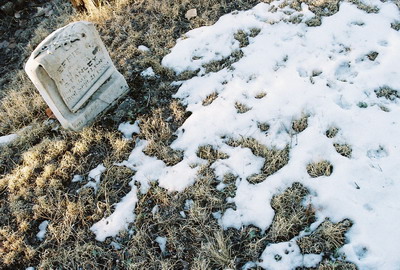
The above photo is from the Pinos Altos cemetery, near Saint Alexis Catholic Church. The cemetery was dedicated on July 17, 1888. Baby Effie lived from January 11, 1888 to September 21, 1888.
The information for this post was compiled from New Mexico’s Best Ghost Towns: A Practical Guide by Philip Varney (1981, Northland Press), The Place Names of New Mexico by Robert Julyan, and Pinos Altos: Then and Now by Robert O. Wilson. Many thanks to these (unwitting) sources.
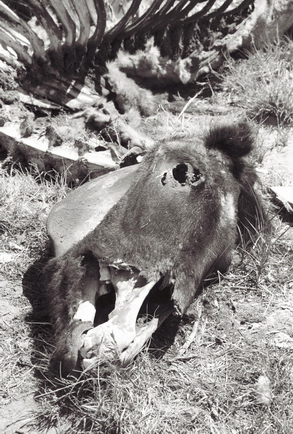 The Printmakers' Studio will be featuring some Albuquerque photographers for the next 6 weeks and I've got two prints in the show. The opening will be this Friday, March 4, 2011, in conjunction with Albuquerque's First Friday events. Most of the photographer's will be present and there will be art on the walls and free food on the tables. What could be better? There will be another event at the gallery the following First Friday, April 1, 2011, with photographer's present at that, too. So, if you're near Albuquerque and free this Friday, why not come on down? The gallery is open during business hours, as well.
This photo of a horse skeleton, taken on Albuquerque's West Mesa, is one of the photos I'll be showing. It looks different (better?) in a fancy frame. The other shot, also taken on the West Mesa, has already been posted on City of Dust. Can you guess which one it is? Yeah, didn't think so.
The Printmakers' Studio is located at 423-425 San Mateo Blvd NE, ABQ, NM. The openings will run from 5PM-9PM.
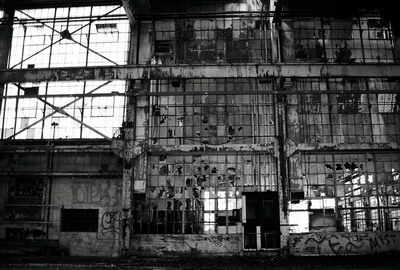
Recently I put together a book of selected photos from the last eight years, essentially the entire length of my photographic "career," which has seen me go from disposable cameras to, uh, toy cameras. Anyway, it turned out to be an arduous process, but I'm pretty happy with the results. These are what I would call "decay" photos; shots of abandoned houses, old prisons, destroyed motels, and desolate textile mills, amongst other alluring places, taken throughout the United States. I tried to include a variety of themes and geographic locations from amongst the relatively small pile of photos that I consider to be "good." "Good" meaning something I'm pretty much at a loss to articulate, which is why I had to take the photo in the first place, I guess. If you want to have a look you can flip through the book RIGHT HERE.
I'm not trying to sell this book, although you CAN buy a copy directly from the link above. The book is fairly expensive and I wouldn't make any money off it anyway. However, if you DO want a hard copy and don't have money to burn, I'd be happy to help you get a copy as cheaply as possible. Picaboo often has on-line coupons to reduce production costs and shipping. So, check for those. Also, they sometimes offer discounts for purchasing multiple copies. If several people want a copy, I could order them all and then send them out to folks at the discounted price. Thus it might pay to contact me before ordering. I can be reached at the e-mail address on my profile page. But, really, if you only check out the book on-line that's fine with me.
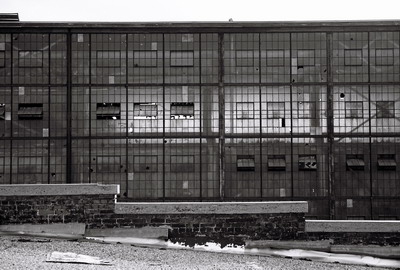
The photos accompanying this post are from the Atchison, Topeka and Santa Fe railyard in downtown Albuquerque, New Mexico. I did a whole post on this magnificent (and vacant) complex awhile back. If you like, you can read it HERE. Two railyard photos are featured prominently as a center spread in the book.
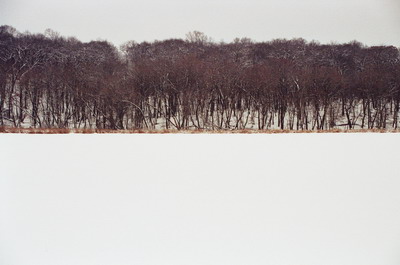
It’s been a hard, cold winter so far. Unrelenting. The snow keeps falling, sometimes just a few flakes throughout the day. But other times it’ll snow for 24, 36 hours at a stretch, an inch every couple hours. The city has already run out of money for plowing the roads. They didn’t budget for this kind of winter. Well, no one plans properly for disaster.
Last night I fell into bed with a girl I met at the bar. She was drunk and I was bored so I figured, “What the hell?” But someone must’ve called my wife because when I got home a little after 1 am Lucy was sitting in her chair waiting for me.
“Where you been?” she asked.
“Out,” I replied, trying not to lie.
“Doing what?”
“Drinking a couple beers.”
She looked at me hard, then stood up, walked across the room to where I was taking off my boots and spit in my face. I wiped the saliva off my cheek and rubbed it on my jeans. We just stared at each other for a moment.
“I know you’ve been screwing Jimmy,” I said, finally. “I’ve known it for awhile.”
Jimmy and I worked at the garage together. I’d seen him and Lucy talking lots of times when Lucy’d come by to pick me up after work. And I saw how she flashed her eyes at him and how he grinned back at her. Eventually, Carl, our manager, took me aside and told me what I already knew. He said he’d fire Jimmy, but I told him to let it go. By then it’d been going on about three months.
A look passed over Lucy’s face that I can’t really put a name to. Then she called me a coward. I started to walk away but she grabbed my shoulder and held me back.
“You pathetic son-of-a-bitch,” she hissed. “Some guy is fucking your wife and you won’t do anything about it. You’re disgusting.”
She took a step closer and dropped her hands to her side. “Hit me,” she said. “Let’s see if you’ve got any man in you at all.” After a moment she twisted up her mouth. “You’re so goddamned weak.”
I started back toward the bedroom. I grabbed my green canvas duffel off the chair on my way down the hall. Lucy followed me.
“What if I told you how he fucked me, huh? Would that piss you off? What if I said he was better than you ever were? If you knew what I let him do to me…”
She said some other things as I put my clothes in the bag, but I wasn’t listening. The next thing I knew she screamed something and hit me in the side of the head. I put a hand to my temple and walked fast to the front door. As I was putting my boots back on she threw a picture at me. It was the one of us on vacation in Hawaii a couple years ago. The picture hit the door jamb and the glass went all over the dirty carpet. I could still hear Lucy screaming as I got in my truck. A few minutes later I was down the road a fair bit.
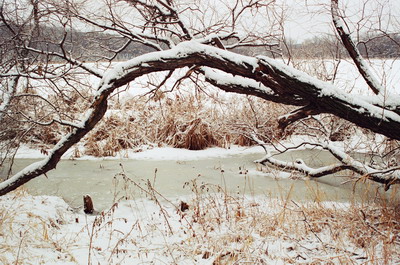
I decided I’d go to the cabin. I’ve never been able to afford a house, let alone a cabin in the north woods, but my dad’s family had it since way back and it got passed down to me when he died. It’s not the only thing I inherited from him, but it’s certainly been the most useful. The sun was coming up by the time I turned off the state highway. I put the truck in 4-wheel drive and hoped the roads wouldn’t get too bad. I don’t think a plow had been through in some days, but the snow was compacted by plenty of traffic. I don’t know what most guys are doing out here in the dead of winter, but it’s not deserted, that’s for sure. Maybe they’re doing the same thing as me.
There was no way I could drive up to the cabin, so I pulled off the road and walked the quarter mile down what was the driveway as near as I could guess. It was a hard walk and the duffel didn’t help. Sometimes I sank up to my thighs in the snow. I was sweating when I unlocked the door. I got the wood-burning stove going to warm the place up, lay down on the bed and fell asleep with my boots still on.
It was mid-afternoon when I woke up. I got a beer from the mini-fridge and just sat there, trying not to think of anything at all. Eventually I realized I was going to need some food. I had some cans in the cupboard and I could always drive back down the road to the convenience store, but I decided to go out and try to find a deer. I’d seen plenty of tracks on my way in. So, I got my rifle out of the safe in the bathroom closet, put on a few layers of clothes and went out.
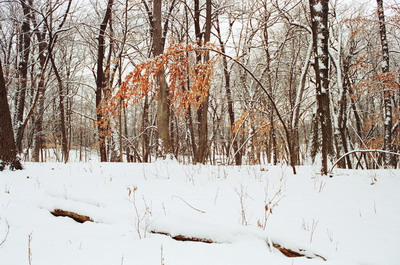
It was cold. A few flakes drifted through the air, but it was too cold to really snow. I kept moving and the effort of getting through the snow soon warmed me up. I came into a stand of pine trees bowed by the weight of the snow and saw a deer about 20 yards away. He was stone still, sensing danger but not yet sure of its nature or direction. I lowered my gun, got the deer in the sight and was just pulling the trigger when a pine bough snapped. The deer started as I fired. It took two steps and went down. A moment later it was back up. I could see that I’d hit it just behind the neck and it was bleeding badly, but it stayed upright. It began to move off, slowly at first, and then it took a couple tentative leaps. I walked through the trees to where the deer had been. There was plenty of blood and I figured it wouldn’t be hard to track. I doubted the deer would live long.
I followed the bloody snow for over an hour, longer than I thought I would, although I guess I didn’t cover much distance because the snow made it such slow going. The forest had become denser and I had to duck under branches now and then. The sun was already starting to dip toward the western horizon. I was getting cold and was far enough from the cabin to be unsure if I could get the deer back before nightfall.
 I was about to turn back when I entered a small clearing and there, on the other side, maybe 15 yards away, was the deer. It stared at me and lowered its head. Then it bellowed and charged a few feet before stopping. It was a buck, an eight-pointer, well-fed and strong. Again it bellowed and then stomped a foreleg heavily. I lowered my rifle as the deer charged to within about 30 feet. It backed up a bit and I could see blood running from its nose. It reared up on its hind legs and then slammed its front hooves into the snow. I took aim and the deer charged again. I realized that the deer wanted to kill me. This wasn’t a grizzly or a mountain lion that wanted me for its dinner. The deer couldn’t use my body for anything at all. It wasn’t defending a mate or its offspring. I don't think it was even defending itself. It just wanted me dead. All at once I was struck by the power of the moment. Nothing in the world had ever wanted me dead before. Lucy might wish me gone in the abstract, but she would never actually do the deed. This deer, however, could not act against its instinct.
The deer came and this time it did not stop but reared up right in front of me. It stood taller than I did. I could’ve gotten a clean shot off, but I hesitated and didn't pull the trigger. Instead, I turned slightly to the left and the deer’s hooves caught me in the ribs on my right side. I fell to the snow and the hooves came down again, this time across my back. I heard a crack that seemed to come from inside my head and I saw the deer stagger and fall and then everything went black.
When I woke it was getting dark. I could move my arms but not my legs. I couldn’t feel my legs at all. I wasn’t in any real pain, but I knew I was not getting out of these woods on my own. A few feet away lay the deer. I could see a trickle of blood running from its mouth into the snow. Using all my strength I pulled myself to the animal, telling myself that the warmth from its body would be good, but, really, I think I just wanted to be close to it. As I drew near it heaved and its black eye seemed to come alive. It made a strange noise, an exhalation that seemed part fear and part resignation. I put my hand on its bloody neck and it did not move.
Slowly, I pulled my entire body closer until I was nestled along the deer’s belly, my head resting on its shoulder. I could feel its heat, though it was nearly dead now and would not retain that warmth for long. For my part, I knew I was going to freeze to death before morning but I suddenly felt that this was the most right—-maybe the only right—-thing that had ever happened to me. We live unnatural lives. We die unnaturally, too. We remain plugged into machines long after we’ve ceased to be of use. We even eat ourselves to death. But for most of human history you got taken out by an animal or fell down a ravine or simply couldn’t make the journey to the wintering grounds again. Now, me, here, in these woods, with this deer, the snow drifting out of the trees on the slight evening breeze, this is good. I only hope I can stay conscious long enough to watch the full moon rise over the pines, the snow sparkling, the reflected yellow light making it nearly as bright as day, the silence of these woods and this animal beneath me slowly becoming my own.
 It was almost 10 years that I worked for the county, up until I couldn’t really take it anymore. For all that time I cleaned-out houses that were going to auction after their owners had died without leaving a living relative or specifying a beneficiary. Sometimes I’d show up pretty much right as the medical examiner was loading the body into the ambulance. Other times it took quite awhile to comb through the deceased’s past and determine if they were, for our purposes, at least, alone in this world. Some people talk about immortality as something to be desired but, from what I’ve seen, outliving (or, perhaps, living long enough to alienate) every one of your friends and family is a fate a far sight worse than death.
You might think that I’d have come across some pretty cool things over the years and, in fact, I was explicitly barred from taking anything for myself from any of the homes I worked. On one occasion, in amongst a stack of worthless albums by the Ray Coniff Singers and Bing Crosby, I found a Blind Lemon Jefferson 78 rpm record. “Bad Luck Blues” on one side and “Broke and Hungry” on the other. I slid the record into the duffel that held my lunch even though I don’t have the equipment to play it. 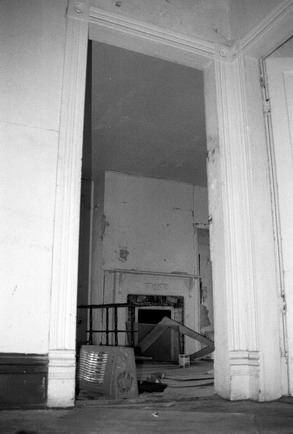 Another time I found a water-stained photo of Marilyn Monroe signed, “To Petey, Love Always, MM.” I’ve tried to compare the writing against other examples I’ve found on the internet and can’t be sure but it might be authentic. Really, though, most of what was in these houses, the vast, vast majority, was of no use to anyone. Old photo albums, paperbacks, clothes, trinkets of every sort and description; things that mattered only to the decedent. Most of this gets put in black plastic bags and taken to the landfill. Even the Goodwill didn’t want it from us. Furniture that is in nice shape, electronic equipment, appliances, and things of some obvious value are shipped to a warehouse and auctioned off four times a year. You might not think that in a city of this size enough people shuffle off this mortal coil entirely without heir to warrant such an operation. In fact, I was part of a twelve-person team and we struggled not to run a backlog.
Of course, the first rule of the job is not to get involved. Don’t read the personal correspondence. Don’t try to put meaning to the faces in the pictures. And don’t try to reconstruct the last days or years of the deceased. Remain detached. Keep filling the black plastic bags. It’s hard. 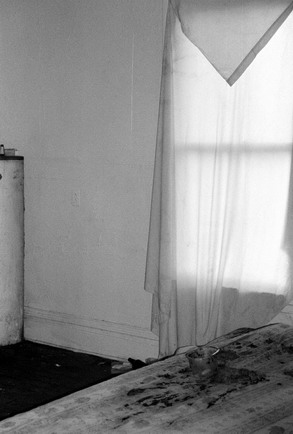 I think most people expect that death will be a passageway from a life well-lived to something even better. Surrounded by our family and friends there will be anxiety and tears, to be sure, but also the warmth given off by a lifetime of memories and the knowledge that, in a very real way, our life continues in those that come after us. Perhaps it is like that for some. But the evidence I’ve seen would indicate that the end of life can also be a long slide into oblivion, the weight of regret hanging heavy as dreams go unfulfilled or collapse in on themselves entirely. When the mind finally can’t cope I guess madness sets in. I often found it something to consider as I tried to not get involved.
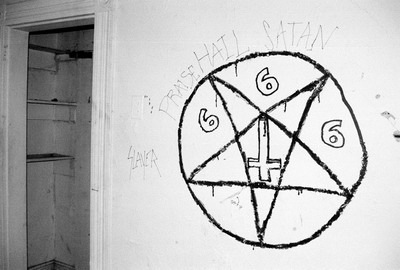
A good number of the homes I went into were what you might call “garbage houses,” the former occupants having hoarded mountains of worthless material items against a yawning spiritual and emotional void. Old newspapers. Cereal boxes. Children’s toys (despite there apparently having been no children around lately). Bits of yarn. Anything that might be of some use in a future that would never arrive. When it got real bad we had to call in a HAZMAT team. My own father lived in a house somewhat like this. As a boy I recall a mix of anticipation and revulsion as I dug around in drawers looking for interesting artifacts or stalked around piles of old magazines that had begun to disintegrate in backed-up sewage. 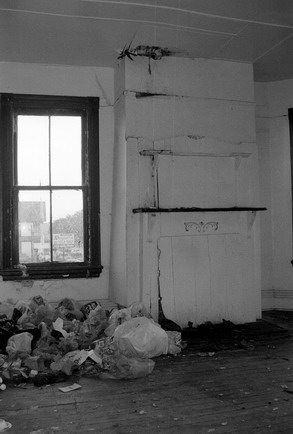 The lights in the basement didn’t work and I had to use a flashlight to make my way over the cracked concrete floor, occasionally scaring up the ragged old black cat my dad kept, while holding my shirt over my mouth and nose, afraid of catching some type of disease. Even the garage was piled high with junk, some of which--strange medallions, old coins, car parts--I found truly fascinating. But, in the end, my wariness always won out and I was careful to keep some distance from both my father and his house, sensing, however obliquely, that what was reflected, each in the other, could do me harm. When my father died a few years later there was no clean-up or estate auction. Instead, the city bulldozed his house and everything in it to the ground and carted the wreckage off to the dump. I went by twice afterward; once to see the flattened house and again to see the newly vacant lot. To this day I think that this is really the right and proper way to deal with such homes. Thus, I suppose, I do believe it would be better if jobs such as mine didn’t exist.
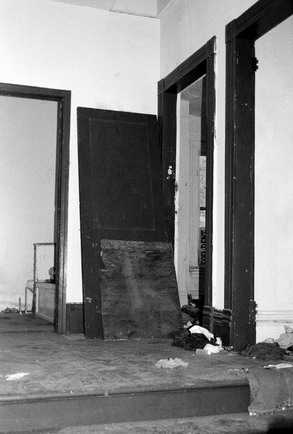 Or, I should say, jobs such as mine used to be. I’d like to relate that one day some dramatic realization hit me in some filthy home whose tainted atmosphere suddenly struck me deeply with a dire message. That would be interesting. But, I think, it was more a process of attrition, each “case,” wearing me down a bit more until all I saw was the utter futility and grinding isolation of lives that came to an end surrounded by useless bits of paper and plastic and not much else. We can’t always choose our fate but I’ve seen a lot of what happens when life is simply left to follow its own slow, sad course. Someone had better be at the wheel at all times. What I saw were lives and deaths empty of action or meaning. Finally, I couldn’t stomach the waste. I just had to turn away and find something better to do with my time.
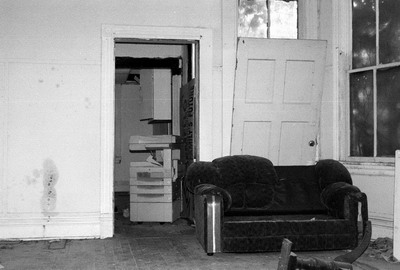
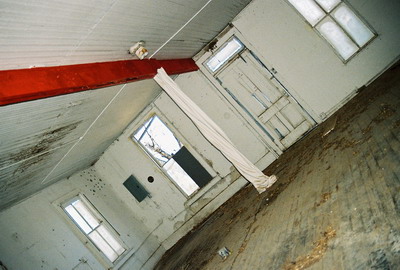
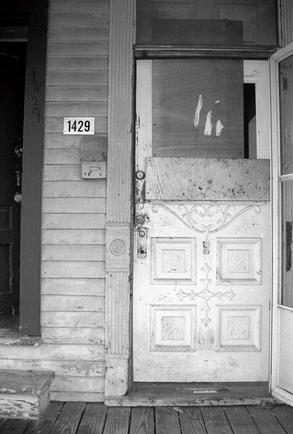
All the above photos were taken Spring 2010 inside three abandoned homes standing right next to each other in downtown Augusta, Georgia, USA.
I first heard of Willis Earl Beal through Found Magazine. Gracing the COVER OF ISSUE #7 was a flier Willis had made in an attempt to meet a “nice pretty girl” and inside was an interview with Willis himself. At the end of the interview was a note telling readers that if they wanted to see some of Willis’s artwork or hear some of his music they should e-mail Found Magazine. I was intrigued by the interview and, as Willis and I lived in the same town, I wanted to see what this guy was up to. So, I e-mailed Found and they told me they hadn’t actually received anything from Willis yet. Could I track him down, collect some of his work, and send it on to them? Well, sure, I could do that. After all, Willis wasn’t hard to reach; his phone number was on the cover of Found Magazine.
While walking home from work one day I gave Willis a call and told him that Found Magazine wanted me to send some of his artwork on to them. He said he had some CD’s with him right then and that we could meet at a nearby Wendy’s, where he was applying for a job. So, I turned around and headed over to the restaurant. I didn’t know if we’d have much to talk about. All I knew about Willis was what I’d read in Found: that he liked nighttime, oatmeal and heavily favored the music of Norah Jones. As it turned out, he also liked Werner Herzog, Bob Dylan and William Burroughs. Alright, then.
I took the CD’s home, not sure what to expect, and put one in the player. The first track I heard was “Blue Escape.”
Once Willis began singing, my first thought was, “I want to be in a band with this guy!” The music came across like a bedroom mix of Sam Cooke, Bob Dylan, the Dirt Bombs and Cat Power. So, I called him back and said I could play some drums, my girlfriend could play guitar, and he could obviously sing and write songs. Did he want to be in a band? Willis was up for trying something, but it took awhile for us to find a place to practice. Our first session was on a cold winter’s afternoon in an open barn, the snow-capped mountains of central New Mexico in the distance. It sounded good. In a short time we had a few tunes worked-out, including some from his home-recorded CD’s. One that Willis never seemed too keen on but that we pretty much insisted on playing was called “Monotony.”
Over the next few weeks we managed to practice once a week or so. We got a set together, booked a show, and got a lead on some recording time. The weekend before the gig we were set to rehearse but Willis didn’t show up on time. This was unusual. An hour later he called saying he was on the way to the airport and was flying back home to Chicago. He and his girlfriend had broken up the night before and he couldn’t stand being in New Mexico another day. He'd told his landlady to just throw all his stuff out. And that was that.
Who knows what might or might not have come of Willis’s songs? But we understood that he had to leave. And many of the songs he was writing seemed to be about his relationship; it would have been hard for him to keep singing them. It’s too bad we didn’t record anything though. My girlfriend and I spent a whole Saturday in thrift stores trying (and failing) to find a simple boom box. Even a practice tape would’ve been nice. Here’s one we eventually worked-up called “White Noize.”
Anyway, Willis is back in Chicago—hopefully writing some new songs—and I figured I’d post a couple of his tunes here on City of Dust. All three of these were from his original home recordings, mostly played on instruments he kept pawning. If anyone wants to hear more songs—and there’s a lot more—get in touch and maybe we can find a way to get them out to folks. Willis can sort of be found on FACEBOOK. But the best way to contact him is still to just give him a call. (UPDATE: Not anymore.)
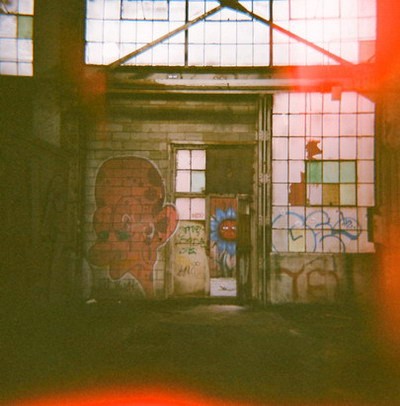
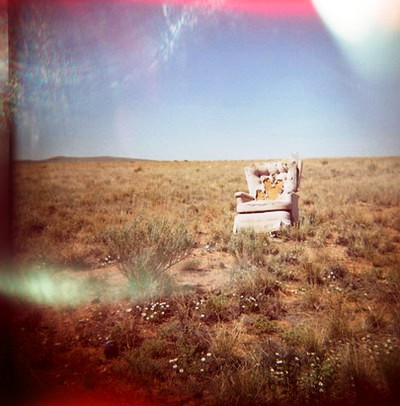
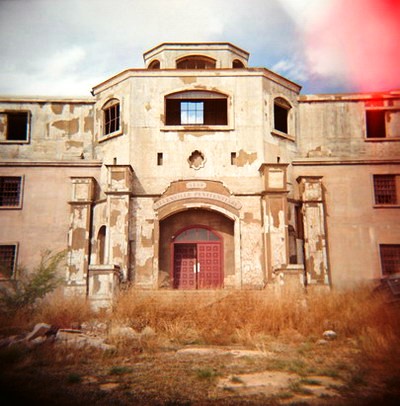
WOCA medium-format photos are from Albuquerque's West Mesa, the old SANTA FE PENITENTIARY, and the ALBUQUERQUE RAILYARDS, respectively.


