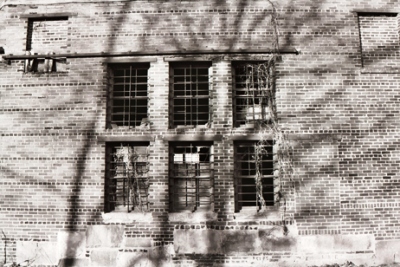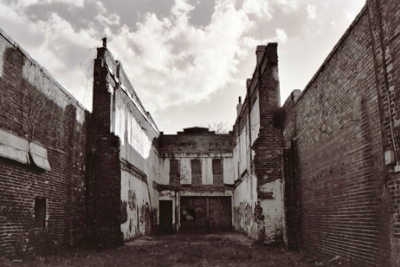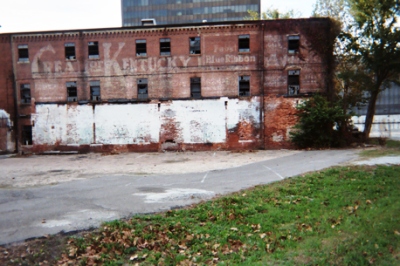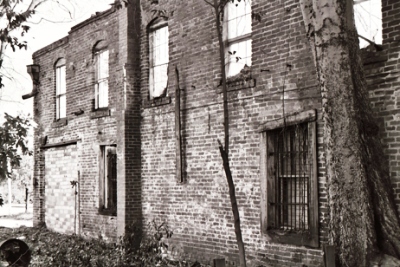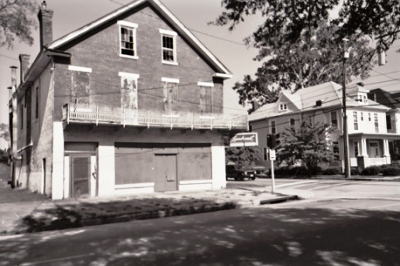
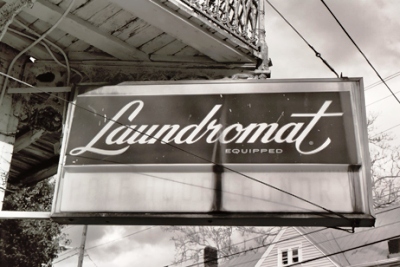
At the corner of Greene St. and 4th is this old laundromat/rooming house. Around the side are obscure painted signs indicating that everything from TV's to newspapers to fishing bait might have at one time been sold on the lower level. However, the top is a series of apartments configured in such a way as to make a person think this had once been a rooming house.
Normally sealed up tight as a drum, one day somebody thoughtfully kicked out the plywood covering the lower level entry.
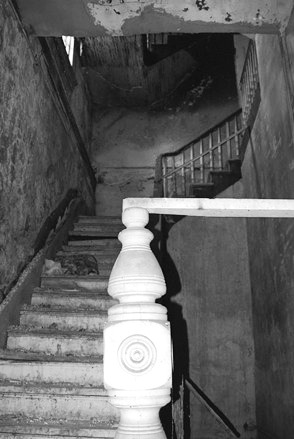 It took a few weeks for it to be sealed up again, but that was enough time to give it a looking over. As you walked through the doorway, this was the first thing you saw. Clearly, a dangerous wooden structure (rather than the preferred concrete or metal), but the stairs were very beckoning. I rarely explore alone, 'cause there's safety in numbers. But, also, it's useful to have someone around to run out and call 911 when their partner falls through the floor. That's a joke. Sorta.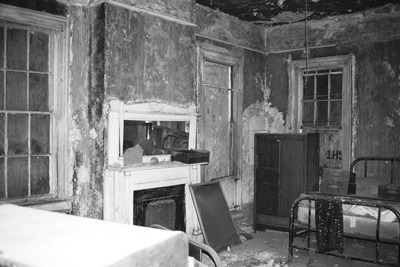
On the first floor were a number of apartments such as this one, most pretty much fully furnished. The rooms themselves seem to have been pretty nice, with real fireplaces and those windows would have provided great views of Greene St. The furnishings aren't exactly top-o'-the-line though and the rooms were all pitch dark. It was impossible to tell what was actually in the rooms until we saw the pictures, taken using a flash. There was an entrance to another entire section of the building on this floor, which would've probably more than doubled the size of this level, but we couldn't go through it as the floorboards were far too rotted out.
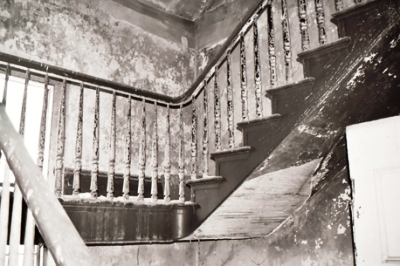 Next it was upstairs to the third floor. The stairs and walkways were some of the most interesting features of this building. Also, they were the most dangerous. You tread very gingerly on old wooden stairs, and even then you're never sure how solid the boards might be. After careful testing things seemed okay, so we continued.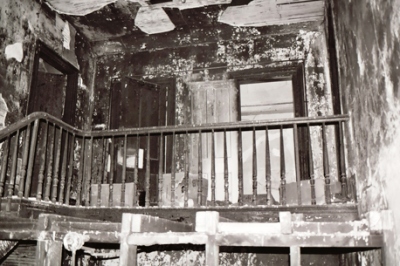
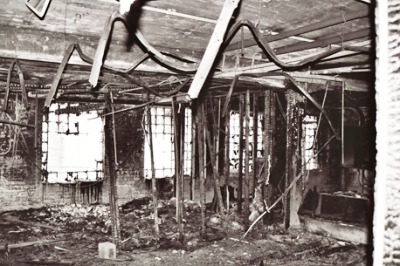
Above is a photo from the second floor landing. Yeah, that's fire damage, making things even more interesting. Also, this is where the pigeons were hanging out. There was lots of cooing and fluttering and, of course, lots of pigeon crap. Breathing the dust of pigeon droppings isn't so healthy, but by this point we were committed and, actually, there didn't seem to be much dust in the air. This was probably due to the size and variety of the holes in the walls and ceiling.
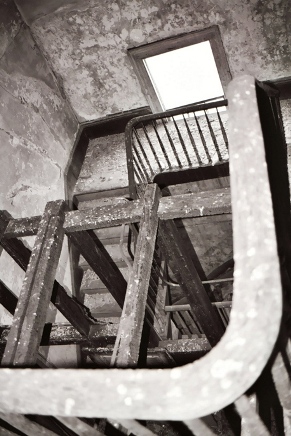 This is the view from the top of the stairs on the third floor. Again, these are really great stairs, eh? It must've been a pretty neat place to live once upon a time and I wish I knew SOMETHING about the building. But I don't. There was some train-hopper graffiti up on the third floor, so it's possible someone had lived here for a bit not too long ago. But this time there was no one home but the pigeons, who'd been busy roosting all over the place. From this angle, standing on questionable lumber, it's a long way down.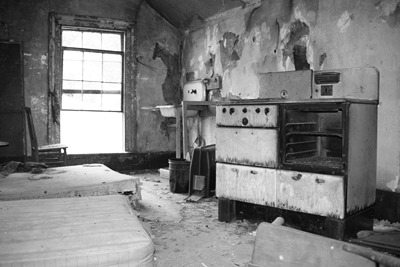
It's hard to tell if this attic kitchen was communal or if the stove in the photo above was simply installed in someone's bedroom, which is an interesting concept. Again, most of the furnishings were still in place, so people must've just walked away from a lot of their stuff. I don't know whether this would have been before or after the fire.
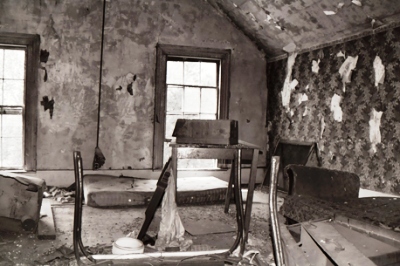
Another attic room offering a lovely view of the tree tops along Greene St. I wouldn't have minded staying here at all...about 40 years ago.
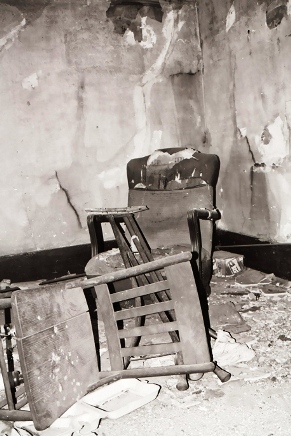 Dust, crutches, fallen plasterboard, and toppled chairs. It's the end of the line for this place, and probably, by this time, the people that lived here, as well. Shortly after our trip someone came around and put new plywood over all the windows and doors. What the ultimate fate of the house will be I don't know. Despite its previous glory(?), it's pretty much a total loss at this point. If the owner never physically tears it down it's probably just a matter of time until it falls to the ground all by itself.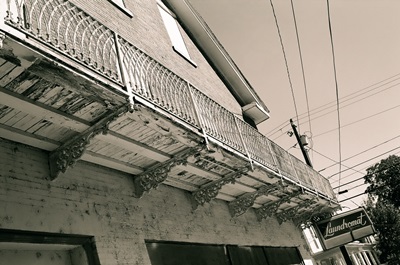
MARCH 2014 UPDATE: While doing some research for an exhibit and presentation at the 2012 Augusta Photography Festival I learned that this building at 401 Greene St. has long been known as Kahrs Grocery. On a 1904 Sanborn Fire Insurance Map the lot is designated as containing a store which also encompassed 403 Greene St. The upstairs must have been apartments even back then. A photo of the place apparently exists from the 1870’s and the building is believed to have been built by German immigrants before the Civil War, probably in the late-1850’s. That's much older than I had originally thought and REALLY COOL!
As of spring 2014, the Kahrs Grocery building persists, wounded but not yet beaten entirely.
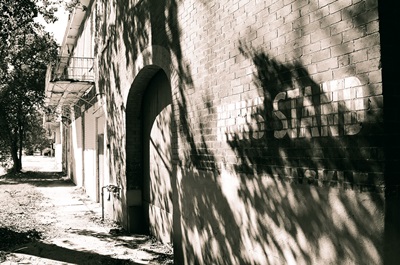
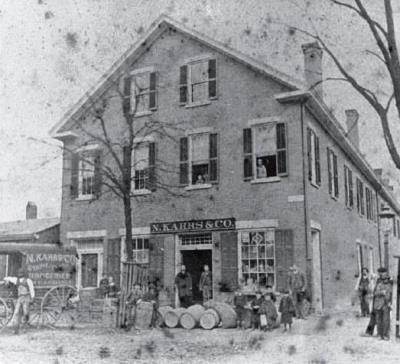
JULY 2014 UPDATE: I've now got a little more to add about the Kahrs Grocery story. The wholesale and retail grocery business was known as N. Kahrs & Co., established by Nicholas Kahrs in the 1850's. In 1881, Kahrs went into partnership with Fred Gehrken and Christian Richers, also German emigrants, and the following year he turned the entire enterprise over to them. But Kahrs was back in business by 1883, this time on Broad Street, most likely purchasing an alleyway and then adding some walls and a roof.
Kahrs, incidentally, was elected Police Commissioner of Augusta in 1885, at which time the Augusta Chronicle approvingly noted his success in business, adding that he was a "conservative, sagacious and popular citizen." He resigned in 1888, citing insufficient time to fulfill his duties. He did have ten children, after all. Nicholas Kahrs died in 1905, the Chronicle stating that "Mr. Kahrs was well known and his funeral will probably be largely attended."
Many thanks to Nick Kahrs, Nicholas Kahr's great, great grandson, for providing all this new information, as well as sending along the fantastic photo below, taken in the 1860's. Compare it to the photo at the top of this post to see about 140 years pass before your eyes. I believe the original resides with the Augusta Museum of History.


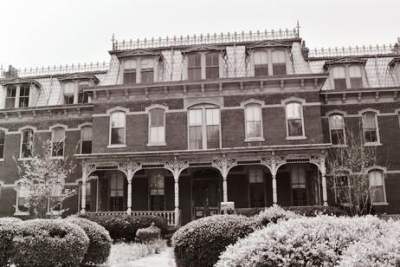
 By the time you get to the end of Greene St., where it "T's" into East Boundary Rd., there's not much going on. Random historical fact: The de Laigle House, on the western side of Greene St., is where the final person to be killed in a duel in GA died. Charles Tilly died a day after defending the honor of the young Mary de Laigle at Sand Bar Ferry, right off the river on the SC border. Apparently Sand Bar Ferry was a major duelling ground, but this one, just before Christmas in 1875, was the last. Charles Tilly is said to haunt the house, which looks like the Addam's Family home.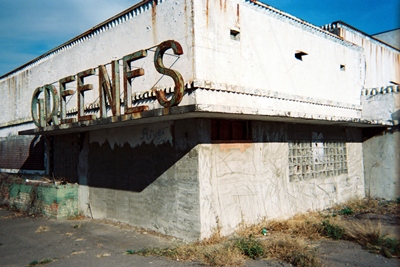
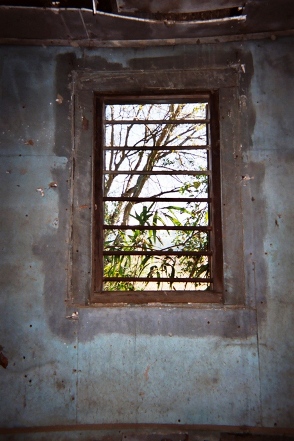 Okay, part two of Augusta's Phinizy Swamp. Right as you leave Lover's Lane and head into the swamp you come across a small old house on the corner. Actually, if it's summer you probably won't see it as it completely disappears into the vegetation. It takes some work to get into even in the best of circumstances since you have to cross a ditch that's sometimes full of water, snakes, bones, etc. But, once you get inside you're in what was probably a pretty cozy little farm pad. There's a brick fireplace and the walls are all painted this dark blue. This photo is of the view out the back.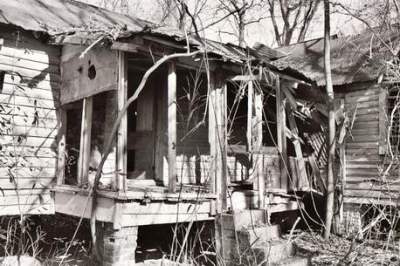
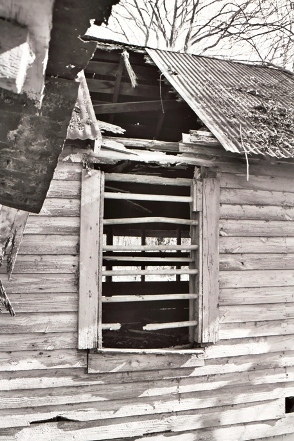 has probably had chiggers, which leave little red, swollen bumps. My worst episode left me with about 50 bites and three sleepless nights. Afterwards, I found out that the best way to get rid of chiggers is simply to wipe yourself down with a towel after you've been in a potentially chigger-infested area. Apparently there's about a 1-2 hour window before they actually bite you. That was great to read as I was desperately trying not to scratch the things. Problem is, it feels REALLY good to scratch 'em. As an associate of mine said, scratching them is "equisite." I'm afraid it's true, and once you start you can't stop.
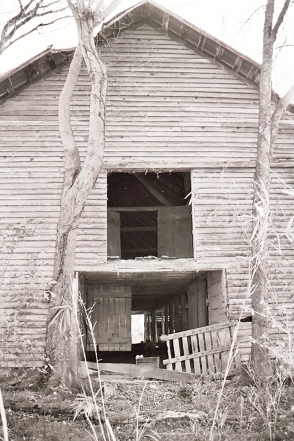 Just adjacent to the farmhouse is this massive barn. The swamp is fast reclaiming the land that isn't being actively bulldozed and it's hard to imagine someone trying to farm, let alone graze cows or ride horses, anywhere around this barn. Around the side, if I had a shot of it, you could see the massive trees that are slowly crushing the eves along the roof, a testament to how old the barn really is.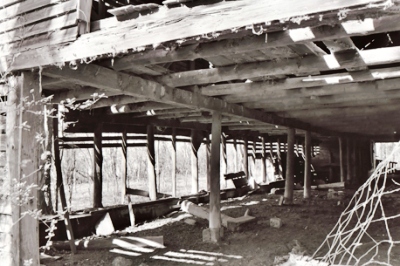
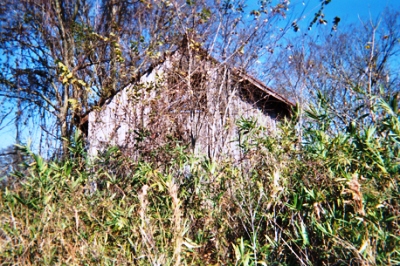
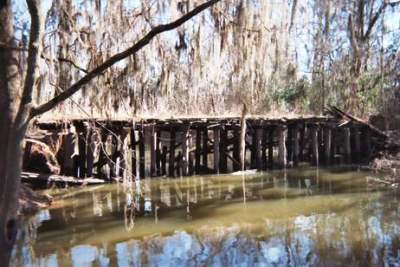
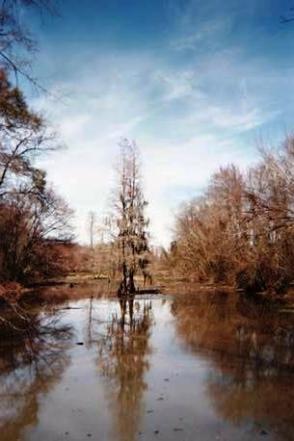 I like swamps. I like them a lot. In fact, I've even parlayed my enjoyment of swamps into a career of sorts for the last eight years, if you include a stint in grad school. Augusta has a nice swamp in the form of the Phinizy. I'm not positive, but I have to assume the Phinizy is named after John Phinizy, the first Italian-American mayor of an American city. He became mayor of Augusta way back in 1837. I suppose it's possible the swamp was named after other Phinizy's, like Jacob (John's son, I believe), who had something to do with the railroad. But as there appears to be literally no information anywhere about this, I'll go with my story.
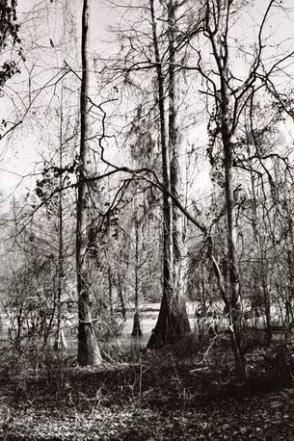 (that's Taxodium distichum L. if you're into scientific nomenclature). The most intact remnant is partitioned off as the Phinizy Swamp Nature Center and has trails, an interpretive center, and nature programs. You can find more information about the nature center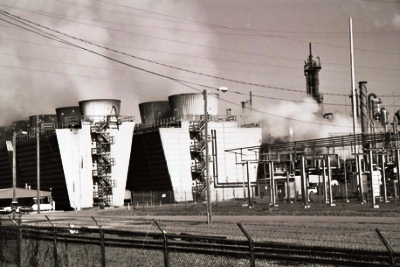
 The periphery of the swamp (and maybe a large part of the swamp itself) is/was farmland. Some of the land looks to be abandoned and chunks have been reclaimed by mother nature. On a few tracts just beyond the swamp you might see a lonely tractor tooling around and, cutting through one section, there is what appears to be serious road construction. I don't know what the plans are or if the construction will be the death knell of a large part of the swamp, but I can tell you that the work isn't moving very fast.
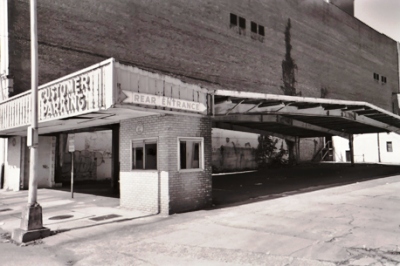
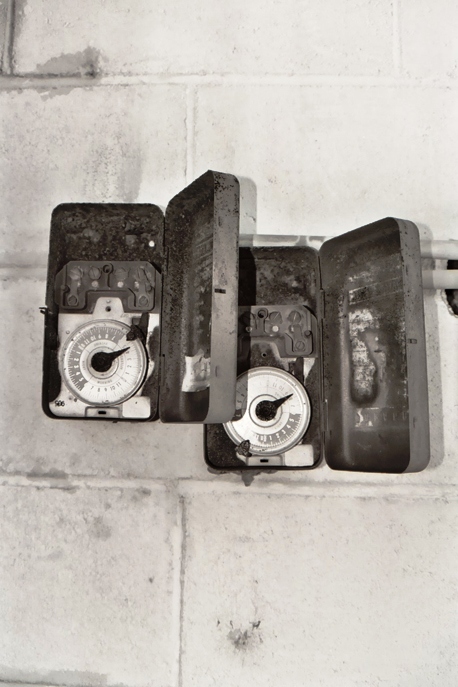 Also in front of this lot is the Miller Theater (a great looking movie theater that I'll get to later) so maybe theatergoers parked here before seeing a film. In any case, it's been awhile since these timers have been used to stamp any tickets.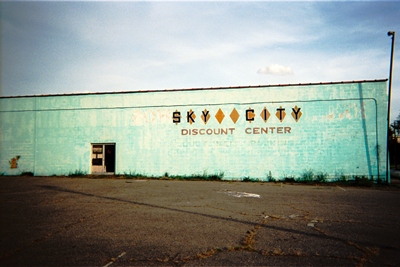
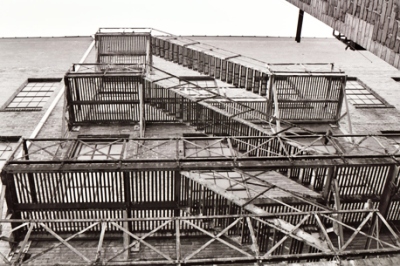 Lots of these old buildings have rickety fire escapes. I've never tried climbing up one since I've got pretty poor health insurance, but they always looked inviting. This one is just down an alley and monitored by video surveillance for some reason. Maybe the pigeons are plotting something.
 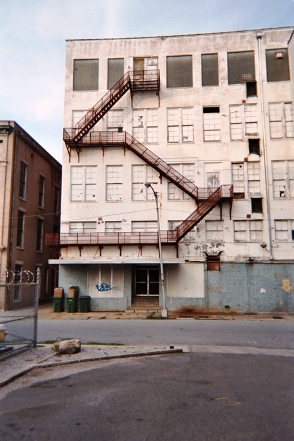 This fire escape is behind the former J. B. White's Department store. Not shown is the neat skyway running across the street from White's a couple stories up. Apparently this is one of the only parts of the building to actually be fully restored as it was being prepared for condos. Interesting choice, since the skyway appears to go into another empty building. These days you don't see many buildings decorated with those little square tiles people used to put in their bathtubs, but all that blue and white along the bottom of the building is just that. They probably had sheets of the things to make installation easy, but I prefer to picture some guy sticking each one on by hand.
 munitions to the Confederate army than any other city. The construction of the Augusta Canal later ensured that the city became a center of industry when it could have been forgotten as the agrarian way of life died a slow and painful death. Following years of tobacco and then cotton cultivation, both crops that strip the soil, farmers were being forced to abandon their land and the city's prospects might have been dim. But the canal provided access to and from the Savannah River, not to mention power, creating just the right environment for textile mills to spring up throughout the city and greasing the wheels of venture capitalism. I'll get into the canal and the mills of nearby Horse Creek Valley later.