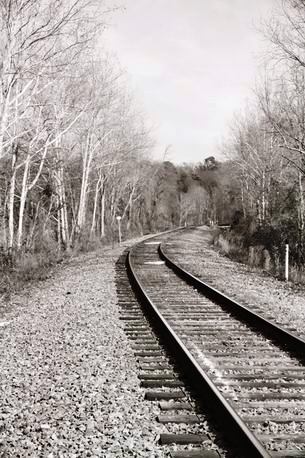
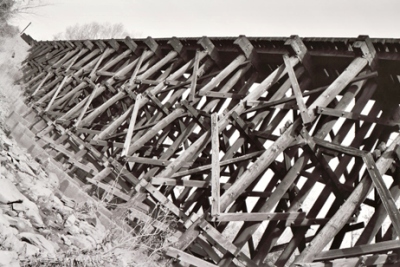
We already know about the short rise and long fall of Hamburg, and we know about the bad things that happened there. We know that Hamburg's founder, Henry Shultz, eventually tried to kill himself. We know that the Hamburg Riot played a key role in the election of Governor Wade Hampton III, the "Saviour of South Carolina," who'd been called "a veritable god of war" by a fellow Confederate soldier, and whose campaign against the policies of Reconstruction had been met with "something akin to religious ecstasy," according to historian Walter Edgar. We also know that the little that remains of Hamburg is also pretty spooky. But, the Hamburg-Charleston Railroad was undeniably a good thing for the whole country. Although, characteristically, the railroad sealed the eventual doom of Hamburg and at least one person was killed by it in spectacular fashion. This is not a picture of the Hamburg-Charleston line. In fact, it's the trestle below the aqueduct by the Augusta Canal. Sneaky of me, I know.
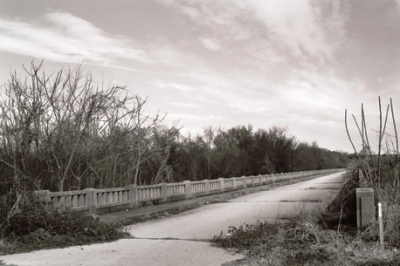
In the 1820's, during what might have been the first economic recession in US history, the politicians of Charleston, SC, were trying to find a way to get more trade into and out of their city. Charleston, of course, is close to the sea, and in those days was isolated by countless swamps, rivers, pine forests, and muddy wagon trails. It was said to be easier to get to Philadelphia from Charleston than it was to get to the towns of northwest South Carolina. The businessmen of Charleston wanted easy access to Augusta, in particular, where the Savannah River was a major conduit of trade. So, in 1827, it was decided that a railroad would be built between Charleston and Hamburg, a boldly brazen and brash move. This railroad would be the first steam-powered railway in the country. At 136 miles long, it would also be the longest railway in the world. The photo is of an abandoned bridge off the Aiken-Augusta Highway in the area of old Hamburg. Just beyond the bottom left of the frame is the spot where a kidnapped man was burned to death in his car. Pleasant.
By the time the line reached Hamburg on October 3, 1833, the Baltimore and Ohio Railroad, which was also attempting to get a steam-powered train up and running, had only completed 13 miles of track. But not everyone was excited about the railroad coming to town. One prominent landowner in Barnwell, SC, refused to allow the train to pass through his town at all as he had adopted the strange notion that the machine would kill his slaves.
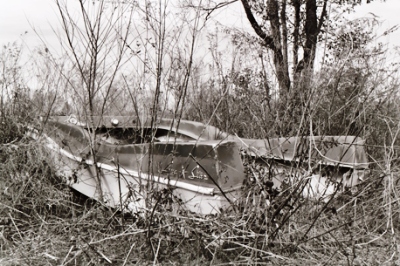
After an early trial run, an observer had this to say about the Best Friend of Charleston: "(The engine) flew on the wings of wind at the speed of 15 to 25 miles per hour, annihilating time and space...leaving all the world behind...and landed us all safe at the Lines before any of us had time to determine whether or not it was prudent to be scared." Uh, okay then. However, the train proved to be unstable at "high" speed and a 10 mph speed limit was imposed for the sake of safety. And, as it happened, it WAS prudent to be scared. The Best Friend of Charleston exploded not long after, killing the fireman, scalding the engineer, and sending locomotive shrapnel all over the countryside. The train had yet to get 10 miles outside of Charleston. But there was no turning back. The usable bits of the blown-up choo-choo were collected and a second locomotive built, the aptly-titled Phoenix. Once the line was complete, the Charleston-Hamburg Railroad was the first line to offer scheduled passenger service. It was also the first line to carry the US Mail. And Branchville, SC, became the first railroad junction in the world. That's a lotta firsts. This is a beached boat on old Hamburg land, just along the Savannah River, fast being covered by an upscale housing development.
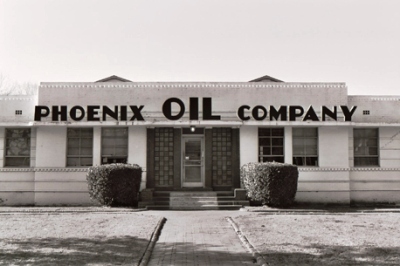
Originally, the Charleston-Hamburg Railroad was supposed to go all the way to Memphis, TN. However, it never really made it past Hamburg. In fact, it was difficult to get the line extended to nearby Columbia, SC. When a line was finally constructed to Columbia from Greenville, it meant trouble for Hamburg. When a depot was finally built in Augusta in 1852, it meant the end of Hamburg's importance as a railroad town altogether. It also meant the beginning of a long slide into obscurity. Incidentally, the route to Memphis was not completed until 1858. This is a random shot of the Phoenix Oil Company, probably not named after the locomotive, but a nice example of the Art-Deco influence that's still to be found around Augusta, tucked into forgotten corners.
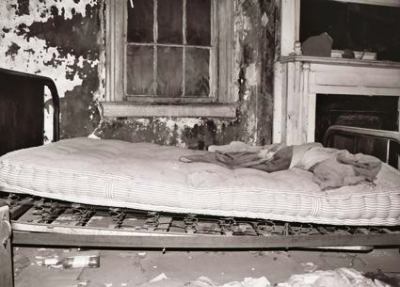
In the 1980's, folks put together a little celebration of the Charleston-Hamburg Railroad, even going so far as to give people rides on a replica of the Best Friend of Charleston. But, after a century-and-a-half of continous service, this publicity push was the end of the line, so to speak, for the original railway. By the mid-1980's, a large section of track from Branchville, in the middle of the state, to Aiken was abandoned. The line from Augusta to Graniteville does still operate (on which a train just derailed), with disastrous results), and the first photo of this post is of part of that stretch (I think!). The picture shown has nothing to do with trains. It's an outtake from the Rooming House. When I first stuck my head around the door I saw something black and furry scamper across the mattress and off into the darkness. Aw, cute, a rat. Note whiskey bottle under bed.
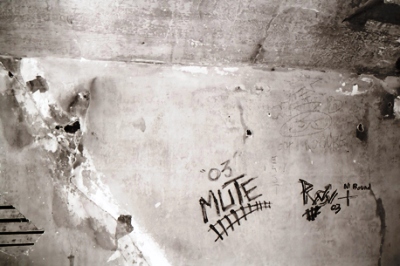
I got my info for this post from a variety of sources. One of the best was a now-gone site on abandoned railroads. A second was a page off the Henry Shultz and Hamburg, SC website. The photo here is another from the Rooming House. That's real train-hopping hobo graffiti on the wall of a third floor bedroom. Whenever I'd get stuck at the tracks down on Laney-Walker I'd assuage my annoyance by looking for the hobo graffiti on the sides of boxcars. Here are some great photos, none of which are by me.






 In 1829, the voting rights of poor Irish peasants were rescinded. Here's what Richard Pearce said: "No longer politically useful and unable to pay rent, the cottier peasant and his family were driven from what little holdings they had and literally placed on the ship that was to carry them on one of the most extraordinary migrations in history. To understand the scale of this social upheaval, for example, during just three years from 1849-51 over a million persons were evicted by Irish landlords. To these vast numbers of newly dispossessed families, the destination mattered little. For Irish immigration during these terrible decades was an exodus, a flight. Oscar Handlin, the noted historian of Boston's immigrant population, quotes The Cork Examiner: 'The immigrants of this year are not like those of former ones; they are now actually running away from fever and disease and hunger, with money scarcely sufficient to pay passage for and find food for the voyage.'" This explains all the Irish graves in Magnolia cemetery (see:
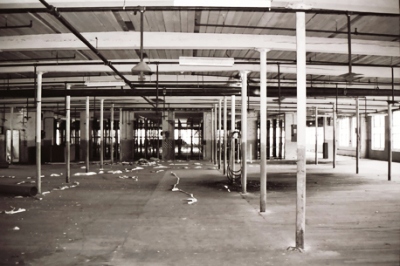

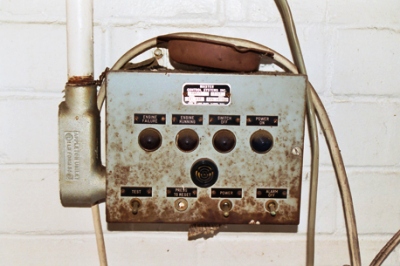
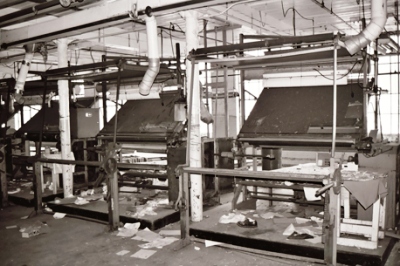
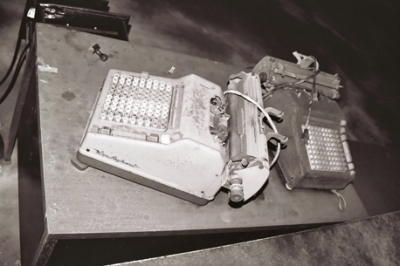
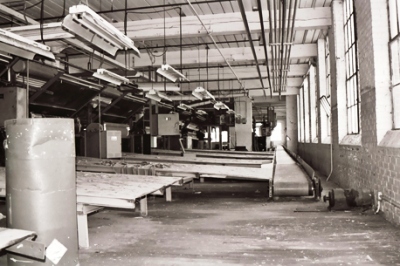
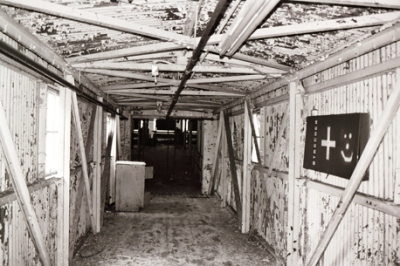
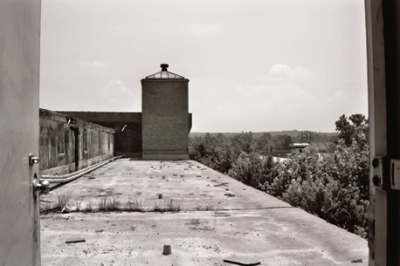
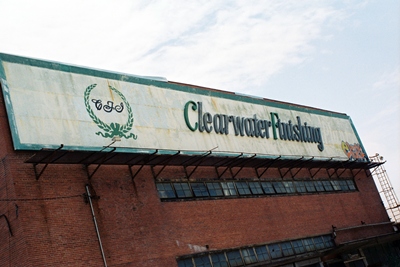
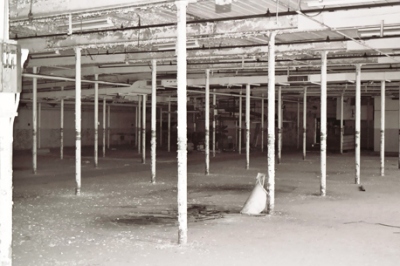
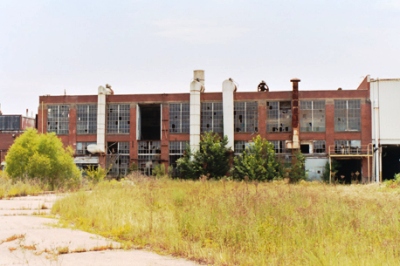
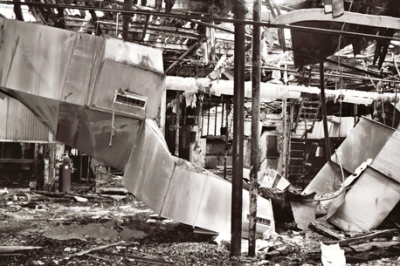
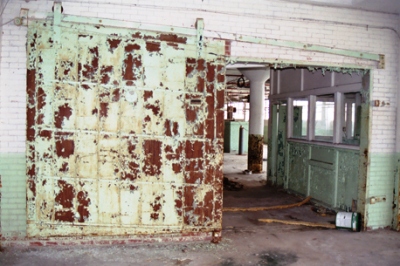
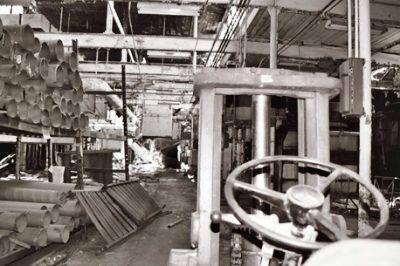
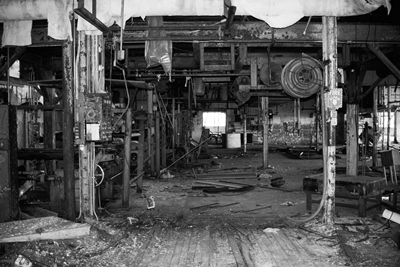
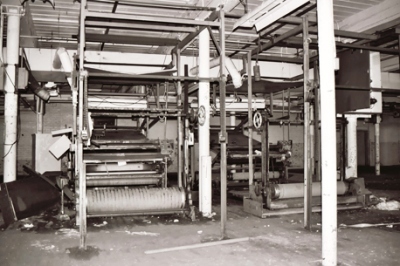
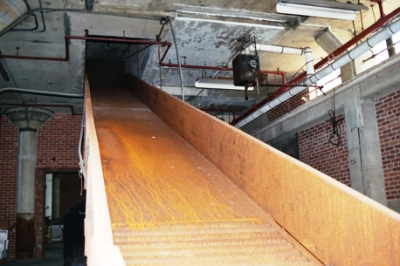
 In one section of the mill thousands of pieces of ancient computer equipment were strewn all around, some of it brand new. If you're looking for giant floppy discs, punch-card readers, and obsolete monitors, the plastic casing yellowed and coated in dust, well, it's out there. Elsewhere, old adding machines, rubber stamps, and discarded reams of fabric were lying on desks and stacked on shelves.
 One of the great things about those old newspaper photos is that nearly all the photgraphers used the Speed Graphic camera, first manufactured in 1912. The Speed Graphic is that classic black box camera with the bellows and a couple lenses and a huge flash. That camera, particularly when used with a flash at night, lit up the foreground, but threw long, dark shadows into the background, which went to black. Thus the shots are very striking and even mundane pictures can appear powerfully stark. Try doing that with your digital! By the mid-1960s, of course, small 35mm cameras were becoming popular and the last Speed Graphic was made in 1973, the year I was born.
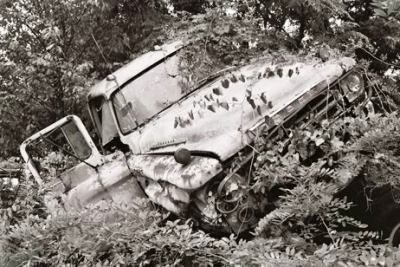
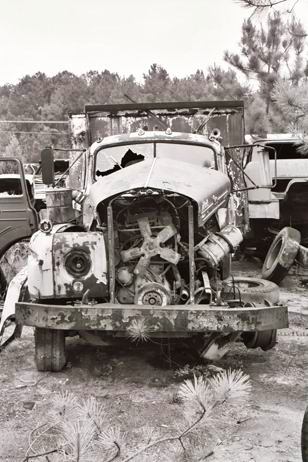
 Taking to the road in South Carolina is a bit like playing Russian Roulette. I recall hearing that at one time Aiken County had the highest per capita auto accident rate in the US. I don't doubt it. As a result, there's lots of smashed cars around. There's a huge junkyard in a forest outside Aiken that is full of cars dating back to the 1930's. However, I never went to check it out because it just didn't seem like a good idea. In the South, in particular, you'll find that people are very protective of their property. When someone threatens you with a shotgun if you don't get off their land, they're not just trying to scare you. You better leave. Quickly. On the two occasions that I've been confronted it's seemed questionable to me whether the angry citizens I found myself dealing with really owned the property I was on or not. If they did, why would they admit it? Yeah, I know, a lawsuit. Still, they should have been embarrassed. Both were rotted eyesores off busy highway intersections. In any case, it's always best to play dumb and polite and make a hasty exit.
 "All progressions from a higher to a lower order are marked by ruins and mystery and a residue of nameless rage"-Cormac McCarthy, "Blood Meridian." "Blood Meridian" is a brilliant, bloody novel about, at least partially, how a proximity to sustained violence can result in deep disaffection, putting the participant at a remove from civilized society in a way that is real and possibly permanent. The book is like Apocalypse Now set in the desert of the West around 1850. In the mid-1990's, Vietnam Vet Bill Shields wrote three books of powerful poems about the difficulty soldiers have reintegrating. It's something to think about right now.
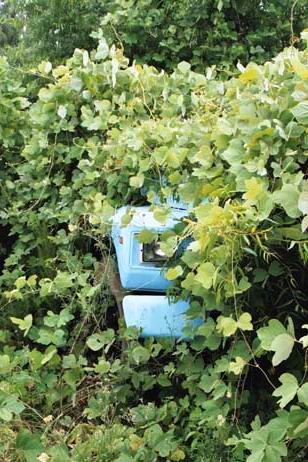 A kind reader suggested that some of the places featured on this site be GPS'd so that they can be revisited. This is a good idea and it'd be especially interesting to go back to areas that will be demolished, such as the brick factory, and see what was built there. You could then take a photo and say, "Where this $200,000 townhome is there used to be a brick kiln." I might be able to do this on a return visit to the area, but if anybody else down there wants to try let me know. I'll only send you on safe and lawful excursions. But watch out for the kudzu. See ya next time.
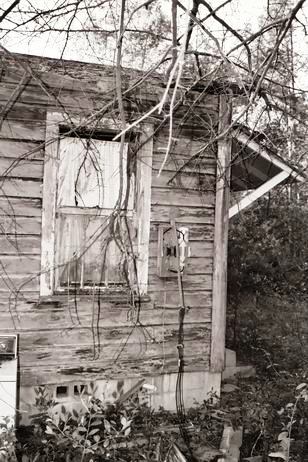 By the summer of 1876, Hamburg's prosperity was on the wane (see:
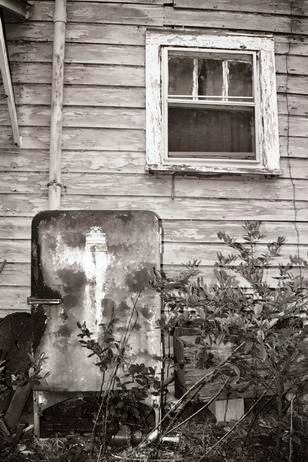 The next day the two farmers went to the courthouse and demanded that the militia captain be arrested. The captain thought this was absurd, said as much, and was then ordered to stand trial for contempt of court on July 8, 1876. The members of the black militia gathered together in town, refusing to disarm. Some fighting began whereupon the white citizens recruited 100 men from Augusta and returned to the scene with...a cannon! After nightfall the militia men tried to escape, but 25 were captured and one killed. The following day, up to eight more captives were brutally murdered and the homes of the black townspeople were looted. The number of African-Americans killed seems to vary from 6 to 9, but everyone agrees that during the looting one white man was killed. This was probably not what Joe Strummer had in mind when he called for a white riot exactly 100 years later.
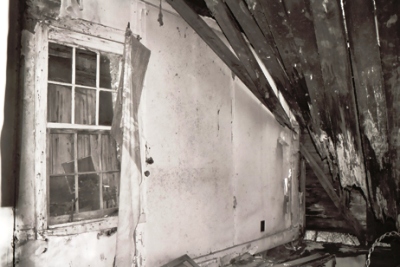
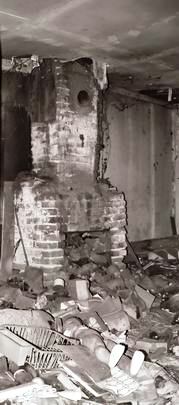 Benjamin Tillman was one of those guys that made an entire political career out of being a complete prick. There sure have been a lot of them. He was present at the Hamburg Riot and instrumental in spreading the intended "message" of the event to citizens of both colors. Initially the commander of a paramilitary unit called the Sweetwater Sabre Club, Tillman became Governor of South Carolina in 1890, in which office he was heralded as the "Champion of White Men's Rule and Woman's Virtue." In 1894 he joined the US Senate and remained there for 24 years, making a run for President in 1896. And all of it can be traced to the popularity afforded him by his involvement in the Hamburg Riot. The guy has said so many mind-bending things it's tough to pick quotes. But how about this, concerning the riot:
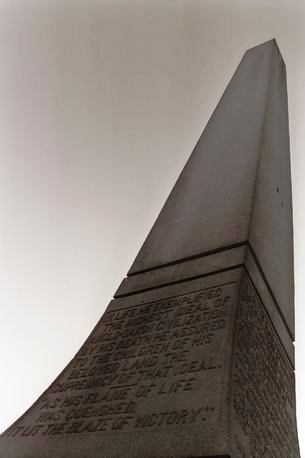 In the center of North Augusta there's a monument to the Hamburg Riot. Only, it commemorates the single white victim, whose name I've forgotten. Meriwether something, I think. It reads: "In life he exemplified the highest ideal of Anglo-Saxon civilization. By his death he assured to the children of his beloved land the supremacy of that ideal. 'As his flame of life was quenched it lit the blaze of victory.'" Now, I would just like to say, the Hamburg Riot was a long time ago and you'll find racists everywhere you go, as you'll find people that couldn't care less about skin color. This is not an indictment of southerners or their culture, only a glimpse of an ugly footnote in history. And there's plenty of ugly history to go around. Now the monument on the other hand...
