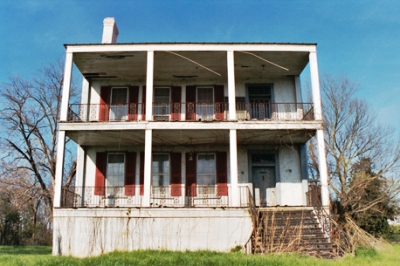
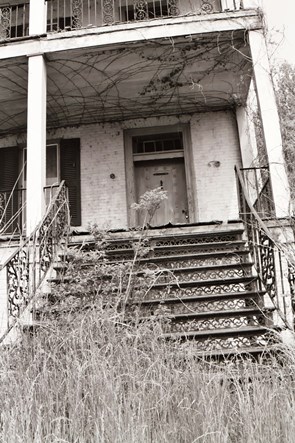
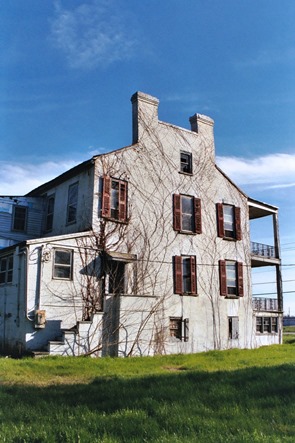
On the east end of Sand Bar Ferry, right by I-520, sits the Goodale Inn, formerly the head house of the Goodale Plantation, and built in the Federal style. Also known as the Hampton House or the Fitzsimmons House or some combination of the above, it was built in 1799. That makes it one of the oldest buildings in Augusta and it's on the National Register of Historic Places. Naturally, it's vacant and has been for some time, possibly because its nearest neighbor is the Columbia Nitrogen plant. See "Swampland" for a glimpse of the adjacent industrial landscape. On the other hand, it is offically for sale and occasionally there seems to be some work going on inside. At least, there's often a light left on. Yeah, I know. Ghosts.
Given its long history, the Goodale should be haunted. Dr. Paul Fitzsimmons Eve, an early Dean of the Medical College of GA, occupied the house while he lived in Augusta, from the early 1830's to 1850.
 Eve was a participant in the Paris Revolution of 1830, served as a soldier and surgeon in the Polish Rebellion, and was a doctor for the Confederacy. He was also known for his hard stance against mesmerism. (The 18th century method of faith healing involving hypnotism and magnets pioneered by Dr. Mesmer, friend of Louis XVI and Marie Antoinette.) The Polish government eventually erected a statue in Augusta in his honor and put him on a stamp (for his role in the Rebellion, not the mesmerism thing...).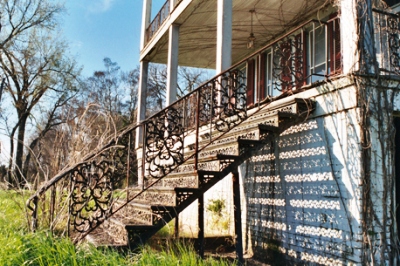
As far as I can tell, the "Hampton" of Hampton House refers to Wade Hampton III, a Lieutenant General in the Confederate Army and later Governor of South Carolina. Hampton was 42 when the Civil War began and took over the Confederate Calvary Corps at the behest of Robert E. Lee when JEB Stuart was killed in 1864. Hampton carried a four-foot long double-edged sword and on one occasion is said to have split a Union solider's skull to the chin with a single blow. After the war he told Ulysses S. Grant, "If we had known that you were going to back with bayonets the carpetbagger, the scalawag, and the negro in their infamous acts, we would never have given up our arms!" He was called the "Saviour of South Carolina" for railing against the policies of Reconstruction. Later, upon his death bed, in 1902, his last words were reportedly, "God bless all my people, black and white." Such is the conflicted history of the South.
I don't know much about another resident of the house, Jonathan Miller,
 other than that he was Surgeon General of the Army of Tennessee. In the 1970's the house became a dinner club, sometimes featuring musical acts, run by a Mr. and Mrs. Harris. Word is that they made a mean beef stew and served A-1 prime rib. After that, it appears that some private owners occupied the place. I don't know when they left, but judging from the various debris lying around it was inhabited into the 1990's.
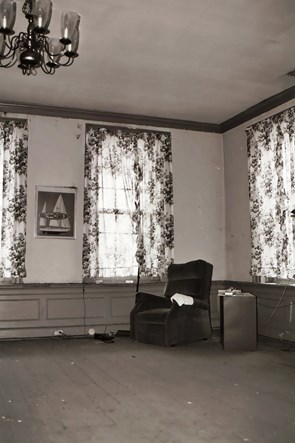 As I mentioned, the Inn is for sale (a steal at $129,500) and I wouldn't recommend that folks go into it for a variety of reasons. Yup, do as I say not as I do. But, if you want the best reason not to go in, it's this: It's boring. You'd think that a plantation house built in 1799 with 5 fireplaces and 10 rooms would be cool. Well, it's not. It's a bunch of square rooms, each featuring various amounts of dusty and dilapidated furniture. Trust me, I checked all three floors. Even the attic (a 200+ year-old attic!) was uninteresting.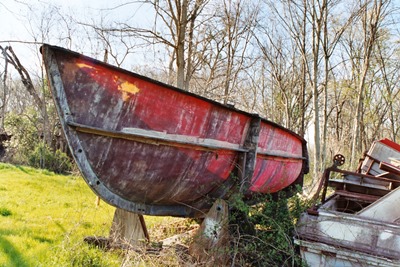
In back of the house are a bunch of abandoned boats. There's at least three, if I recall. The river is just over the levee, at the back of the yard, but then you'd have to go through the condos on the other side to get to the water. The builder of the condos must have been pretty confident about modern river control, I guess.
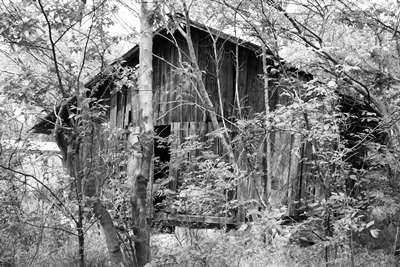
Next to the house are some old shacks. Right as I began to explore them my companion began having a severe allergic reaction on account of the Goodale's unmowed yard and waist-high grass. I wasn't about to miss a good shot just 'cause he couldn't breathe, so I looked around for a bit.


21 comments:
I can recall, some years ago now, the remains of a steamboat on the property. I would imagine with dedication and the correct tools, some trace of it can be found, obviously placed there before the levies were built.
It is a shame that the people of Augusta just allow these historic buildings to rot away like this.This would never happen in Savannah.
What's the state of the Goodale Inn? Anybody know? Last I knew it was being "renovated." Is that still happening or did they give up? That was years ago. And, yeah, Savannah is pretty good at protecting their buildings, especially ones built in the 1700's.
Starting around 1971 or 72 (before the resturant) it was actually a school. Grades k-12. I went to High School there. It was called "Our School" and was patterned after Summerhill in England - what was known as a "Free School". Just thought you might be interested.
Wow, I had no idea it was ever a school. There's no information on that anywhere. Thanks for passing that on. It must've made for an interesting school, being a couple hundred years old and all.
Anyone know what the current state of the Goodale Inn is? I haven't seen it in about 5 years.
My husband and I visited the house yesterday. We peeped in the windows. Loved the house. Seems restorable. Great price. I would assume that Augusta has an historical society; why don't they take on the project. Funds can be raised and since it is on the National Register I would think that grants can be obtained. It is such a shame that the house just sits there.
It's for sale again?! Or maybe it's just been for sale continuously since 2004. Strange that an historic house, built in the 1700's, would languish like this one. Then again, maybe not so strange. I'm certainly not holding my breath for a thorough restoration.
Anyway, thanks very much for the update.
In 1950 my grandparents ran a boarding house on Sand Bar Ferry Road. My childhood memory of their place makes me wonder if this could have been the same house.
While there's no documentation that I found of the Goodale Inn having been a boarding house, that doesn't mean it wasn't one. Most of the history of the inn has vanished, including the period of the 1950's and 1960's. The inn would certainly have made an excellent boarding house, so...maybe. Can anyone out there confirm or deny?
Thanks for your comment, Debby.
well the side of the house has fallen so who knows what will happen to it but its ashame i pass it every time i go to Augusta
The side of the house has fallen down?! You've got to be kidding me. A house built in 1799 is just left to collapse? Not good, Augusta.
Well, thanks for the update, dreary though it is.
Hey y'all! I just drove by the building today and there was a huge sign on the porch that said " Save the Goodale...find us on facebook" so I did...you've got to check it out as there are tons of photos...BTW, the place is being restored... I also found it interesting that there was a Paranormal Investigation done in Sept '10 with very interesting findings!
Wendy in Beaufort, SC
Thanks for the message, Wendy! I did find them on Facebook and I'm really happy someone is restoring the place. Hopefully they're successful in their efforts and the Goodale Inn will once again be put to good use.
JM
My name is Josh and I am with South Coast Paranormal Society. We are the team that did the paranormal investigation on the location. What a great location and yes it is haunted. We collected alot of evidence. We are currently working on restoring the house and making slow progress. We will get her back to her old self after lots of work.
Ah, that's you guys that are doing the restoration! Very cool. It was a shame that the house was going to ruin and I'm glad you're putting a stop to that. I'm sure it is very hard work. I should say that seeing photos of the rooms without any junky furnishings in them on the Goodale Inn's Facebook page made them look WAY more interesting. I feel bad for saying the rooms were "boring" in the post. That was my mistake. Of course, the house as a whole and its history has always fascinated me.
Best of luck and...any new ghost tales to tell as restoration has progressed?
Thanks for the comment.
JM
Look up our website. www.southcoastparanormalsociety.com for our past investigation. It was also featured in the Augusta Chronicle. The most recent one is of the upstairs door that opens out onto the upstairs front porch. Now as the story goes this door is constantly being found open when no one has been in the house. We have blocked it in the past only to return and find it open again. I know for a fact that only two people have keys to the home. Myself being one of them and my partner and founder of the paranormal team the other. We now have the door pressure blocked. Since I originaly blocked it in this fashion the door has ceased to open by itself. Although something did happen. From the inside, the middle pane of glass in the door was broken and blasted out onto the porch. No one has been in the house. We have documented it and will soon be on the website. If you would like any more info, I'll be happy to share.
ghosthunter247
You were completly correct in saying that the rooms are boring in the home. Whats not boring is seeing how the house was made. Its amazing how many nails are in the ceiling alone. The whole foundation was built on river bricks. Unfortunantly they are turning into the finest brick dust you have ever seen. The heart of pine floors are held together with wooden pegs. All in all, its turning out not to be as boring as what you see with the naked eye.
ghosthunter247
Well, you did get a nice shot from the top of the stairway and some good fireplace photos. With old reclining chairs and plastic storage bins in the way I couldn't get many interior photos I was happy with. I do have some interesting outtakes, including one of a mounted snake. I don't know if those were old home furnishings or what.
I bet that 18th Century construction *is* yielding some interesting features. The foundation of river bricks sounds very cool...too bad they're disintegrating.
Wow, a door window blown outward is pretty dramatic. I used to drive by there everyday and sometimes that upstairs light was on and sometimes not. I always figured someone was squatting the place, but when I went in I saw that the interior wasn't vandalized in any way, as I would've expected with squatting. That was a nice surprise.
Thanks for all the info. I hope the restoration continues to move along. It's too historic a structure to just let tumble down. Keep up the good work!
John
As of today, November 2, 2013, the man that bought the house for less than $20,000 still has not done any renos. It is in jeopardy of being demolished. Very sad story. http://m.chronicle.augusta.com/news/metro/2013-11-01/augustas-goodale-house-facing-demolition
Thanks for the update, Dee, even if the news is bad. Perhaps Historic Augusta can rally some support. The Goodale Inn really needs more money and attention than it seems the current owner can provide. JM
It has been demolished.
Post a Comment