The train from Zagreb passes through a landscape that seems unlike anyplace else I’ve visited in Western Europe. I don’t recognize the names of towns to come: Velika Gorica, Banja Luka, Maglaj, Visoko. Shortly after leaving the station most signs are in Cyrillic only. The door to the train compartment is thrown open by a man in uniform. We’ve reached the border with Bosnia-Herzegovina. I feel strangely intimidated during an exchange which requires no speaking on my part. After a moment he hands me back my passport. “Hvala.” Thank you.
Beyond the train, old women work dry fields, sowing seed by hand. Thin, leathery men rake and hoe beside them. A goat or two meanders around a yard. A river runs alongside the tracks and the rocks and branches are hung with thousands—perhaps millions—of plastic bags, representing all the colors of the rainbow. However, I notice that most are blue or yellow. Bags way up in the brush along the bank show the high water mark. Sometimes there are signs warning of landmines and buildings pocked with the scars of artillery fire.
The attendant from passport control has been looking closely at the identification of the man on the other side of the compartment. The attendant turns and asks me something but I don’t understand. He sees this and laughs. “You are okay,” he says, pleasantly. The man across the compartment smiles and winks at me as he is handed back his ID card. “Do viđenja.” Good-bye.
 Bosnia-Herzegovina is a land marked by war and Sarajevo, its capital city, reflects this history. Near the city center is the bridge where Franz Ferdinand, heir to the Austro-Hungarian throne, and his wife, Sophia, were assassinated. Shortly afterwards Austria-Hungary declared war on Serbia, starting WWI. Not far away is a second bridge where two young women, Suada Dilberović and
Olga Sučić, became the first Bosnian civilian casualties in Sarajevo of a much more recent war.

It is hard to imagine that less than a decade after hosting the 1984 Winter Olympics Sarajevo had become a bloody warzone, the cities dead nearly reaching 10,000 by the start of 1996. Today the Olympic buildings remain, though some have had to be rebuilt. The Olympic Village can be seen under the snow-capped peaks of the Dinaric Alps beyond and the Olympic flame is now re-lit each year to commemorate the games. Yet across the street is a cemetery with row after row of graves, each bearing a similar date: 1992, 1993, 1994... Above the markers, now made of stone to replace the flimsy old plywood memorials, sits a lion; it, too, partially repaired in the last few years.

 Yet the city of Sarajevo is vibrant, feeling to me as much like Western Europe as my first glimpse of the surrounding landscape did not. Tourists have returned to Baščaršija, the Old Town, where ancient mosques and minarets flank cafes and souvenir stores. Cobbled streets lead to dessert shops and internet clubs. The baroque Cathedral Church of the Nativity of the Theotokos, one of the largest Orthodox churches in the Balkans, stands majestically, waiting for the faithful, as it has for nearly 150 years.

On the other end of town are the headwaters of Vrelo Bosne, several gushing mountain springs that provide drinking water for all of Sarajevo.
 I fill my water bottle and drink the impossibly clear water all day. A ridge rises above the spring, where once ran the “Road to Salvation,” so-named because, if one could just cross the hills alive, on the other side was free Bosnia. Now a horse-drawn carriage transports us back and forth along a tree-lined avenue and vendors line the small streams that join to become the mighty river that gave Bosnia its name.
The “yellow Holiday Inn” still stands, formerly the last refuge of foreign journalists reporting on the unfolding carnage in Sarajevo. Alongside is the infamous “Sniper Alley,” an open street that made easy targets out of anyone trying to travel it, even at a dead run. But the thoroughfares now bustle with cars and people, cell phones in hands, attend to the day’s business.

 High above the city sits the Vraca WWII Partisan Memorial, formerly an ideal vantage point for soldiers firing into the city, and utterly destroyed by the war’s end. No effort has yet been made to repair this place, the building stripped of anything of worth and strewn with garbage. But one can’t help feeling that this is the Sarajevo of yesterday, when the future was at best uncertain, at worst something to be feared.
On the train back to Zagreb a young Muslim boy hears me speak and enters my compartment. He says he speaks some English and tells me he would like my address and phone number so that when he visits America he can look me up. He enters the information in his mobile while telling me that wants to travel and “live a life like Indiana Jones.” There are many other things he tells me; his English is actually quite good. He loves animals, especially dolphins. His father’s best friend from the war drinks too much and lives in Texas. There is a hotel by his home where I could stay if I don’t have reservations elsewhere. (I do.) He has already visited Switzerland, Canada and South America. Much of what he says is surprising to me, though, in the way of kids, it must seem perfectly natural to him. As the train pulls into the station and we say good-bye I can only hope that his life will not be marked by the kind of war his father has known, that he will get the chance to live the life he desires. And, if by chance he arrives at my door several years hence, it will be a life that I will be very anxious to hear about it.


 ANSWERING MACHINE, Pt. II - I call your answering machine just to hear your voice. Sometimes I call nine or ten times a day. Most of the time I can’t force myself to hang up before the beep so I know you see the number of calls. 10, 11, 12. You’ll come home and push play and there won’t be anything. There are times when I leave you a message after I’ve hung up. I go on and on. Maybe I should feel embarrassed at myself or humiliated, but I’m so far beyond that now. Have you ever loved someone so much you…what? Cried? Stayed in bed all day? Told yourself you’d never be with anyone else again? Have you ever loved someone so much that all you longed for became nothing? Nothing might feel right, but you can’t make it happen, no matter how hard you will it.
 DEAD SEASONS


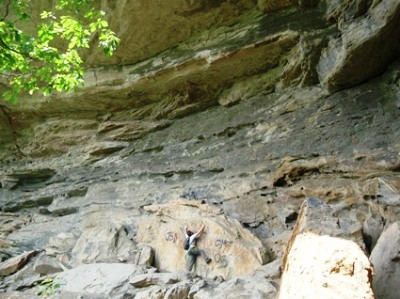
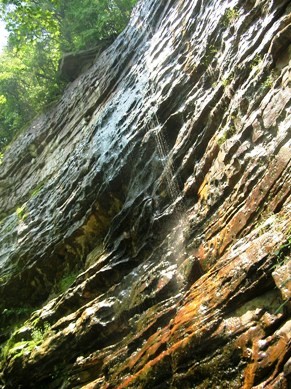 We drive back down the steep and winding road to the pull-off we stopped at earlier. Checking the distance on our GPS machines we mutter some oaths, stare forlornly out the window, then shrug and start walking. As it happens, we soon find ourselves walking on a bonafide nature trail, well-used and even signed. We continue on as the distance on the GPS unit keeps dropping. A few mountain skullcap are even growing alongside the trail. For once, things look promising. But it’s not long before we realize that there’s a problem. While the distance to our first transect keeps dropping, the bluff to our right keeps rising. And rising. It’s a serious bluff, too, entirely unclimbable to anyone without rappelling experience.
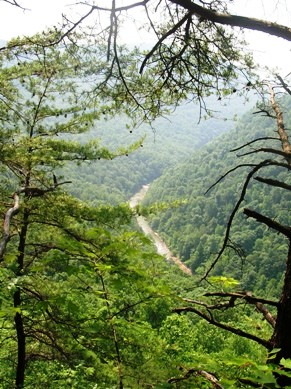 It’s too late in the day to bother, so we decide to come back the next day and give it a shot. In fact, climbing up the waterfall does work, however, at the top of the ascent, we find ourselves staring dumbly at the base of a second bluff. Our transects are actually up on the top of this second bluff. We get lucky and quickly find the only way up the second bluff, following a rocky creek bed that tumbles down from out of the trees above. We are now, at points, over 100 feet above the trail, working in an area with only one way up and the same way down. In an emergency there will simply be no way to get out quickly or get anyone in. We’ll spend many days wondering if we’d have been better off never having found the way up.


 Aw, hell. I keep promising tales of blood, violence and near-death experiences--and they're all true--but I can't seem to get the time to sit down and bang 'em out. They're coming, I swear. In the meantime, here's a story from Friday night, Knoxville, TN. It's almost true. The photos are also from Knoxville. They're totally true. More soon. More soon.

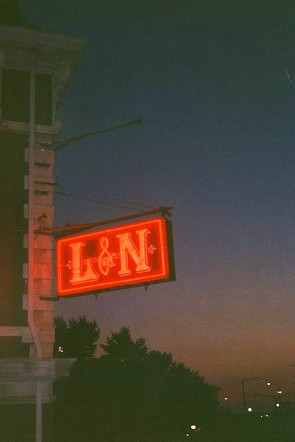 Despite having many more tales from the Cumberland Plateau I have clearly not been posting much lately. Sometimes life can get in the way of blogging, which is good. Remember life? Back before everyone sat in front of glowing screens with buttons in their ears or talked on little plastic phones all day? No, I didn't think so. Anyway, while I like writing I don't particularly like computers and, now being one of those people that spends eight hours each day fighting with one, I'm not getting much up here. But I will! I promise! I think! I even have some things I wrote in real-time, as the disasters were occurring. However, at the moment I'm bound to be off to the UK for a few weeks to return in the New Year. The accompanying photo of the Louisville and Nashville building was taken one warm and quiet fall evening here in Knoxville. I'm not sure how much longer I'll be in Knoxville and I seem to be painting myself into (another) corner (again). But I would love to actually get around to doing a little bit on this town. So, we'll see. Otherwise, have a Merry Christmas and Happy New Year and I'll be back in 2007. John.
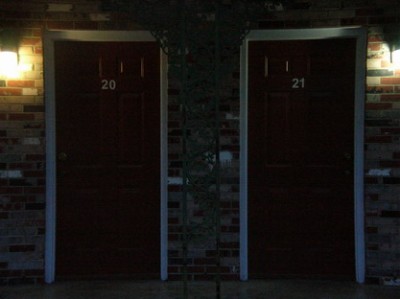
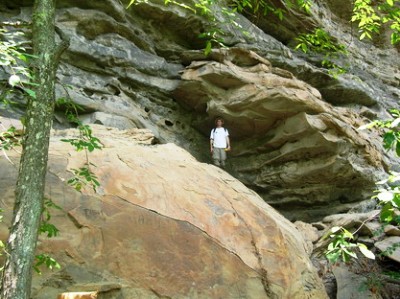
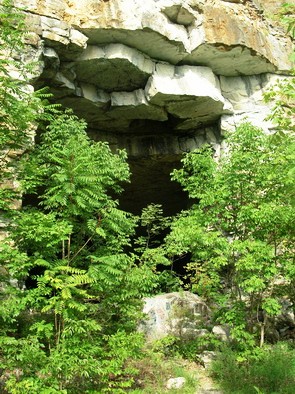 Carl and I come to the edge of a thicket of raspberry brambles. It’s been rough going for the last couple hundred meters and we are covered in small cuts from the thorns of the bushes. The sweat makes the wounds sting. Our pants have been torn. It’s seems like a mistake in navigation was made at some point but we can’t figure out exactly where. As the brambles finally give way we find ourselves standing on the edge of a large hunting camp. Ahead of us is a green school bus up on blocks, the windows spray-painted black. A huge stars ‘n’ bars hangs across the front of the bus. Sometimes you come upon places that just feel unsettling and unsafe and you want to get away as quickly as possible by the closest means at hand. “I don’t really want to go through this,” says Carl, looking from one end of the camp to the other. This coming from an avid hunter who has struck up jovial conversations with every sportsman we’ve come across. He calls it the “brotherhood of hunters” but apparently doesn’t feel too fraternal with whoever has set up this imposing camp. I look out at the array of shacks and decrepit cars. I see a well with a memorial to a dead man chiseled into the front of it. A barbeque pit. Ropes hanging from trees. Burnt logs. I don’t want to go through it either. I look behind us at three hundred meters of dry raspberry thicket and dead pine trees. “We can’t go back the way we came,” I say. We wait. A tattered plastic tarp flaps in the slight breeze. What looks to be an old flag pole stands in the middle of the clearing. There doesn’t seem to be anyone around.
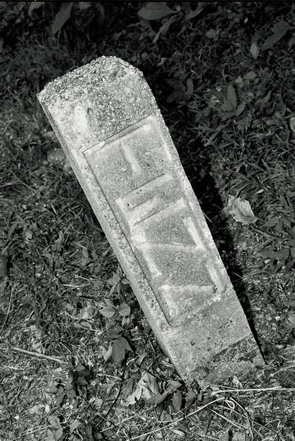 We gingerly step out of the bushes and start across the camp. The shacks stand in lines along a dirt road that we quickly cross. Beer cans crushed on the ground. I want to stop and take a picture but something feels wrong and instead I start walking faster. As we reach the far side a jeep turns onto the dirt road and I trot the last twenty feet to the woods. Carl is behind me and a few seconds later we’re both well into the trees. As far as we know, the man in the jeep did not see us. Months will pass before in casual conversation I mention this odd camp to a colleague of mine familiar with the area. “Oh,” he replies. “You want to stay away from there. They don’t like anyone near them and aren’t afraid to prove it. They aren’t even supposed to be up there but no one can get them down.” Yet another disaster amongst a seemingly endless string has been narrowly averted this day.
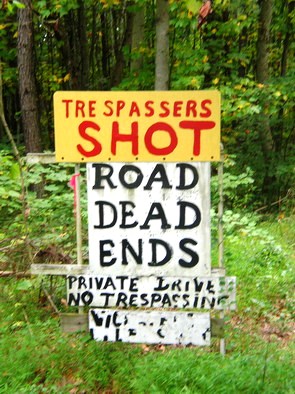 It’s Jason’s second day on the job. We’re working lower on Aetna Mountain, skirting a neighborhood known as the “Devil’s Poket” (sic) in Whiteside, TN. The neighborhood is comprised of nothing more than one dead end street located nearly at the bottom of the mountain, merely a small notch of land cut out of the surrounding timber holdings. There are about eight houses on the street. One is a trailer that has been burnt to the ground, only its steel support beams remaining intact, rusting out of the melted debris. A second house looks habitable from the street except that “No Trespassing! Private Property!” is spray-painted across the front in big, black letters. From behind it can be seen that the roof of the house has caved in, the backyard littered with shingles and splintered 2”x 4”’s. The home nearest the outlet of the street is flying a massive stars ‘n’ bars on a pole in the front yard. Railroad tracks run just beyond and when a train stops, as will happen soon enough, there is no way in or out of the neighborhood.
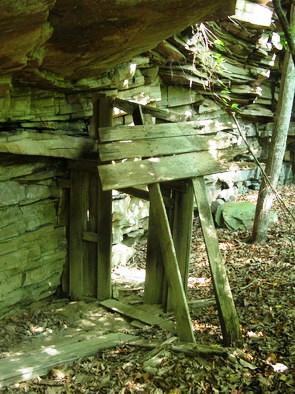 We enter the neighborhood and pass a woman and child. They appear to be doing some yard work but as we get closer it’s hard to tell if the property they’re tending is abandoned or not. We wave hello and the woman waves back, then quickly crosses the street with the child and enters another home. Now our GPS unit indicates that our point is actually in the backyard of the house at the end of the block. We have no intention of going into anyone’s yard, but figure we can get close enough from somewhere on the street. Of course, we look ridiculous with all our gear. Soaking with sweat and filthy, holding a GPS unit in one hand and a compass in the other, I spot two people watching us from the top of a driveway near the end of the street. For a moment I consider whether to go up to them and explain what we are doing, but something just doesn’t feel right and so we decide to keep moving through the neighborhood, picking up our pace a bit. Suddenly there’s a crack and a bullet cuts through the trees about 20 feet away. A few more shots are fired before we can take cover behind a row of twenty or so strange brick ovens that have been filled with trash. It’s possible these ovens are the remnants of a coke operation decades previous or maybe they were built when Aetna Mountain was being heavily mined for coal. Whatever the case, they are now protecting us from the residents of Devil’s Poket.