skip to main |
skip to sidebar
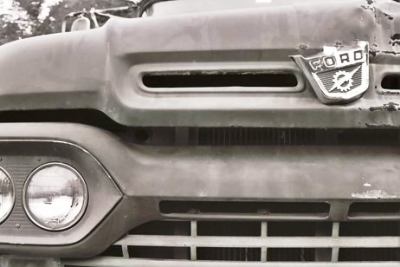
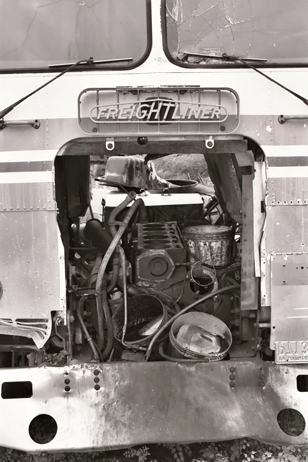
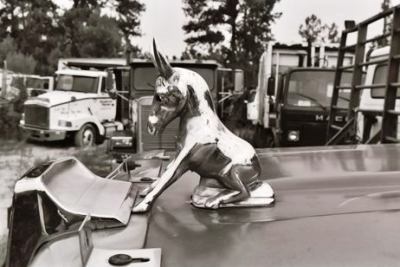
I hope everyone had a nice Christmas. We're going to get a little whimsical for this post and visit a heavy equipment junkyard along the Aiken-Augusta highway. The next post will be epic, detailing the largest building we got into in the CSRA (that's the Central Savannah River Area, don't ya know) and it's going to take a couple posts to cover. For now then, in the holiday spirit, we'll take it a little easy. If you were driving from Augusta to the building-to-be-posted you might pass the junkyard anyway, so it does make some sense.
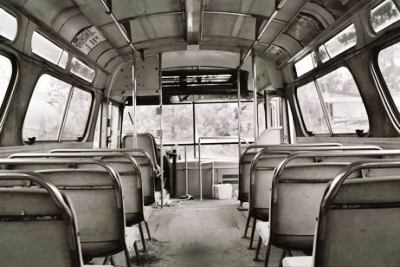
Remember this view? I don't know if sitting in the back of the bus carries the same connotations it once did, but that used to be where all the bad kids sat so they could do bad things on the way to and from school. The good kids sat in the middle seats and those subject to getting beat up would go for the front. I never really did most of those bad things, but I still preferred sitting in the back, myself.
There are a couple impressive photo books out there that have shots of smashed-up vintage cars. One is "Car Crashes and Other Sad Stories," by Mell Kilpatrick. Mell took pictures for newspapers in Southern California in the 1940's and 1950's and was often one of the first people to arrive at accident scenes. Some of his photos are undeniably gruesome (you can often see the victims strewn about the wreckage) but there is something disquietingly beautiful about the mangled Packards and disemboweled Chevy's. All that fractured glass and twisted chrome reminds you that life can be dangerous and it's always been so. But especially when you're not wearing your seatbelt.
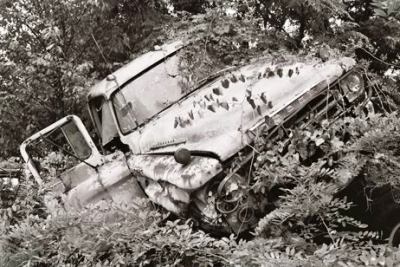
Another book of interest is "Strange Days, Dangerous Nights," by Larry Millett. Larry worked as a reporter for the St. Paul Pioneer Press in Minnesota and has assembled photos from the Pioneer Press and the St. Paul Dispatch circa 1940-1960. Many are accidents and murder scenes, but there's plenty of strange "cultural" shots as well. These photos were all published, sometimes on the front page, and if you think media coverage can be graphic now this book (and exhibit) will give you pause.
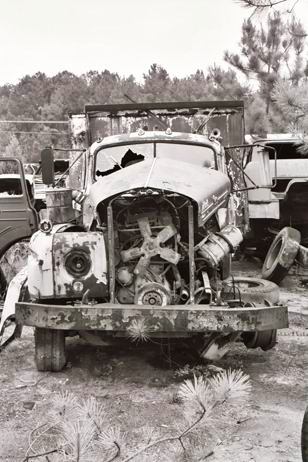 One of the great things about those old newspaper photos is that nearly all the photgraphers used the Speed Graphic camera, first manufactured in 1912. The Speed Graphic is that classic black box camera with the bellows and a couple lenses and a huge flash. That camera, particularly when used with a flash at night, lit up the foreground, but threw long, dark shadows into the background, which went to black. Thus the shots are very striking and even mundane pictures can appear powerfully stark. Try doing that with your digital! By the mid-1960s, of course, small 35mm cameras were becoming popular and the last Speed Graphic was made in 1973, the year I was born.
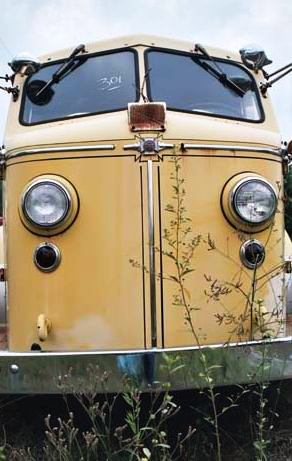 Taking to the road in South Carolina is a bit like playing Russian Roulette. I recall hearing that at one time Aiken County had the highest per capita auto accident rate in the US. I don't doubt it. As a result, there's lots of smashed cars around. There's a huge junkyard in a forest outside Aiken that is full of cars dating back to the 1930's. However, I never went to check it out because it just didn't seem like a good idea. In the South, in particular, you'll find that people are very protective of their property. When someone threatens you with a shotgun if you don't get off their land, they're not just trying to scare you. You better leave. Quickly. On the two occasions that I've been confronted it's seemed questionable to me whether the angry citizens I found myself dealing with really owned the property I was on or not. If they did, why would they admit it? Yeah, I know, a lawsuit. Still, they should have been embarrassed. Both were rotted eyesores off busy highway intersections. In any case, it's always best to play dumb and polite and make a hasty exit.
 "All progressions from a higher to a lower order are marked by ruins and mystery and a residue of nameless rage"-Cormac McCarthy, "Blood Meridian." "Blood Meridian" is a brilliant, bloody novel about, at least partially, how a proximity to sustained violence can result in deep disaffection, putting the participant at a remove from civilized society in a way that is real and possibly permanent. The book is like Apocalypse Now set in the desert of the West around 1850. In the mid-1990's, Vietnam Vet Bill Shields wrote three books of powerful poems about the difficulty soldiers have reintegrating. It's something to think about right now.
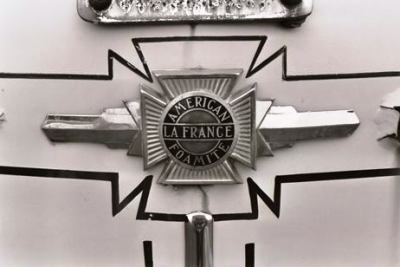
I won't argue whether our society is progressing from a higher to lower order. I'll leave that to others to waste their time with. However, it does seem like things constructed in the fast-fading past were built better and more expressively, at least when it comes to architecture and design (and the grill badges on fire trucks). McCarthy was speaking of civilizations, but the statement is no less applicable to the decay of objects. And these places and things now frequently lie in ruins and there is always an air of mystery about them. You can even imagine that the neglect and abandonment of what was once so important to those who built them and the people that used them, now unhappily forgotten, has cast the slightest pall of rage over what little remains. I can't believe that wandering around an abandoned Wal-Mart in 50 years will be as profound an experience as creeping through a turn-of-the-century farmhouse or Art Deco movie theater. But, ah, what a thought, that: abandoned Wal-Marts.
 A kind reader suggested that some of the places featured on this site be GPS'd so that they can be revisited. This is a good idea and it'd be especially interesting to go back to areas that will be demolished, such as the brick factory, and see what was built there. You could then take a photo and say, "Where this $200,000 townhome is there used to be a brick kiln." I might be able to do this on a return visit to the area, but if anybody else down there wants to try let me know. I'll only send you on safe and lawful excursions. But watch out for the kudzu. See ya next time.
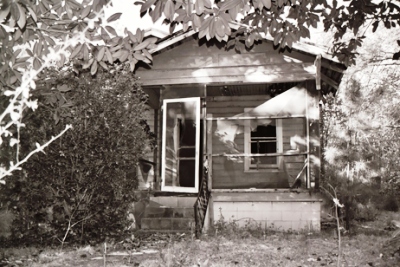
Okay, I'm back from a couple weeks down in the South. Most of the time I had to actually do work, but I made it to a few new places and got some photos. People seemed to like the brick factory shots and I went back there and got some more. There's plenty of survey flags, but the bulldozers aren't rolling yet. If the pictures turn out well I might put some more of the factory up. Yes, IF. I don't have a digital camera and I don't know what the shots look like until I develop them. Remember that feeling? Some of the pictures I've posted were even taken with a disposable, which is a good way to uselessly burn through a lot of money.
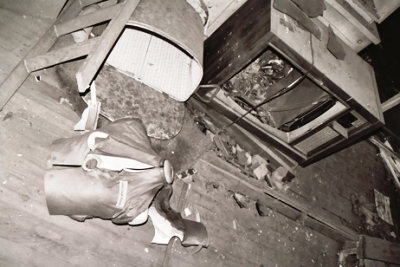
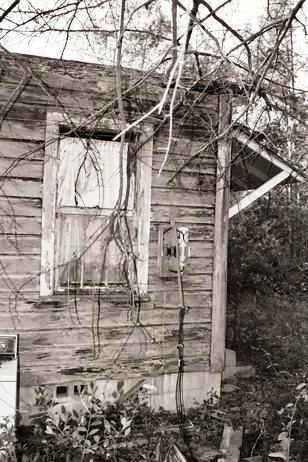
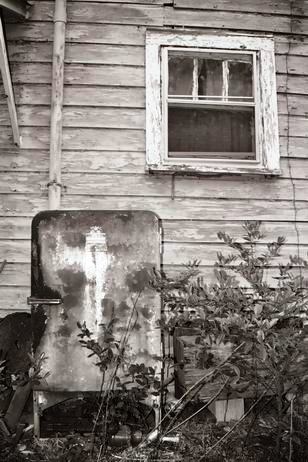
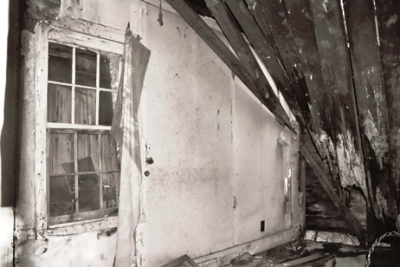
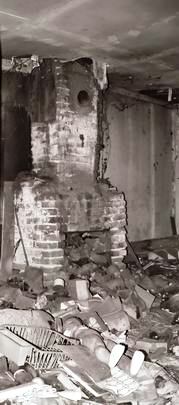
Anyway, above is a photo of a house in the woods off of Buena Vista in N. Augusta, SC. As usual, the occupants left lots of belongings, including a strange mannequin torso. The last two shots in the series are of a tarpaper shack just beyond the house in an overgrown powerline cut. This shack was kinda creepy and the trash was stacked high on the floor, making walking difficult (and dangerous). The most recent date found was off a football sports page from 1982. Don't panic, that's a DOLL lying in the filth. It was about 3 feet tall. Otherwise, I don't have much to say about this place. Who knows who lived there, what they did, or why they left? So, it being the night before Christmas and all, I thought I'd tell you the charming tale of the Hamburg Riot of 1876. Just throw another log on the fire, curl up with your favorite blanket, and enjoy a glimpse of history from the ghost of race relations past.
In the 1870's Federal troops were leaving the South and Reconstruction was losing momentum. Some southern states had reverted to keeping blacks from voting and the all-white Democratic administrations that followed were called "Redeemer" governments. However, South Carolina was one of only three states where the US Army was still present, preventing a "Redeemer" administration, and racial tensions were high. Some in the state argued that each white Democrat should find a way to keep at least one black man from voting, thus making it more likely that a Democratic candidate would be elected to office. Remember, Lincoln was a Republican. However, the Democratic Party was generally in disarray and couldn't even agree on candidates. It was against this political backdrop that the Hamburg Riot took place.
 By the summer of 1876, Hamburg's prosperity was on the wane (see: previous post) and most white residents had left. The town was now populated largely by African-Americans with a few openly hostile white citizens hanging around. On July 4 there was an Independence Day parade and members of the local black militia were marching down the street when two white farmers ordered them to halt so they could move their wagon through. The militia members didn't want to stop marching and some arguments ensued. However, eventually the parade was stopped and the wagon allowed to pass.
 The next day the two farmers went to the courthouse and demanded that the militia captain be arrested. The captain thought this was absurd, said as much, and was then ordered to stand trial for contempt of court on July 8, 1876. The members of the black militia gathered together in town, refusing to disarm. Some fighting began whereupon the white citizens recruited 100 men from Augusta and returned to the scene with...a cannon! After nightfall the militia men tried to escape, but 25 were captured and one killed. The following day, up to eight more captives were brutally murdered and the homes of the black townspeople were looted. The number of African-Americans killed seems to vary from 6 to 9, but everyone agrees that during the looting one white man was killed. This was probably not what Joe Strummer had in mind when he called for a white riot exactly 100 years later.
Further skirmishes erupted in Aiken, where 5000 men on horseback were reported to have gathered to aid 60 men being charged with murder. Despite this account coming from a Clemson College publication, the overtly racist tone of the source makes me question the figures. In any case, serious violence also followed in Ellenton, SC on September 15, 1876. According to Benjamin Tillman, "no one ever knew how many Negroes were killed, but there were forty or fifty or a hundred." The period around the Hamburg Riot was the beginning of the "red-shirt" movement, in which Democrats wore red shirts to protest "scalawags," considered traitors for cooperating with US troops, and "carpetbaggers," who came from the North, at least ostensibly to aid with Reconstruction. These events galvanized the white people of South Carolina and they were able to elect a Democratic governor, Wade Hampton III, later that year. (Remember, his family once owned the Goodale Inn.) Thus South Carolina became a "Redeemed" state, and the Hamburg Riot a symbol of racist violence to the North and self-determination to the South. Seven white men were indicted for the murders committed during the Hamburg Riot, but as soon as the new administration assumed office, all charges were dropped. The riot also kick-started the career of Benjamin Tillman, known affectionately as Pitchfork Ben after he threatened to stick a pitchfork in President Grover Cleveland.
 Benjamin Tillman was one of those guys that made an entire political career out of being a complete prick. There sure have been a lot of them. He was present at the Hamburg Riot and instrumental in spreading the intended "message" of the event to citizens of both colors. Initially the commander of a paramilitary unit called the Sweetwater Sabre Club, Tillman became Governor of South Carolina in 1890, in which office he was heralded as the "Champion of White Men's Rule and Woman's Virtue." In 1894 he joined the US Senate and remained there for 24 years, making a run for President in 1896. And all of it can be traced to the popularity afforded him by his involvement in the Hamburg Riot. The guy has said so many mind-bending things it's tough to pick quotes. But how about this, concerning the riot:
"The purpose of our visit was to strike terror, and the next morning when the negroes who had fled to the swamp returned to the town, the ghastly sight which met their gaze of seven dead negroes lying stark and stiff certainly had its effect. The state of South Carolina has disenfranchised all of the colored race that it could under the 13th, 14th, and 15th Amendments. We have done our level best, we have scratched our heads to find out how we could eliminate the last one of them, and we would have done it if we could, we took the government away. We stuffed ballot boxes. We shot them. We are not ashamed of it."
Or this, in a Congressional address:
"I have three daughters, but so help me God, I had rather find either one of them killed by a tiger or a bear and gather up her bones and bury them, conscious that she had died in the purity of her maidenhood, than to have her crawl to me and tell me the horrid story that she had been robbed of the jewel of her womanhood by a black fiend."
If you want a bit more information, within the context of violence in America, go here. A cartoon drawn at that time, featuring Lady Justice holding unbalanced scales of men killed in the riot is out there on the internet, too. Finally, a book has been written about Tillman, called "Tightening the Noose: Ben Tillman and the Reconstruction of White Supremacy," by Stephen Kantrowitz. I haven't read it yet, but would like to. A review of the book, including more quotes and biography, is here.
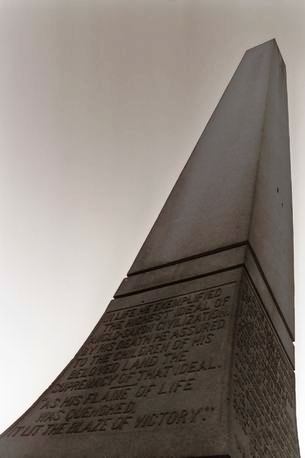 In the center of North Augusta there's a monument to the Hamburg Riot. Only, it commemorates the single white victim, whose name I've forgotten. Meriwether something, I think. It reads: "In life he exemplified the highest ideal of Anglo-Saxon civilization. By his death he assured to the children of his beloved land the supremacy of that ideal. 'As his flame of life was quenched it lit the blaze of victory.'" Now, I would just like to say, the Hamburg Riot was a long time ago and you'll find racists everywhere you go, as you'll find people that couldn't care less about skin color. This is not an indictment of southerners or their culture, only a glimpse of an ugly footnote in history. And there's plenty of ugly history to go around. Now the monument on the other hand...
Merry Christmas. And to all, a good night.
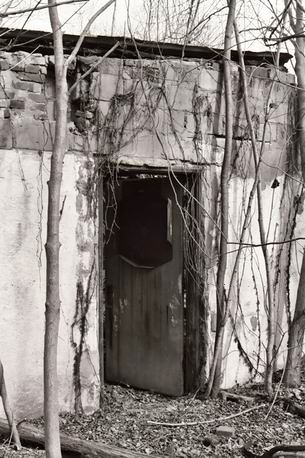 I've been in a lot of abandoned buildings. It's normal--in fact, it's downright useful--to feel at least a little fear when you explore a new place. However, I've never been in a building that gave me the creeps as badly as this building, located in the now-non-existent town of Hamburg, SC. What's strange is that this building is only one story tall, made of sturdy concrete, and has numerous holes in the walls, providing many possible escape routes (and light/oxygen) in the event a hasty getaway is required. So, what gives? Is it the history of this place, set back in the woods above the Savannah River, that accounts for the bad vibes? Well, let's go inside and see.
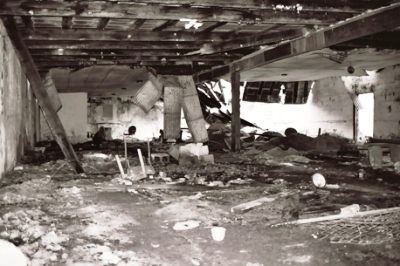
Henry Shultz came from Hamburg, Germany to Augusta in 1806 and, after being involved in riverboating and bridge-building, decided to build a town to compete with Augusta. Right across the river, on the bluffs, he scouted a location that he believed would provide excellent access to the water and enable Hamburg to usurp Augusta as a mover of goods up and downstream. When construction began in about 1821, Shultz issued a statement saying that Hamburg would be "a place of great importance." For awhile, he was right.
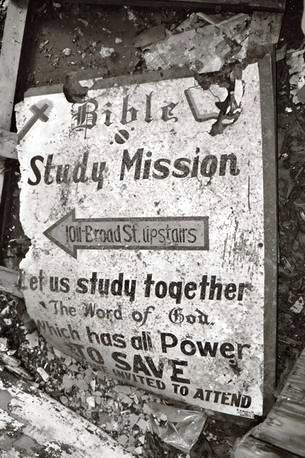 Hamburg grew quickly and began to drain trade from Augusta and even Savannah. However, by 1827, trade was shifting far downriver toward Charleston and Shultz dug himself into debt, attracted a manslaughter charge, and attempted suicide. The town struggled on and was the site of a riot in 1876. I'll return to the "Hamburg Riot," which was more a race-based massacre, in a later post. Following two floods in 1929, all remaining citizens were relocated. Virtually nothing of the town remains--except this place. Rumor has it that this was once the location of a honky tonk frequented by workers on the river. Clearly, its last incarnation was as a mission. So, good versus evil. But who won?
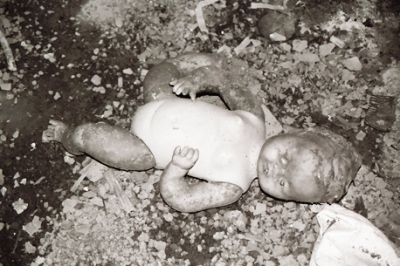
The mission must've served mostly women and children, as the floor is littered with women's and children's clothes, dolls, and toys. There are dozens of dolls like this one all around, which is pretty creepy all by itself. We tip-toed from room to room as cautiously as possible, even though it seemed unlikely anyone would be there. The whole joint just felt wrong. My companion actually had nightmares about the place.
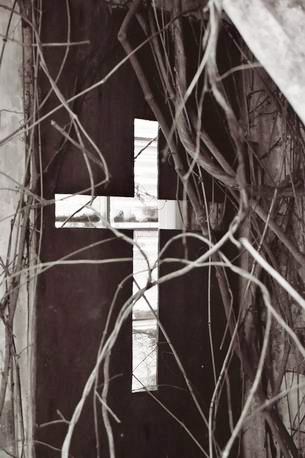 But it gets worse. There is a small access road near a deserted bridge that leads down a hill to this building. Some years ago, at the top of this road, a man, who had been kidnapped from a Wal-Mart, was apparently burned in the trunk of his car. While we were exploring, we found someone's eyeglasses lying in the grass near the building. They looked new and reasonably expensive. The glasses hadn't been there long and whoever lost them probably needed them. I have no idea how anyone could've lost their prescription glasses in this particular spot, unless they were out-of-their-minds like us and thought the concrete and steel wreckage looked worth investigating.
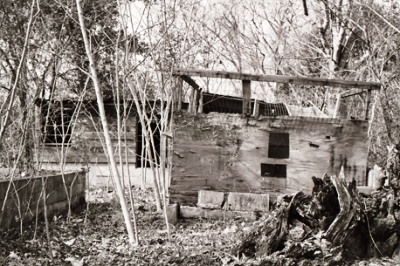
This is one of the strange outbuildings beside the mission. It looks like it might've been a chicken coup at one point. Someone had been living in it and they'd even set-up a tape player so they could listen to cassettes. But they hadn't been back in some time.
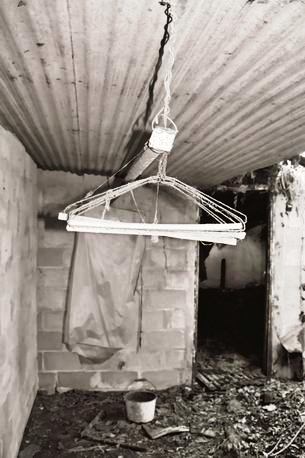 Lots of things were still in place, including chairs, boxes of clothes, old matresses, and this coat rack. Magazines on the floor dated back to January 3, 1955, and an old semi-trailer outside was filled with rotting toys. As in many abandoned buildings, you're left wondering why everyone took off so quickly. The toys really didn't go well with the pornography, also strewn about here and there.
I like old buildings and I hate to see them destroyed, even when they're clearly structurally unsound. In this case, I make an exception. This building might as well be torn down as quickly as possibly. It is the most unsettling, unpleasant, and evil-feeling abandoned building I've ever been in. And, hey, as we've seen so far, that's sorta saying something. If they were all this bad, I'd find a new hobby. I always recommend that people don't explore abandoned buildings. If this one doesn't convince you, I don't know what will. Remember, we go there so you don't have to.
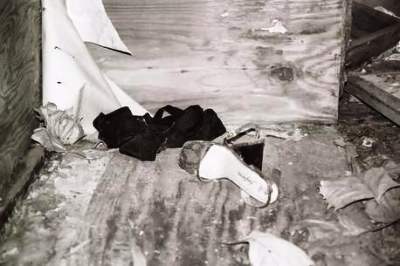
After this light-hearted post, there'll be a break while I head back down to the South to take care of some business for a couple weeks. I'll bring my camera and hit some new locations, including an airplane junkyard. Next post won't be nearly so dark, I promise. Until then, enjoy the run-up to the holidays. It's always such fun.
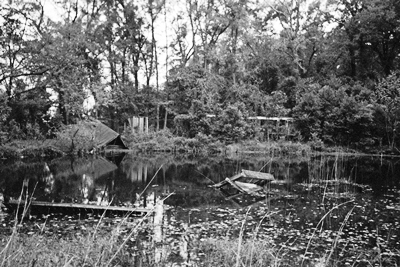
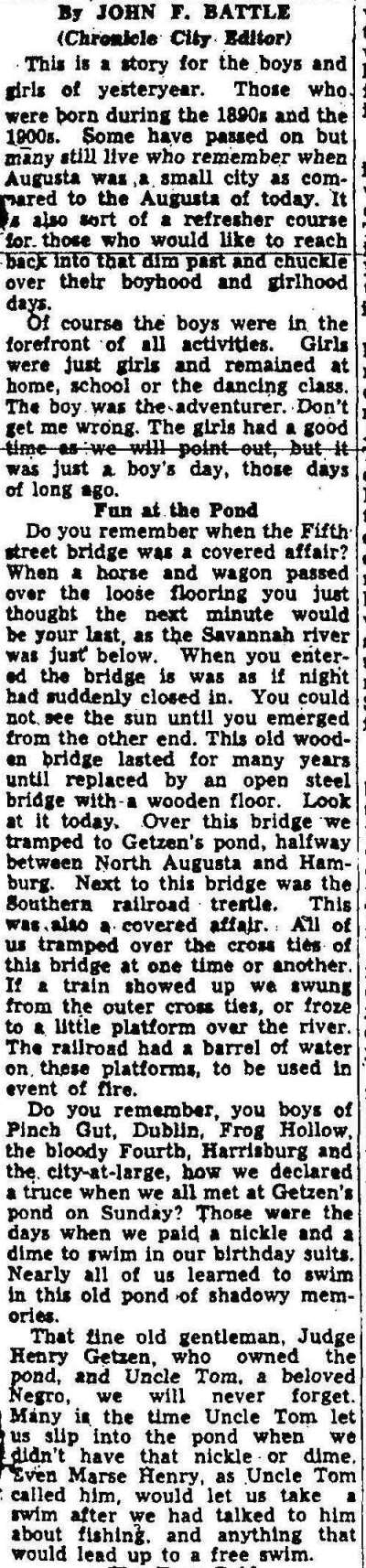
Well, we're deep into the gritty, nefarious world of swimming holes, so we'll hit another one. The oldest record of Getzen's Pond dates back to 1815, when the property was owned by Robert Butler. Butler used the pond to power his mill and, also, probably swam in it. Butler's daughter inherited the pond and she married Judge Henry Getzen. It was Getzen's idea to turn the place into a full-fledged swimming hole.
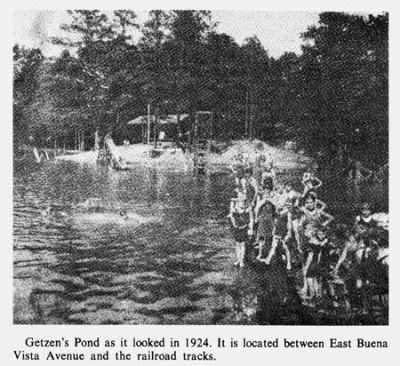 As you can see, Getzen's was a pretty swinging place. At first, only males could use the pond, which was soon known for it's clear, cold, spring-fed water. Initially, everyone just swam nude, since this was back in the days before people had clinical body-image problems. By the time of this photo in 1924, the boys had put their bathing suits back on and the girls were allowed in. I can only assume those events happened in that order, but you never know. This photo (and most of the info) was swiped from that History of N. Augusta book I mentioned last time.
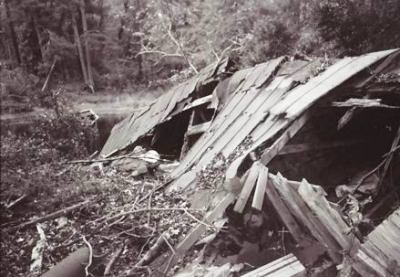
The pond was rented to one "Possum" Lott during WWI, but "Possum" got drafted and Dr. H. G. Mealing took over. This is when Getzen's Pond really became popular, with folks walking in from all over N. Augusta and coming across the bridge from Augusta for all-day outings. Incidentally, there is supposedly a beech tree beside the pond with the initials "H.C." carved in it. The initials are said to refer to Kentuckian Henry Clay, who we all know as a famous senator, Speaker of the House of Representatives, Secretary of State under John Quincy Adams, and bitter enemy of Andrew Jackson. He died in 1852 though, so he would've had to have stopped by the pond pretty early. I haven't really canvassed the pond to look for the tree because, uh, there's a lot of trees. But beeches can live to be 300-400 years old, so it might still be there.
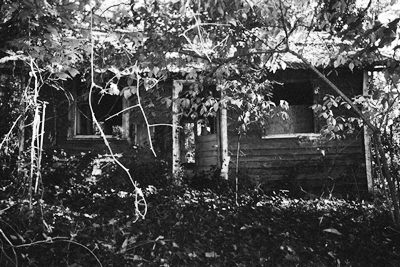
Eventually, Dr. Mealing's mother, Katherine Getzen Mealing (Judge Getzen's daughter), assumed management of Getzen's Pond. Cabins were built nearby and some families stayed throughout the summer months. It's possible that pictured above is one of those original cabins.
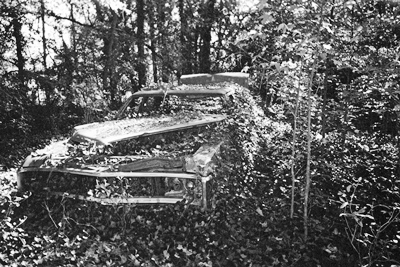
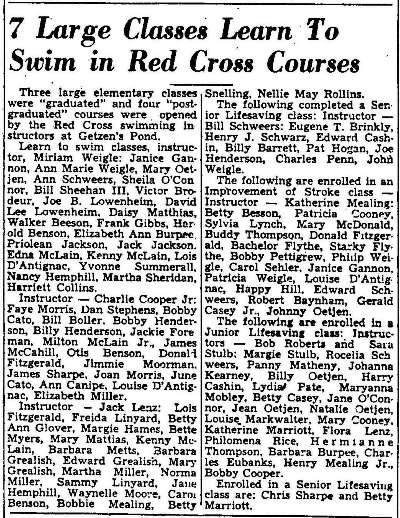
After the death of Kate Getzen Mealing in 1936, her daughter, Katherine Mealing, ran the place, offering Red Cross lifesaving lessons at least into the mid-1940's. But she eventually closed the pond when it got too expensive to operate, perhaps because of taxation by the City of North Augusta. Ms. Mealing still swam there herself though, and snuck a few of her friends in. There's no mention of who owned it after the Mealing's, but they forgot their car.
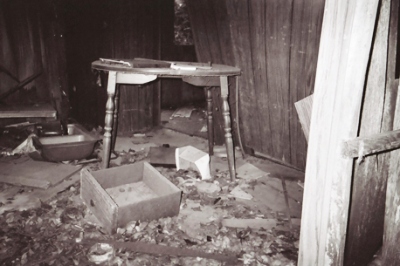
At some point a trailer was moved next to the lake. There's not much left of it at this point. It wasn't safe to actually go into the thing, but you didn't have to. This picture was taken through a massive hole in one side. Now, Getzen's Pond abuts a golf course on one side and a busy road on the other. It sits in a large parcel of woodland, however, so it might take the developer's awhile to get to it. In the meantime, the citizens of N. Augusta swim there no more. I think next time we'll visit the scariest abandoned building I've ever been to. Good fun.
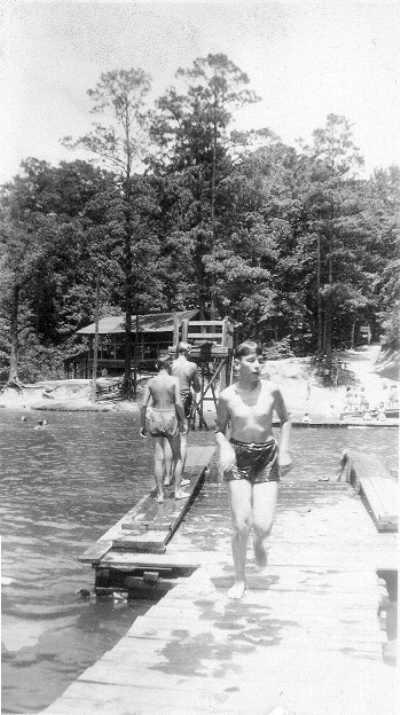
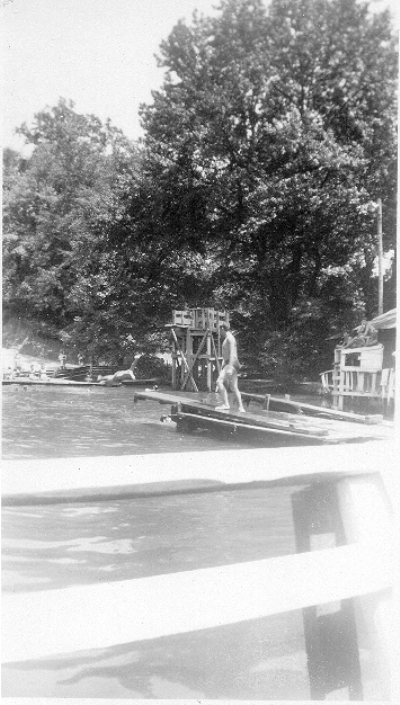
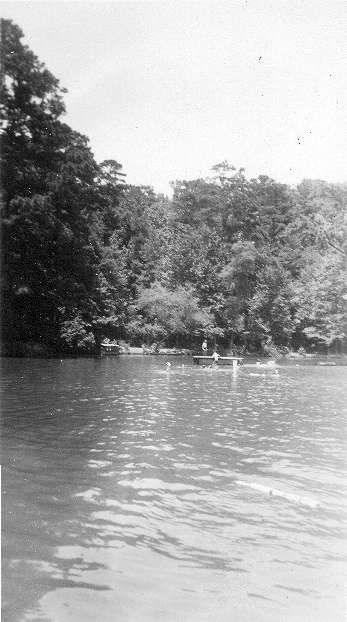
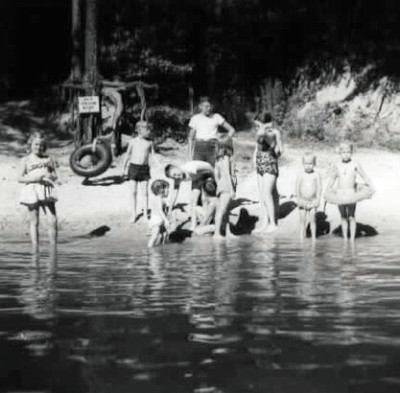
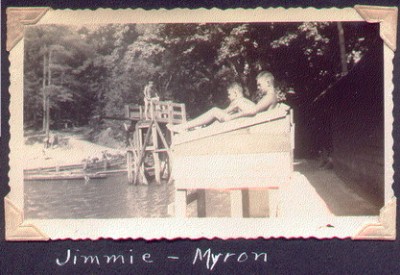
2006 UPDATE: Below are some great old shots of Getzen's Pond in all its glory. The first picture was taken in the early 1950's, possibly 1952. The second photo is from 1943, when it would appear the pond was fairly well built-up. The last photo is undated but shows a diving board and what is possibly a lifeguard stand. Looking at the recent shots it's hard to believe it was once a major swimming hole, but here's more proof. These photos are courtesy of Clarence and Ann Sikes and I thank them for letting me post them. Please see the comments section to read the Sikes family's recollections of Getzen's Pond in its prime.
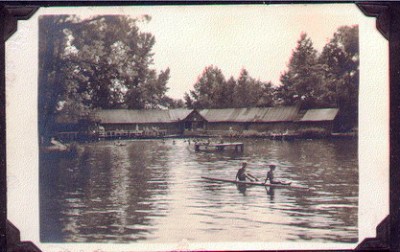
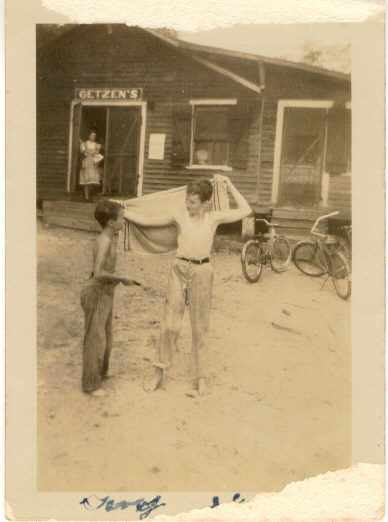
2009 UPDATE: I was recently sent two great photos by JC Young of Augusta. The first is the only shot I've seen featuring the intact Getzen's outbuilding with signage and everything. The photograph is of Gary and JC Young, dated around 1943. The second photo is of JC, Gary and Barbara Young, taken about 1944, after a dip in the pond. I thank JC Young for letting me publish them here. I'm really pleased to present such excellent documentation of Getzen's Pond. Please keep the photos and stories coming!
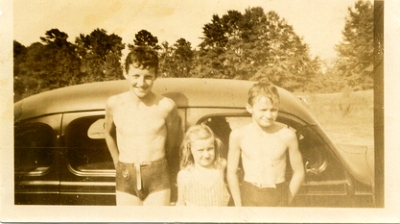
2012 UPDATE: Over the years I've been asked about the fate of Getzen Pond's neighbor, Panic Pond. Until recently, I didn't know a thing about the place. Now, in addition to having learned that it was named for the stock market "panic" that preceded the Great Depression, I can also report that it is under a couple tennis courts by the North Augusta police station. Some of it might be under a Publix, too. It was spring fed and sounded like a nice place for a dip. If you want to read a somewhat bittersweet recollection by Dan Smith of summer days spent at Panic Pond, you can do so HERE. Thanks to Tina M. and her dad for the info.
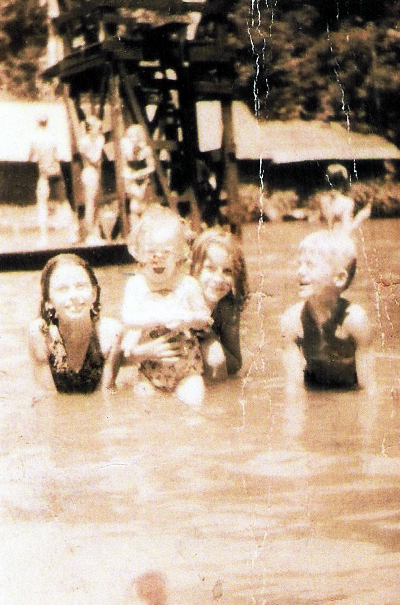
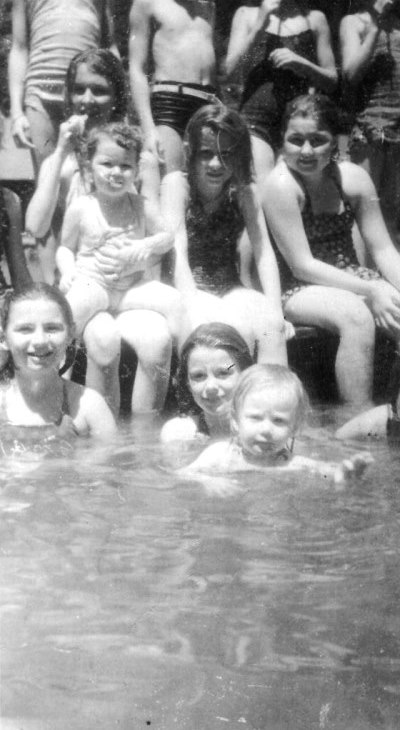
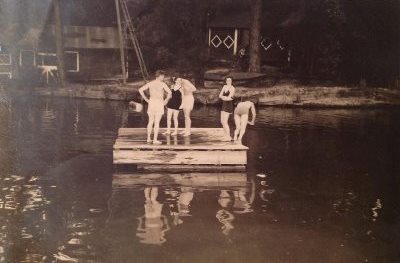
2015 UPDATE: I recently received perhaps the most detailed first-person description of the halcyon days of Getzen's Pond that I've ever come across. Happily, the author has graciously agreed to let me publish it here. For those wondering what Getzen's was like, this is a treasure trove of information. For those that were there, more than a few bells should ring. Many thanks to Sheila O'Connor-Wilson for sharing her recollections. The first photo at the bottom is of young Sheila and her three older siblings, Jane, Patricia, and Danny, taken in 1941. The second family shot is from 1942-1943. Front row: Betty Casey and Jane O'Connor holding Sheila O'Connor. Second row: Jeanne Otis holding Anne Schweers, Patricia O'Connor and Natalie Oetgen on the box near the shallow water at Getzen's. The last picture is a great one of the diving platform at Getzen's.
"My mother, Mary O’Gorman-O’Connor, and Katherine Mealing were close friends and our family spent most of our summer days at Getzen’s. I had sister’s Patricia, who was 8 years older, and Jane, 7 years older. There was brother Danny, 6 years older, as well as my younger sister, Mary. My memories are mostly from when I was about 7 to 14.
"Most mornings in the summer a group of girls and boys would arrive by bus from the Hill (Casey’s, Cooney’s, and others), as well as the Oetjen’s, Schweer’s, Van Sant’s, and Cashin’s, who lived near our home right across from Sacred Heart School. We all would meet and prepare for the walk from 13th Street across the bridge and down the ramp (which was near the tall condos now adjacent to the bridge, just on the SC side on the right). The walk continued with the daredevils walking the railroad tracks. The rest of us would continue along the dirt road ‘til arriving at the 'pond.'
"There was a specific way we rolled our bathing suits up in our towels and carried them under our arms on route to the pond while also carrying our lunches, often tomato sandwiches that were yummy soggy by the time we ate them. Of course, the lunch was always carried in a brown bag (no special designer lunchboxes). The older girls spent a lot of time on the 'boxes,' sunning all day and dousing their bodies with iodine mixed with baby oil to help tan easier. Some of the big girls would venture to the 'little box' in the 'snake water' to hide and smoke. Was interesting to watch them tread water to get there while holding the cigarettes high above their heads. The first of each summer you would decide to try to jump off the high dive but after going up the ladder you would get 'chicken.' The older kids always told us Katherine’s rule was that we could not come back down the ladder or we could not come back. Terrified to jump we might sit on the high dive for hours getting the nerve to jump into the freezing water.
"I remember well the candy store behind the lifeguard stands with 'Mary Jane’s' and 'Now or Later’s.' It was usually run by Mary Parrish and Tip Mealing, Katherine’s sister. There was a ping pong table next to the store that was well-utilized by the boys. Tip was very tiny and quiet. She taught swimming lessons in summer. Think she taught the 'Minnows,' who were the real beginners. She and Katherine both were school teachers. Katherine taught at Tubman and I think Tip taught kindergarten.
"Some of the ballplayers from the Augusta Tigers used to frequent Getzen’s. I specifically remember Leo Rigetti. Remember many of the life guards. There were Billy and Charlie Cooper, Ron Galloway, and Billy Lange. They enforced the unwritten rules we abided by at Getzen’s in order to maintain order and safety. These are but a few I recall: 1. If you go up the high dive you exit off the board, not via the steps. 2. Only one swimmer on a diving board at a time. 3. Never jump off the sides of a diving board. 4. No ducking. 5. Remain out of the pond either 30 - 60 minutes after eating (not sure exactly of time). 6. No horseplay (never sure what that was but think it was a boy thing). 7. No running on the boardwalk. (That, if you know Getzen's, is funny as the" boardwalk" was a sand path behind the lifeguard stand extending from the bathhouse and entrance area and past the candy store on around to the shallow water.) If one was involved in a game of chase he had to supposedly speedwalk before we knew the word speedwalk existed. Now if we broke these rules one was sentenced to sit on the "bench" for an amount of time determined by the lifeguard. You always had a friend nearby on the "bench" with whom to talk. Everybody seemed to be friends.
"Think of what carefree days these were. No cellphones, no texting, no TV. When a train came by out front the younger children ran to wave to the conductor and the caboose man. There was a black family that lived on a hill to the left of the front entrance of Getzen's. They had a girl and boy in their teens named "Brother" and "Sister." Sister helped Tip in the store at times. They had billy goats that roamed on the little hill and often down in front of the entrance. Precious memories.
"Yes, dibble dabble was the best of games most days whereas chase was always a favorite. Mother and Katherine and some other ladies would play bridge most afternoons for hours on end. Oh we little chillen were forbidden to go to the sand pit. Never quite figured that out. These were very special days of our lives and many friends were made at Getzen’s. Thanks so much for this work of yours. Love the stories from all the other friends of Getzen’s."
Sheila O’Connor-Wilson. Martinez,GA.
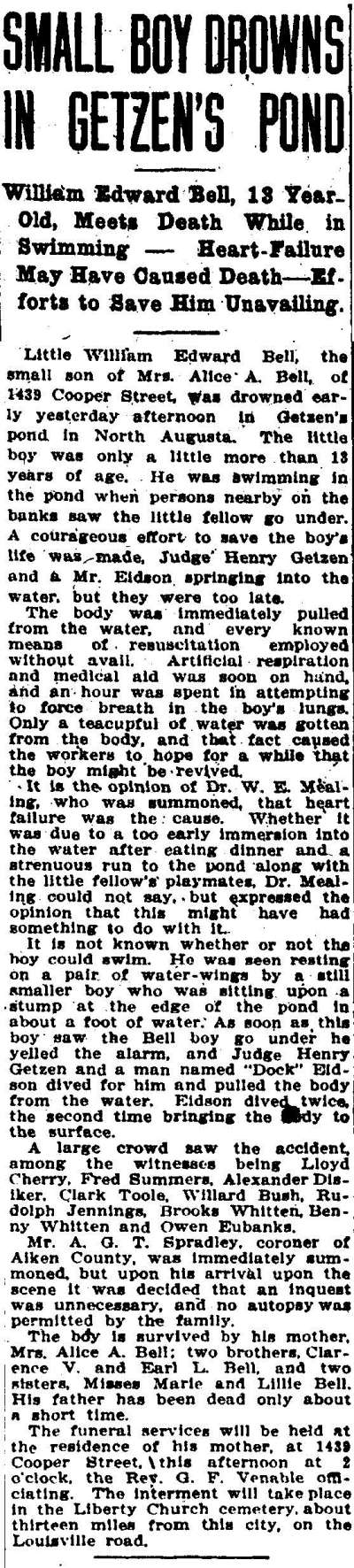
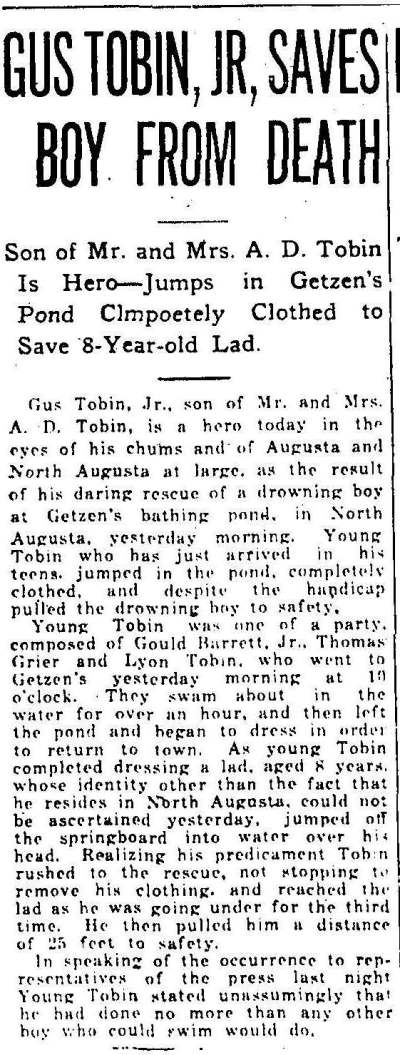
2015 UPDATE (Pt II): In addition to providing the above account, Sheila O'Connor-Wilson combed the archives of the Augusta Chronicle for mentions of Getzen's Pond and turned up some real gems going back 100 years. They're included below in chronological order and speak for themselves, I think. Don't miss the recounting of a scout troop hike to Getzen's from June 3, 1923; it gives a real flavor of the time and place. Many thanks to Mrs. O'Connor-Wilson for her work.
Drowning at Getzen's Pond. Augusta Chronicle, July 14, 1913:
Rescue at Getzen's Pond. Augusta Chronicle, July 28, 1918:
Scout troop hike to Getzen's Pond. Augusta Chronicle, June 3, 1923:
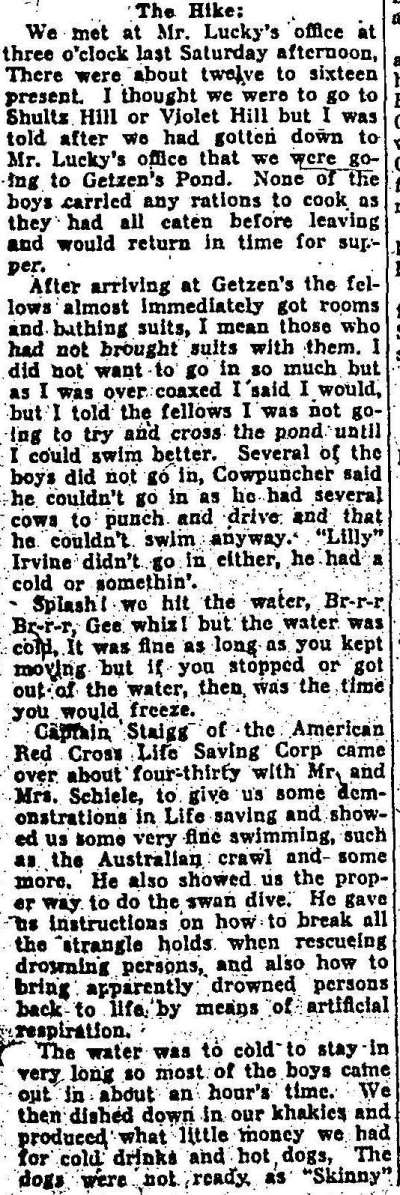
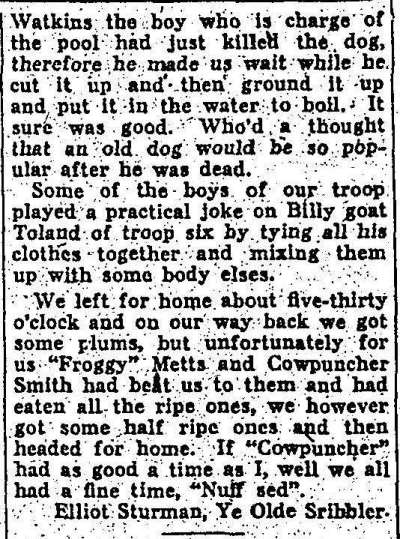
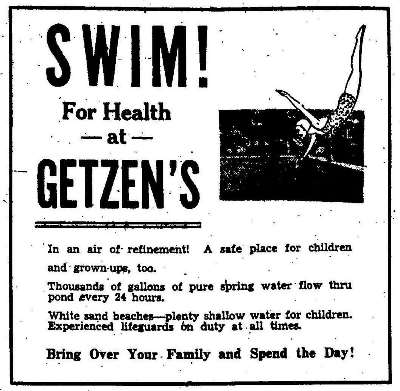
Getzen's Pond advertisement. Augusta Chronicle, May 31, 1925:
Getzen's passes with swimsuit purchase. Augusta Chronicle, May 22, 1932:

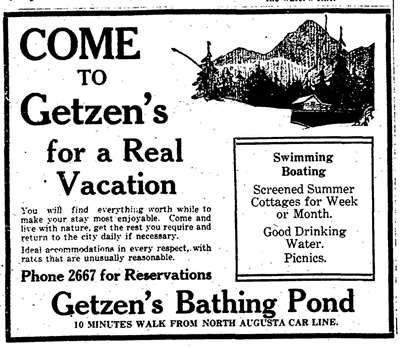
Kate Getzen Mealing obituary. Augusta Chronicle, May 16, 1936:
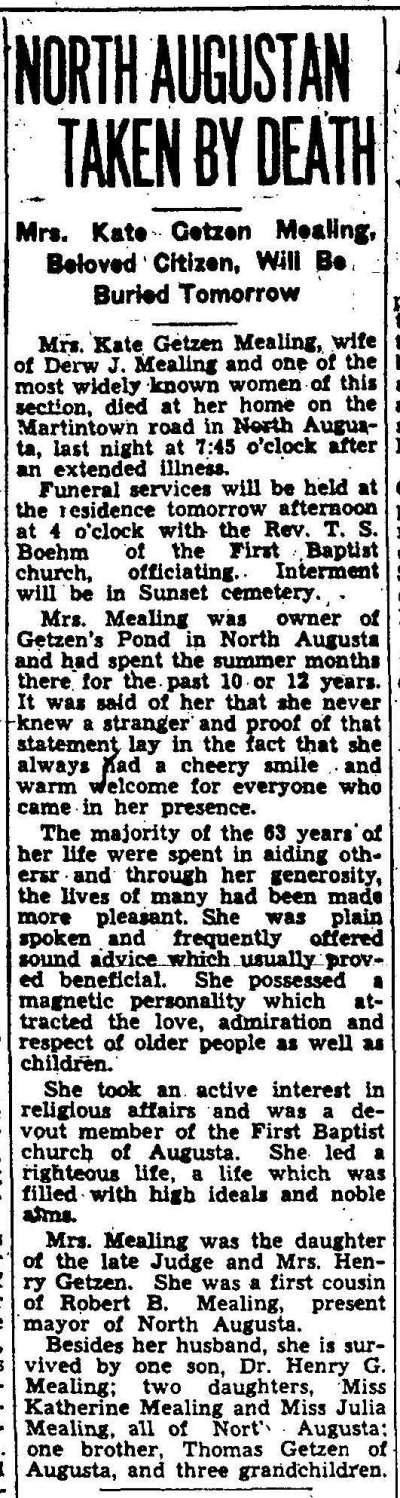
Getzen's Pond advertisement. Augusta Chronicle, May 26, 1940:
Classes at Getzen's Pond. Augusta Chronicle, June 27, 1945:
Excerpt from story. Augusta Chronicle, November 13, 1949:
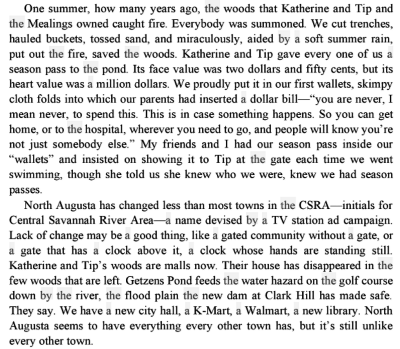
Excerpt from "A Little Different, a Little the Same" by Starkey Flythe. Anthologized in State of the Heart: South Carolina Writers on the Places They Love, published 2013:
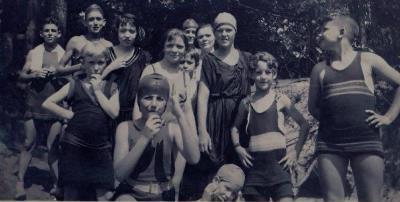
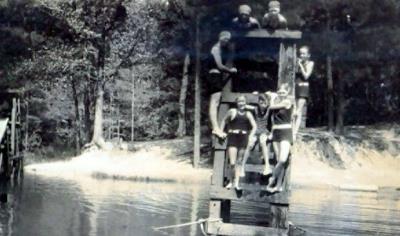
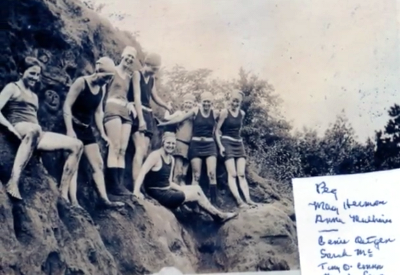
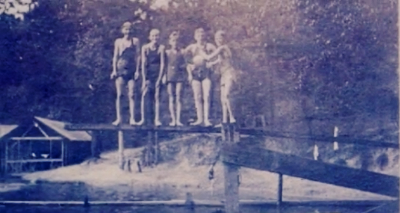
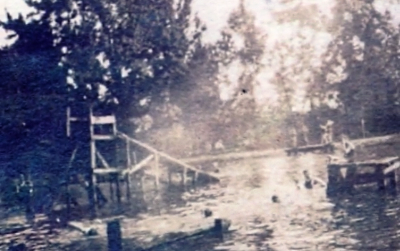
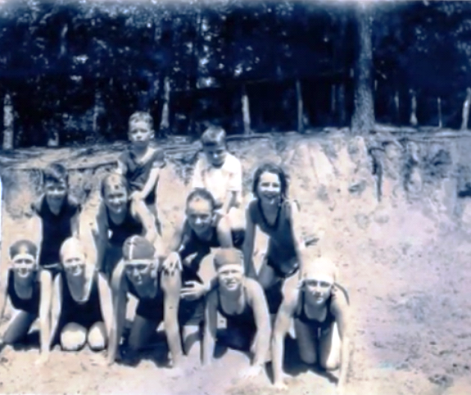
2015 UPDATE (Pt III): And the vintage Getzen's photos just keep on coming! These are from the 1920's or possibly even earlier and come via Ben Schweers, who received them from his aunt Peg. Peg Schweers is in the first picture and was later a sister of St. Joseph, Sr. Rose Margaret. You can find Bill Schweers listed as having completed a Senior Lifesaving course in the June 27, 1945 class list above. Thanks to the Schweers family, as well as Sheila O'Connor-Wilson, for providing such wonderful family photographs from Getzen's!
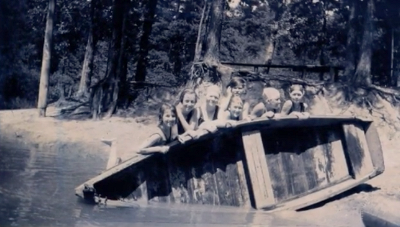
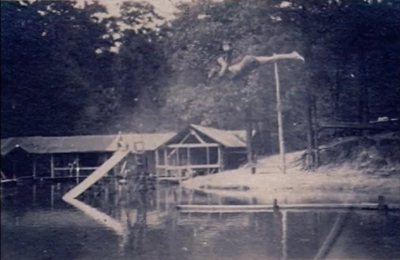
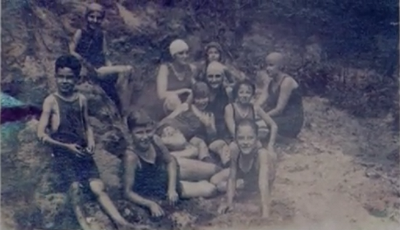
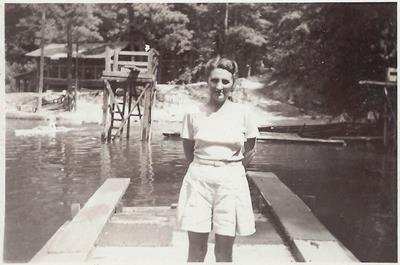
2015 UPDATE (Pt IV): Below we have the best photo of Katherine Mealing, who ran Getzen's Pond into at least the mid-1940's until costs became prohibitive, that I've ever seen. This was shot in 1949 or 1950 and clearly taken at Getzen's Pond, too! In fact, Getzen's might well have no longer been open to the public at this point. Many thanks to J.O. Nimeskern for passing along this gem.
APRIL 2017 UPDATE: Recently a man named Bob Cooper left a comment below about his memories of Getzen's Pond and graciously offered to share his collection of photos. Not being foolish enough to pass up an offer like that, I had Mr. Cooper send them directly to me so that I could add them here. I'll include Mr. Cooper's original comment below. Any information I have about the pictures that follow will be included underneath the photo.
Many thanks to Bob Cooper for letting me post his treasure trove of vintage scenes from the heyday of Getzen's Pond! JM
"My father, Bobby Cooper, and his brother, Charles Cooper, Jr., were both lifeguards and swimming instructors at Getzen's Pond. They both later swam for the University of Georgia and were conference champions. My grandfather, Charles Cooper, Sr., taught there as well. In the early '70's I remember our dad taking us out there to swim. The road was a rutted, bumpy, sandy affair, and the water was ice cold. The swim platform was still out in the water, but the buildings were falling in. We went and visited with Katherine Mealing, as well. I have a lot of these photos as originals. They were shared by some of the kind folks posting here. Will Mealing was my great uncle. We also have a link to The Sibley Mill, it having been built by my grandmother's grandfather."
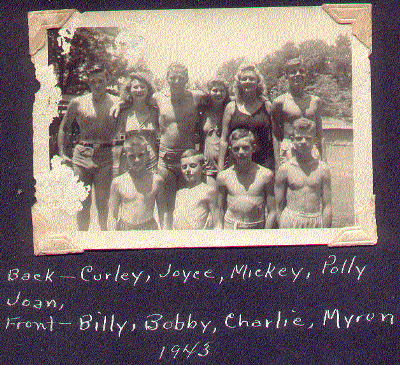
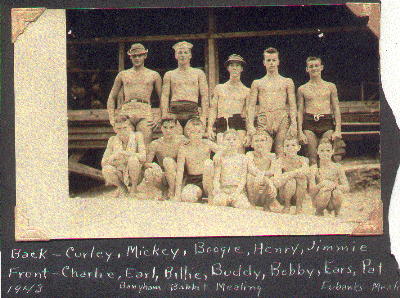
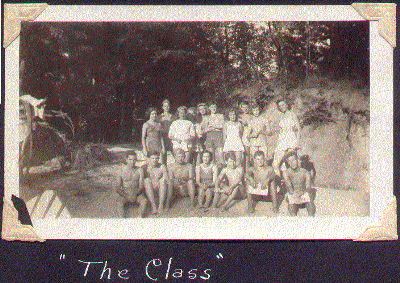
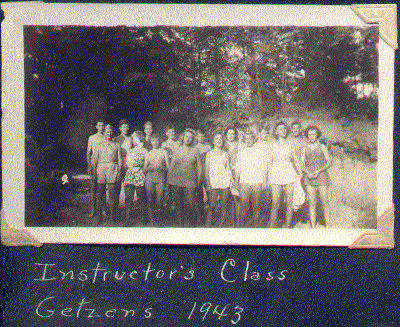
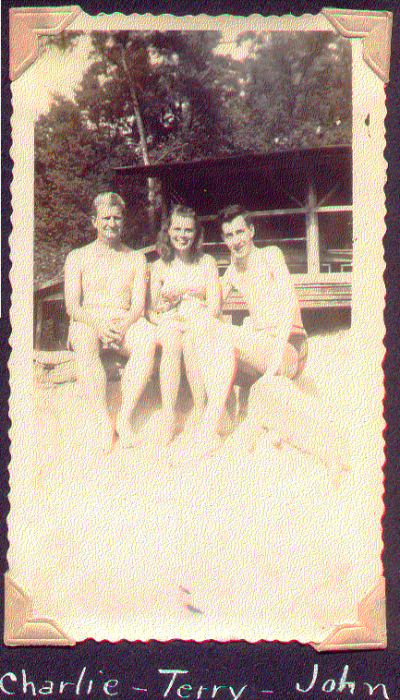
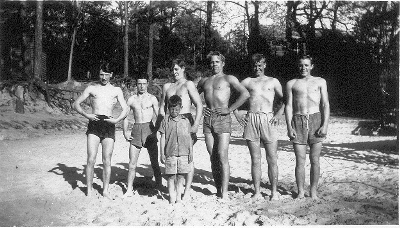
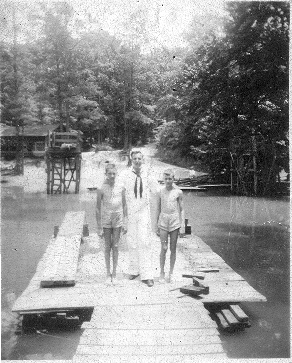
Above: Charlie Cooper, Clarence Sikes, and Bobby Cooper.
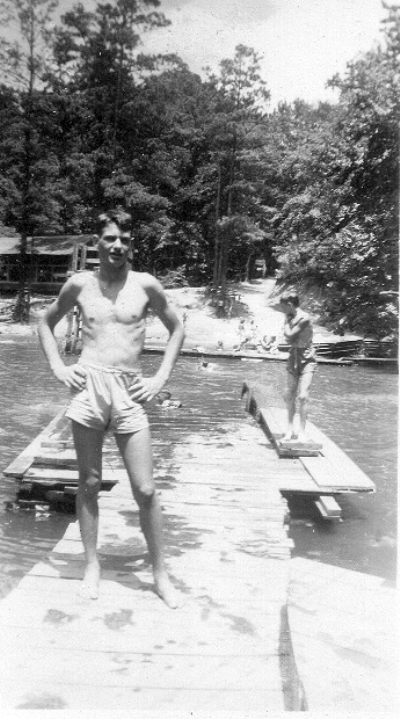
Above: Albert Kelly, Jr.