skip to main |
skip to sidebar
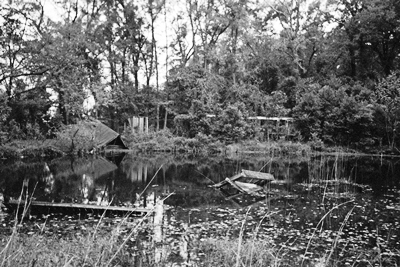
Well, we're deep into the gritty, nefarious world of swimming holes, so we'll hit another one. The oldest record of Getzen's Pond dates back to 1815, when the property was owned by Robert Butler. Butler used the pond to power his mill and, also, probably swam in it. Butler's daughter inherited the pond and she married Judge Henry Getzen. It was Getzen's idea to turn the place into a full-fledged swimming hole.
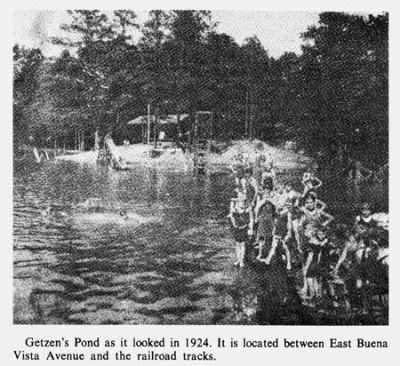 As you can see, Getzen's was a pretty swinging place. At first, only males could use the pond, which was soon known for it's clear, cold, spring-fed water. Initially, everyone just swam nude, since this was back in the days before people had clinical body-image problems. By the time of this photo in 1924, the boys had put their bathing suits back on and the girls were allowed in. I can only assume those events happened in that order, but you never know. This photo (and most of the info) was swiped from that History of N. Augusta book I mentioned last time.
The pond was rented to one "Possum" Lott during WWI, but "Possum" got drafted and Dr. H. G. Mealing took over. This is when Getzen's Pond really became popular, with folks walking in from all over N. Augusta and coming across the bridge from Augusta for all-day outings. Incidentally, there is supposedly a beech tree beside the pond with the initials "H.C." carved in it. The initials are said to refer to Kentuckian Henry Clay, who we all know as a famous senator, Speaker of the House of Representatives, Secretary of State under John Quincy Adams, and bitter enemy of Andrew Jackson. He died in 1852 though, so he would've had to have stopped by the pond pretty early. I haven't really canvassed the pond to look for the tree because, uh, there's a lot of trees. But beeches can live to be 300-400 years old, so it might still be there.
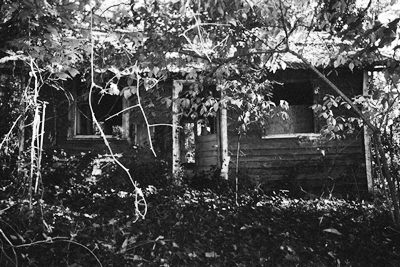
Eventually, Dr. Mealing's mother, Katherine Getzen Mealing (Judge Getzen's daughter), assumed management of Getzen's Pond. Cabins were built nearby and some families stayed throughout the summer months. It's possible that pictured above is one of those original cabins.
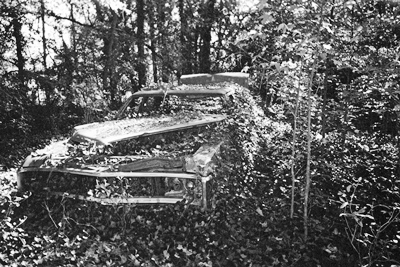
After the death of Kate Getzen Mealing in 1936, her daughter, Katherine Mealing, ran the place, offering Red Cross lifesaving lessons at least into the mid-1940's. But she eventually closed the pond when it got too expensive to operate, perhaps because of taxation by the City of North Augusta. Ms. Mealing still swam there herself though, and snuck a few of her friends in. There's no mention of who owned it after the Mealing's, but they forgot their car.
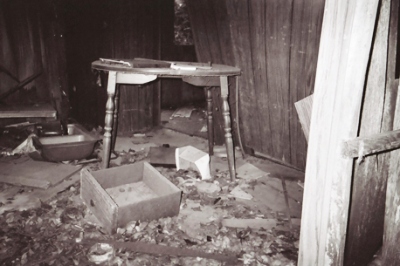
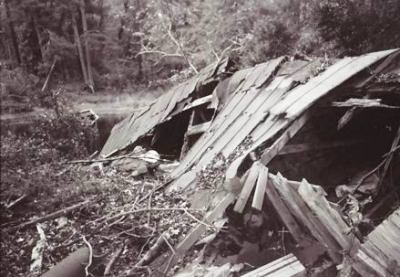
At some point a trailer was moved next to the lake. There's not much left of it at this point. It wasn't safe to actually go into the thing, but you didn't have to. This picture was taken through a massive hole in one side. Now, Getzen's Pond abuts a golf course on one side and a busy road on the other. It sits in a large parcel of woodland, however, so it might take the developer's awhile to get to it. In the meantime, the citizens of N. Augusta swim there no more. I think next time we'll visit the scariest abandoned building I've ever been to. Good fun.
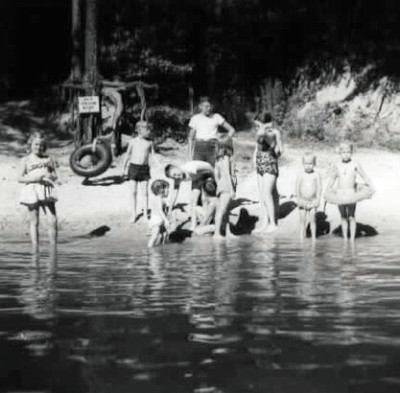
2006 UPDATE: Below are some great old shots of Getzen's Pond in all its glory. The first picture was taken in the early 1950's, possibly 1952. The second photo is from 1943, when it would appear the pond was fairly well built-up. The last photo is undated but shows a diving board and what is possibly a lifeguard stand. Looking at the recent shots it's hard to believe it was once a major swimming hole, but here's more proof. These photos are courtesy of Clarence and Ann Sikes and I thank them for letting me post them. Please see the comments section to read the Sikes family's recollections of Getzen's Pond in its prime.
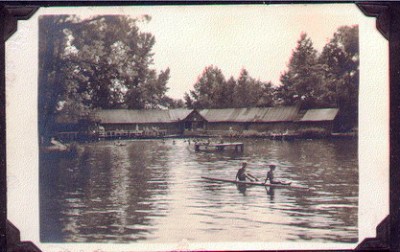
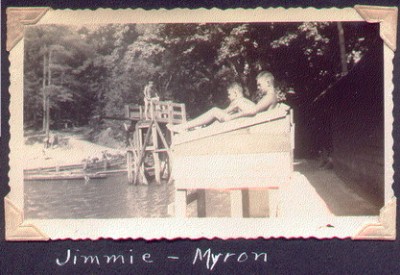
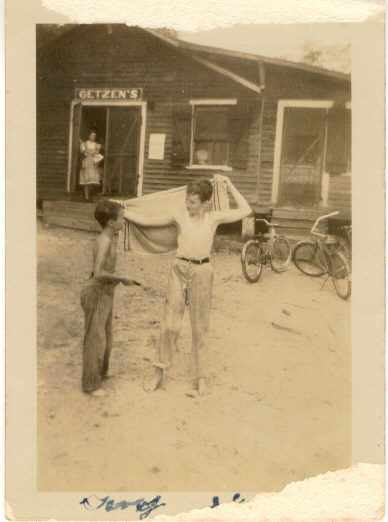
2009 UPDATE: I was recently sent two great photos by JC Young of Augusta. The first is the only shot I've seen featuring the intact Getzen's outbuilding with signage and everything. The photograph is of Gary and JC Young, dated around 1943. The second photo is of JC, Gary and Barbara Young, taken about 1944, after a dip in the pond. I thank JC Young for letting me publish them here. I'm really pleased to present such excellent documentation of Getzen's Pond. Please keep the photos and stories coming!

2012 UPDATE: Over the years I've been asked about the fate of Getzen Pond's neighbor, Panic Pond. Until recently, I didn't know a thing about the place. Now, in addition to having learned that it was named for the stock market "panic" that preceded the Great Depression, I can also report that it is under a couple tennis courts by the North Augusta police station. Some of it might be under a Publix, too. It was spring fed and sounded like a nice place for a dip. If you want to read a somewhat bittersweet recollection by Dan Smith of summer days spent at Panic Pond, you can do so HERE. Thanks to Tina M. and her dad for the info.
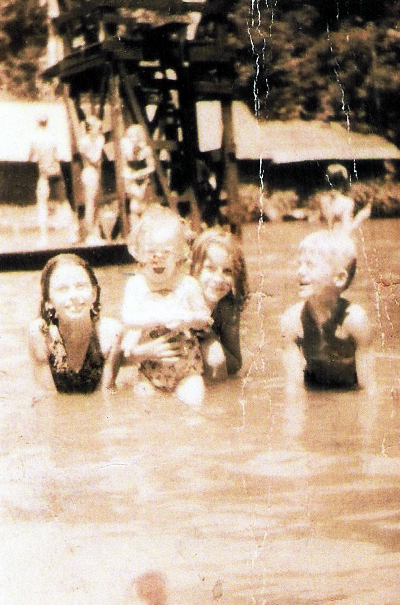
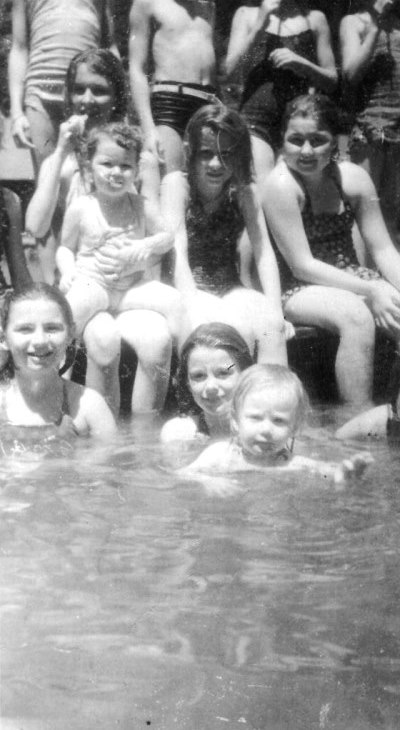
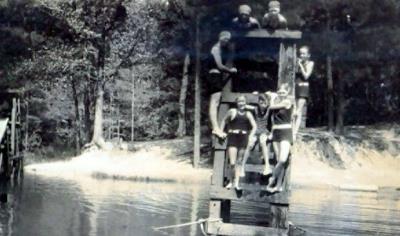
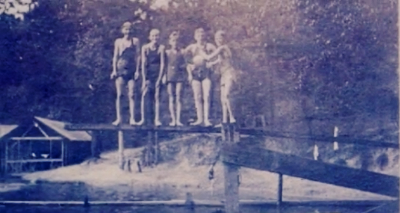
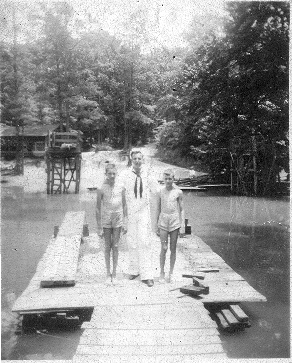
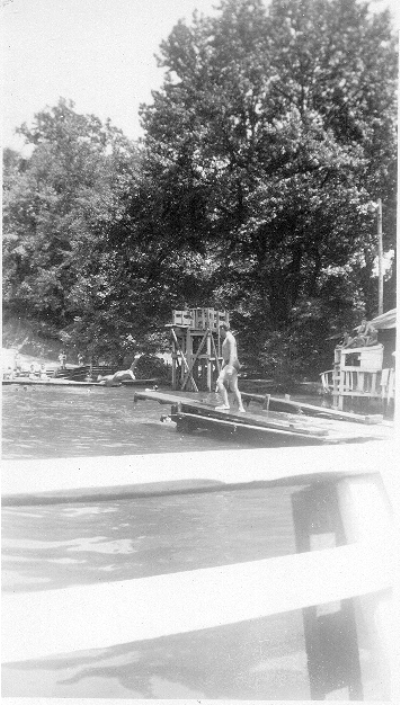
2015 UPDATE: I recently received perhaps the most detailed first-person description of the halcyon days of Getzen's Pond that I've ever come across. Happily, the author has graciously agreed to let me publish it here. For those wondering what Getzen's was like, this is a treasure trove of information. For those that were there, more than a few bells should ring. Many thanks to Sheila O'Connor-Wilson for sharing her recollections. The first photo at the bottom is of young Sheila and her three older siblings, Jane, Patricia, and Danny, taken in 1941. The second family shot is from 1942-1943. Front row: Betty Casey and Jane O'Connor holding Sheila O'Connor. Second row: Jeanne Otis holding Anne Schweers, Patricia O'Connor and Natalie Oetgen on the box near the shallow water at Getzen's. The last picture is a great one of the diving platform at Getzen's.
"My mother, Mary O’Gorman-O’Connor, and Katherine Mealing were close friends and our family spent most of our summer days at Getzen’s. I had sister’s Patricia, who was 8 years older, and Jane, 7 years older. There was brother Danny, 6 years older, as well as my younger sister, Mary. My memories are mostly from when I was about 7 to 14.
"Most mornings in the summer a group of girls and boys would arrive by bus from the Hill (Casey’s, Cooney’s, and others), as well as the Oetjen’s, Schweer’s, Van Sant’s, and Cashin’s, who lived near our home right across from Sacred Heart School. We all would meet and prepare for the walk from 13th Street across the bridge and down the ramp (which was near the tall condos now adjacent to the bridge, just on the SC side on the right). The walk continued with the daredevils walking the railroad tracks. The rest of us would continue along the dirt road ‘til arriving at the 'pond.'
"There was a specific way we rolled our bathing suits up in our towels and carried them under our arms on route to the pond while also carrying our lunches, often tomato sandwiches that were yummy soggy by the time we ate them. Of course, the lunch was always carried in a brown bag (no special designer lunchboxes). The older girls spent a lot of time on the 'boxes,' sunning all day and dousing their bodies with iodine mixed with baby oil to help tan easier. Some of the big girls would venture to the 'little box' in the 'snake water' to hide and smoke. Was interesting to watch them tread water to get there while holding the cigarettes high above their heads. The first of each summer you would decide to try to jump off the high dive but after going up the ladder you would get 'chicken.' The older kids always told us Katherine’s rule was that we could not come back down the ladder or we could not come back. Terrified to jump we might sit on the high dive for hours getting the nerve to jump into the freezing water.
"I remember well the candy store behind the lifeguard stands with 'Mary Jane’s' and 'Now or Later’s.' It was usually run by Mary Parrish and Tip Mealing, Katherine’s sister. There was a ping pong table next to the store that was well-utilized by the boys. Tip was very tiny and quiet. She taught swimming lessons in summer. Think she taught the 'Minnows,' who were the real beginners. She and Katherine both were school teachers. Katherine taught at Tubman and I think Tip taught kindergarten.
"Some of the ballplayers from the Augusta Tigers used to frequent Getzen’s. I specifically remember Leo Rigetti. Remember many of the life guards. There were Billy and Charlie Cooper, Ron Galloway, and Billy Lange. They enforced the unwritten rules we abided by at Getzen’s in order to maintain order and safety. These are but a few I recall: 1. If you go up the high dive you exit off the board, not via the steps. 2. Only one swimmer on a diving board at a time. 3. Never jump off the sides of a diving board. 4. No ducking. 5. Remain out of the pond either 30 - 60 minutes after eating (not sure exactly of time). 6. No horseplay (never sure what that was but think it was a boy thing). 7. No running on the boardwalk. (That, if you know Getzen's, is funny as the" boardwalk" was a sand path behind the lifeguard stand extending from the bathhouse and entrance area and past the candy store on around to the shallow water.) If one was involved in a game of chase he had to supposedly speedwalk before we knew the word speedwalk existed. Now if we broke these rules one was sentenced to sit on the "bench" for an amount of time determined by the lifeguard. You always had a friend nearby on the "bench" with whom to talk. Everybody seemed to be friends.
"Think of what carefree days these were. No cellphones, no texting, no TV. When a train came by out front the younger children ran to wave to the conductor and the caboose man. There was a black family that lived on a hill to the left of the front entrance of Getzen's. They had a girl and boy in their teens named "Brother" and "Sister." Sister helped Tip in the store at times. They had billy goats that roamed on the little hill and often down in front of the entrance. Precious memories.
"Yes, dibble dabble was the best of games most days whereas chase was always a favorite. Mother and Katherine and some other ladies would play bridge most afternoons for hours on end. Oh we little chillen were forbidden to go to the sand pit. Never quite figured that out. These were very special days of our lives and many friends were made at Getzen’s. Thanks so much for this work of yours. Love the stories from all the other friends of Getzen’s."
Sheila O’Connor-Wilson. Martinez,GA.
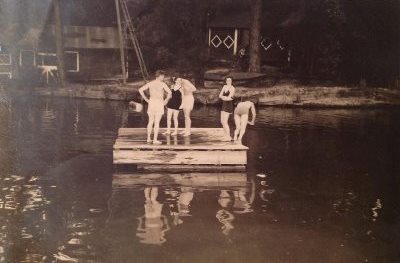
2015 UPDATE (Pt II): In addition to providing the above account, Sheila O'Connor-Wilson combed the archives of the Augusta Chronicle for mentions of Getzen's Pond and turned up some real gems going back 100 years. They're included below in chronological order and speak for themselves, I think. Don't miss the recounting of a scout troop hike to Getzen's from June 3, 1923; it gives a real flavor of the time and place. Many thanks to Mrs. O'Connor-Wilson for her work.
Drowning at Getzen's Pond. Augusta Chronicle, July 14, 1913:
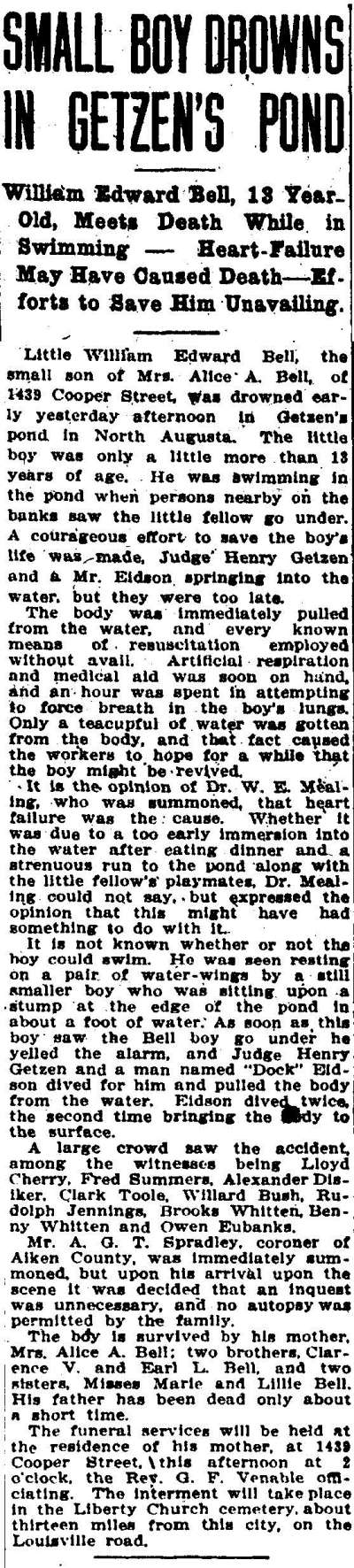
Rescue at Getzen's Pond. Augusta Chronicle, July 28, 1918:
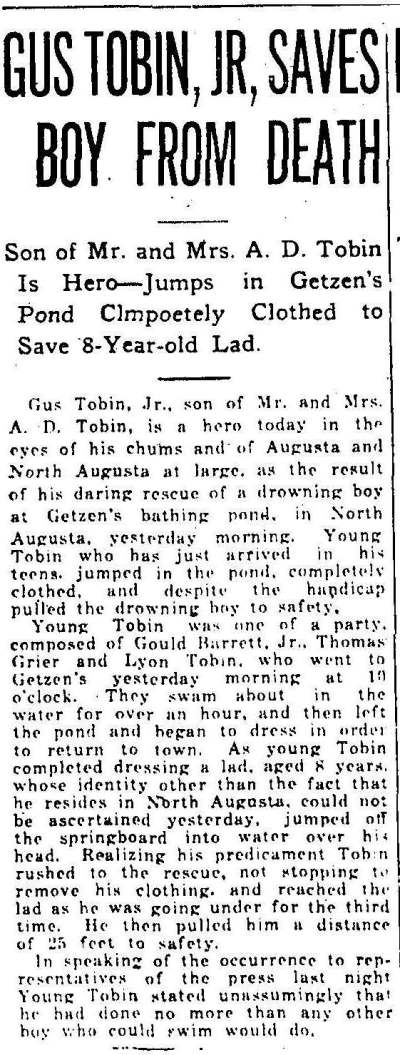
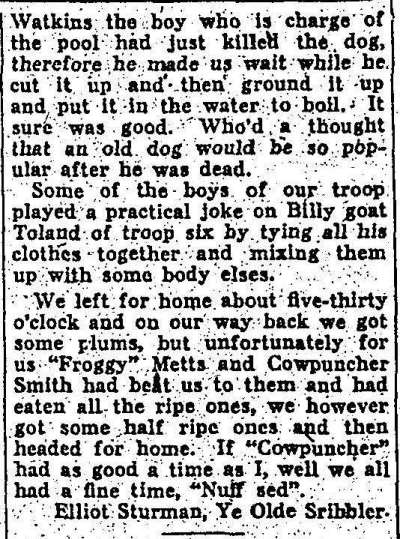
Scout troop hike to Getzen's Pond. Augusta Chronicle, June 3, 1923:
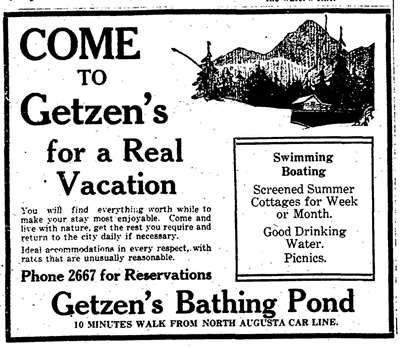
Getzen's Pond advertisement. Augusta Chronicle, May 31, 1925:
Getzen's passes with swimsuit purchase. Augusta Chronicle, May 22, 1932:

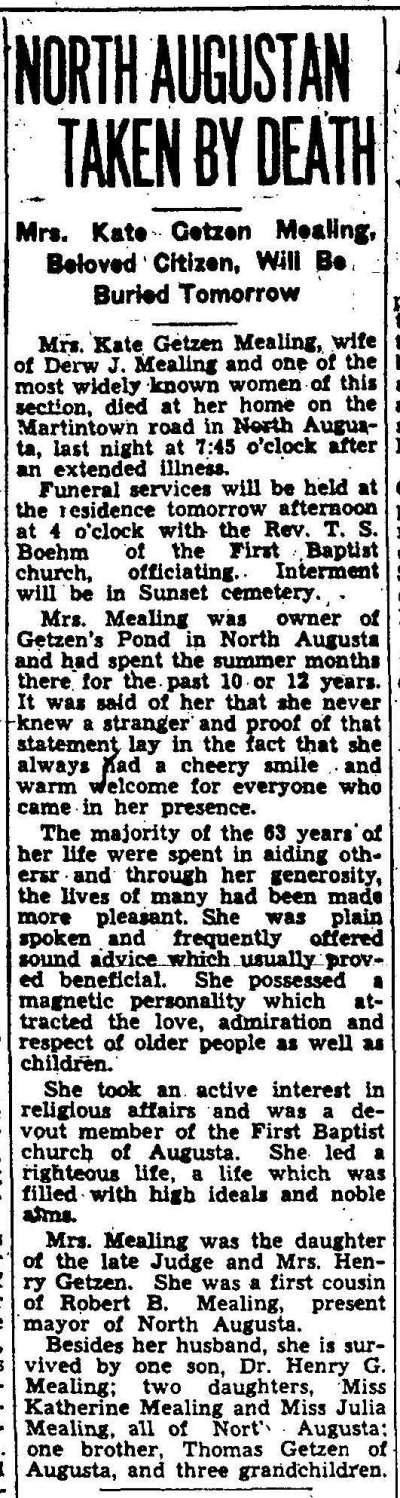
Kate Getzen Mealing obituary. Augusta Chronicle, May 16, 1936:
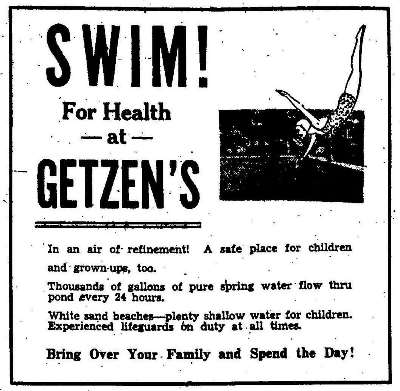
Getzen's Pond advertisement. Augusta Chronicle, May 26, 1940:
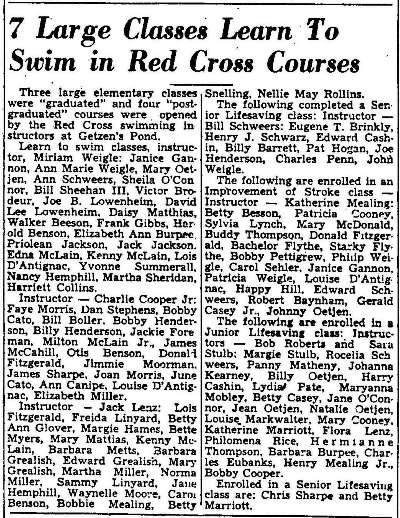
Classes at Getzen's Pond. Augusta Chronicle, June 27, 1945:
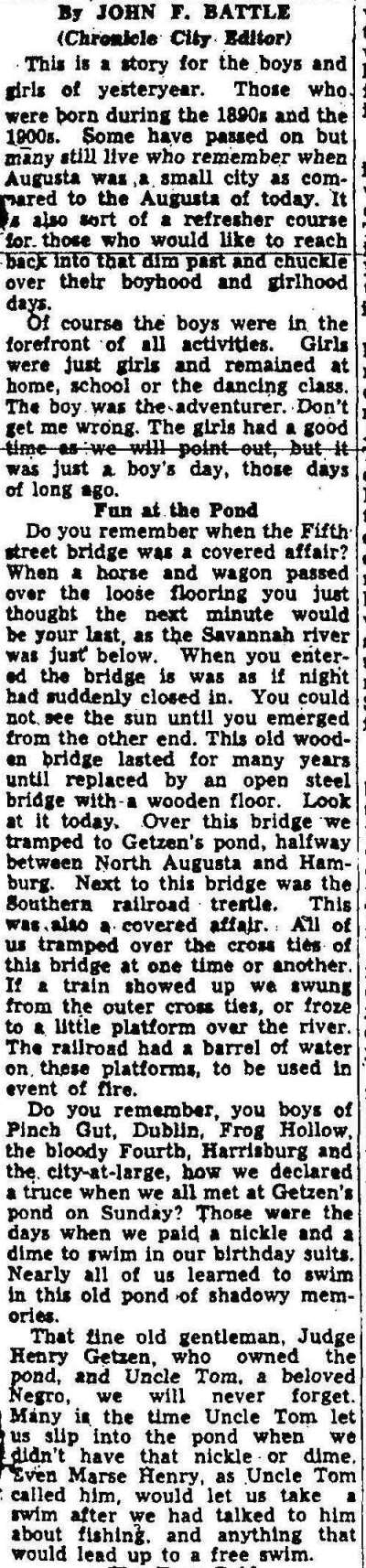
Excerpt from story. Augusta Chronicle, November 13, 1949:
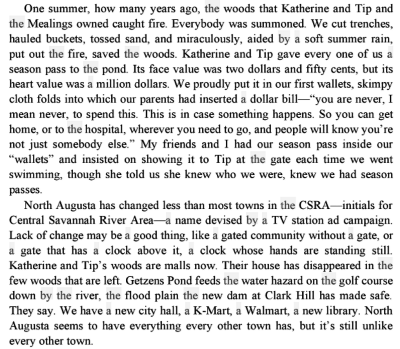
Excerpt from "A Little Different, a Little the Same" by Starkey Flythe. Anthologized in State of the Heart: South Carolina Writers on the Places They Love, published 2013:
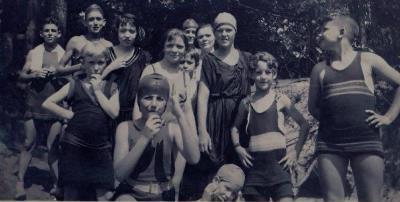
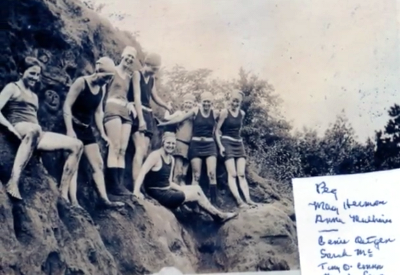
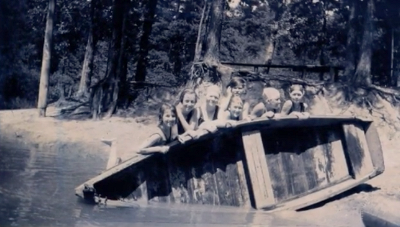
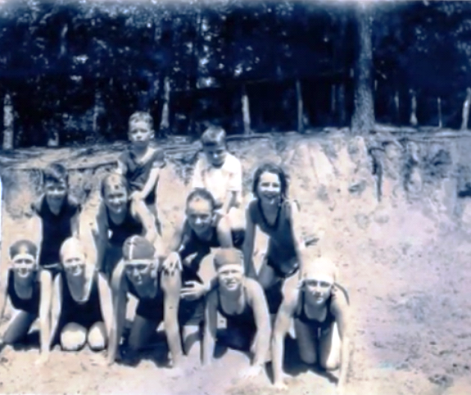
2015 UPDATE (Pt III): And the vintage Getzen's photos just keep on coming! These are from the 1920's or possibly even earlier and come via Ben Schweers, who received them from his aunt Peg. Peg Schweers is in the first picture and was later a sister of St. Joseph, Sr. Rose Margaret. You can find Bill Schweers listed as having completed a Senior Lifesaving course in the June 27, 1945 class list above. Thanks to the Schweers family, as well as Sheila O'Connor-Wilson, for providing such wonderful family photographs from Getzen's!
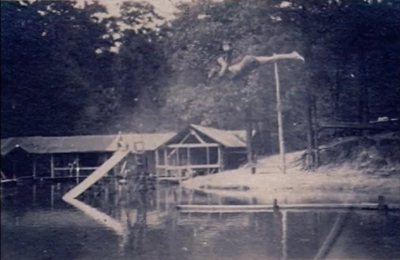
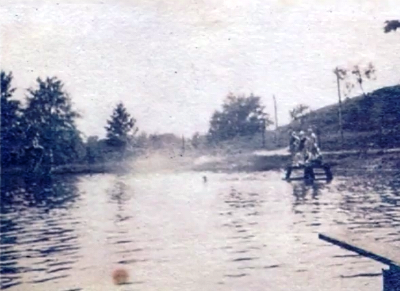
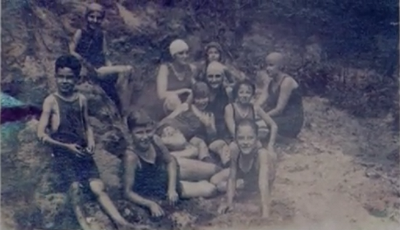
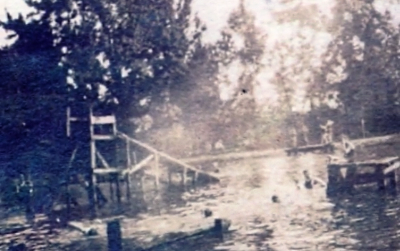
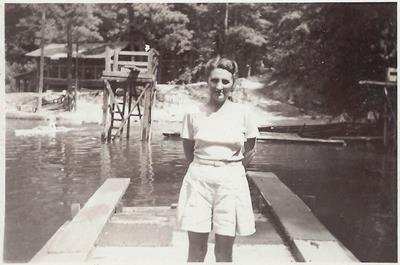
2015 UPDATE (Pt IV): Below we have the best photo of Katherine Mealing, who ran Getzen's Pond into at least the mid-1940's until costs became prohibitive, that I've ever seen. This was shot in 1949 or 1950 and clearly taken at Getzen's Pond, too! In fact, Getzen's might well have no longer been open to the public at this point. Many thanks to J.O. Nimeskern for passing along this gem.
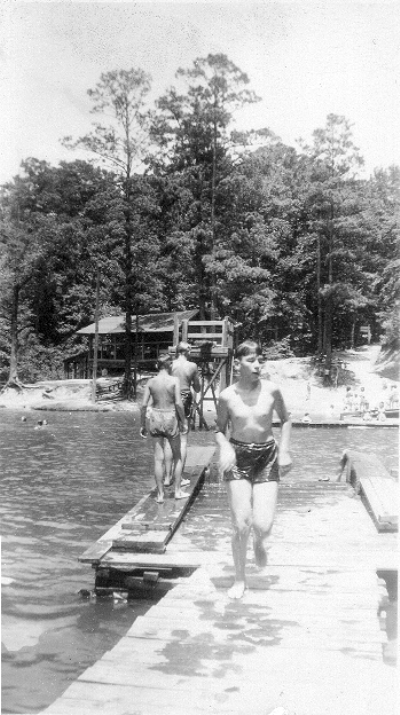
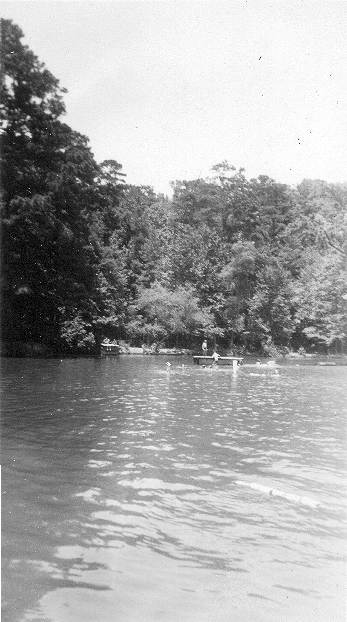
APRIL 2017 UPDATE: Recently a man named Bob Cooper left a comment below about his memories of Getzen's Pond and graciously offered to share his collection of photos. Not being foolish enough to pass up an offer like that, I had Mr. Cooper send them directly to me so that I could add them here. I'll include Mr. Cooper's original comment below. Any information I have about the pictures that follow will be included underneath the photo.
Many thanks to Bob Cooper for letting me post his treasure trove of vintage scenes from the heyday of Getzen's Pond! JM
"My father, Bobby Cooper, and his brother, Charles Cooper, Jr., were both lifeguards and swimming instructors at Getzen's Pond. They both later swam for the University of Georgia and were conference champions. My grandfather, Charles Cooper, Sr., taught there as well. In the early '70's I remember our dad taking us out there to swim. The road was a rutted, bumpy, sandy affair, and the water was ice cold. The swim platform was still out in the water, but the buildings were falling in. We went and visited with Katherine Mealing, as well. I have a lot of these photos as originals. They were shared by some of the kind folks posting here. Will Mealing was my great uncle. We also have a link to The Sibley Mill, it having been built by my grandmother's grandfather."
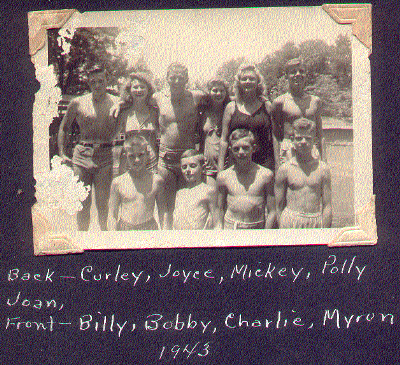
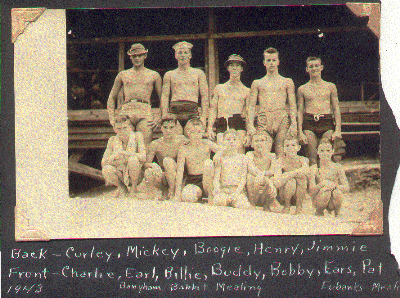
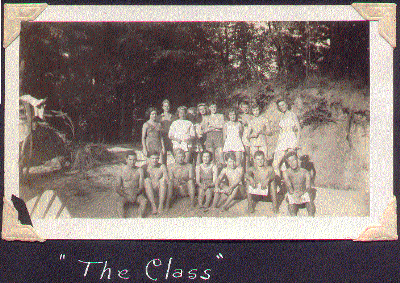
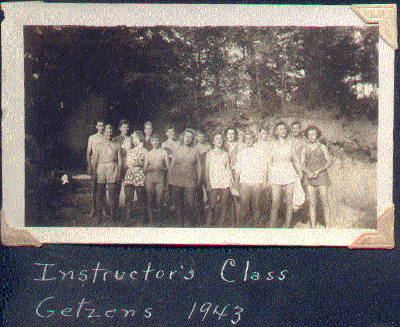

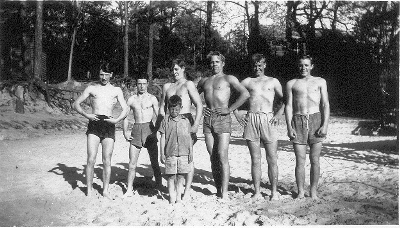
Above: Charlie Cooper, Clarence Sikes, and Bobby Cooper.
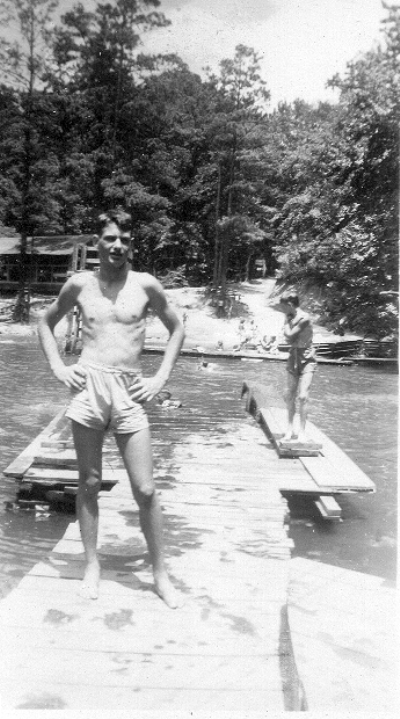
Above: Albert Kelly, Jr.
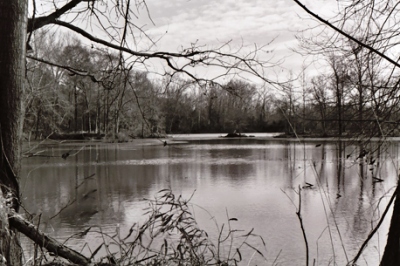
Hammond's Ferry is slated for 850 units of residential housing, in addition to a few retailers. Housing is already up for sale and the first unit sold went for $855,475; the second brought in $129,525. However, the project is already about a year behind schedule. The area has many wetlands, most old clay pits dug by the brick manufacturers. Only a couple are going to be set aside. I don't know if this (admittedly not a clay pit) is one of them.
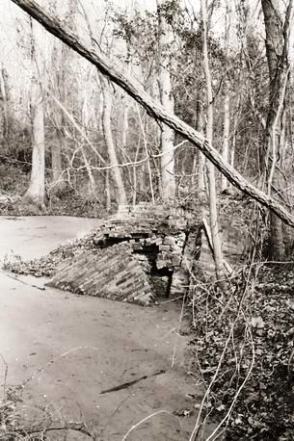 The development of Hammond's Ferry has actually been in the works for 15 years and the remnants of the old brick factories have been cited as one stumbling block. It's not going to be easy to move all that brick and concrete out of the bottomlands. Aiken County reports that all the brick factories were abandoned by the 1930's. The buildings don't look that old to me, but the North Augusta city administrator is quoted as saying, "When the floods of the 1920s and '30s kept coming, we just turned our back on the river and climbed up the hill." So, hell, maybe they are that old. Here's a claypit and a bit of brickwork.
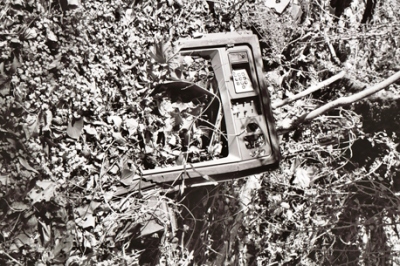
Another hold-up on the development was an archaeological dig. Since Hammond's Ferry had been a river crossing it was thought that there might be some interesting artifacts in the area. I managed to find some on my own just walking around. For instance, this television set is clearly an antique. Notice the keypad that was used to change channels. Barbaric.
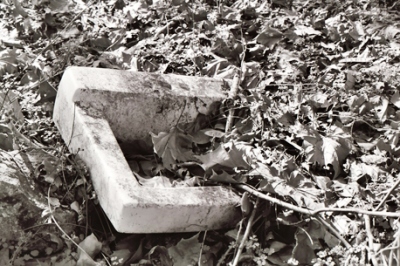
I have no idea how this sink got here. There wasn't much debris in this particular area. I also don't know what sorts of real artifacts, if any, the archaelogical dig yielded. No one seems to have said. Anyway, the dig is over and things can really get moving now.
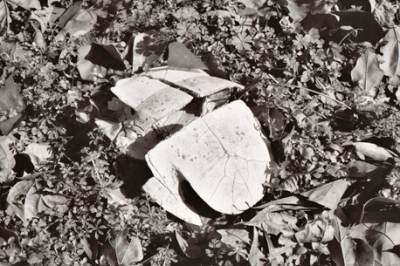
When the development project began in earnest turtles crawled out of the clay pits and committed suicide en masse in protest. Honestly, there were quite a few large bleached turtle shells lying around, all upside down. Maybe they fell victim to raccoons or something. Anyway, these turtles were probably better off getting out before things got really tough. Next time we'll visit Henry Clay's favorite swimming hole.
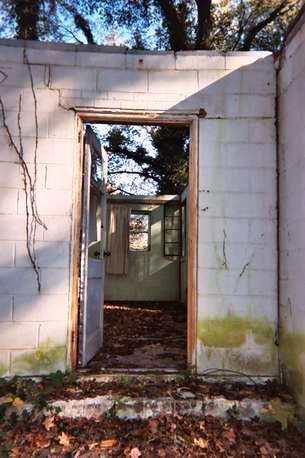 The area encompassing the aforementioned brick factory is known as Hammond's Ferry. Not surprisingly, it was once the docking point of a ferry that crossed the Savannah River from Augusta to North Augusta. I assume the dude that operated the ferry was named Hammond. (Update: Indeed, it was John Hammond. More information HERE.) Anyway, it will soon be paved over and turned into quaint little "Southern" neighborhoods that no one can afford to live in. So, it seems fitting to do a couple more posts on this doomed landscape.
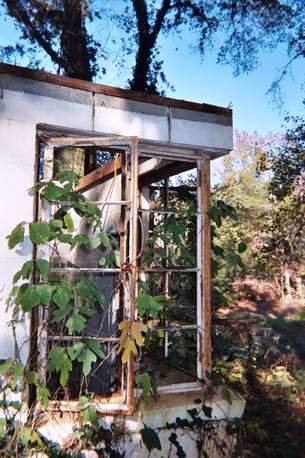 Alright, technically speaking, Crystal Lake isn't part of the Hammond's Ferry development. It's just across the road, in a small residential neighborhood. But in its heyday it was a big deal and one of the major swimming destinations in the area. Along an entire end was a large natatorium (yes, a "natatorium") made of stone. The streetcars were even routed right by it so swimmer's could get there easily.
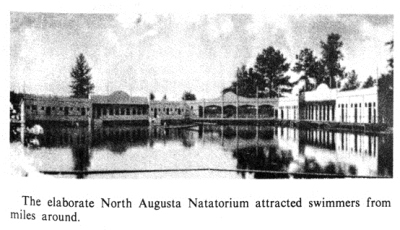
Here's an old photo of the natatorium I swiped from "The History of North Augusta, South Carolina." No, it has no author. It's nearly impossible to find a copy of this book at an affordable price (really, who would pay hundreds of dollars for such a thing?) so I hope no one sues me. The book is pretty interesting, but I don't think the publishers would appreciate my view of the area. It's more a bake sales and tea parties kinda vibe.
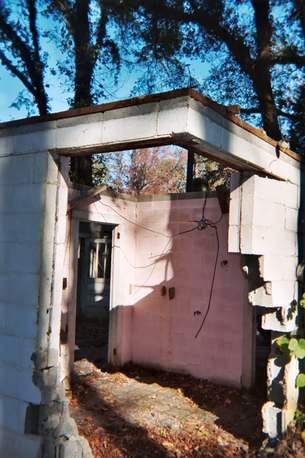 Now you'd never guess that the place was ever so lively. There's no trace of the natatorium, the streetcars are long gone, and no one in their right mind is going to go swimming in the weedy lake. Houses back up against the water on one side and, on the other side, is this bath house. I don't know how old this structure is or if it dates back to the halcyon days of Crystal Lake, but it's probably not long for the world. At one point a car veered off the road and ran into it.
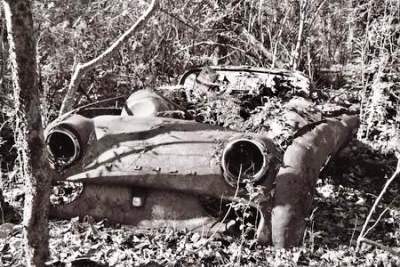
As you enter the Ferry region, just a bit back in the woods is an old Triumph sports car. I'd guess it's been sitting there for a couple decades, which is how long...
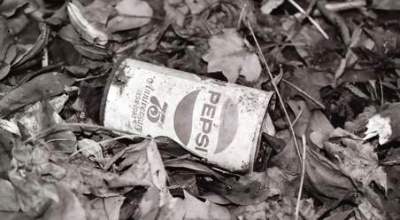
...this can has been here. Celebrating the 75th Anniversary of Pepsi-Cola in 1973, this can is just as old as I am. That is somehow sorta humbling. So far, I haven't been able to outlive a Pepsi can. Huh.
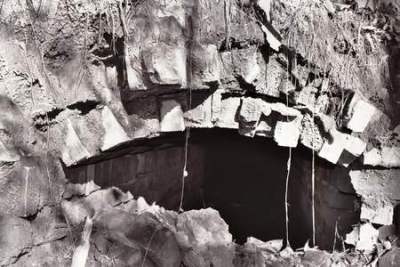
I just had to get a couple more pictures of the brick factory in. Last time I didn't mention that there was an extensive network of small tunnels under the complex. Never having made a brick, I don't know whether these were used as kilns, for cooling, or for moving the bricks around. In any case, the tunnels don't look like much from outside.
 But if you look inside the tunnels they go back as far as you can see. There were quite a few of these tunnels, as well as some old railroad tracks, and numerous trenches. It must've been quite an operation. This picture was taken by my companion on many of these trips who, for simplicity, we'll call XT235. More Hammond's Ferry next time. Happy Thanksgiving.
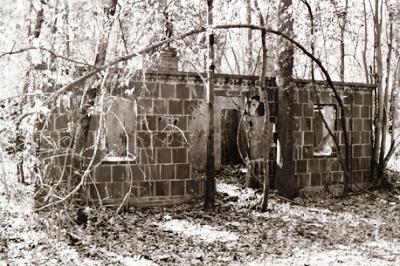
Alright, as I mentioned last post, we're moving across the Savannah River and into North Augusta, SC. In this case, we're crossing the 13th St. bridge, then heading a bit west into what is now forest. Here, tucked away amidst the trees and vines, is an old brick factory. I've tried to figure out just WHAT brick factory this was, but I can find no mention of it anywhere. No, not even on Google.
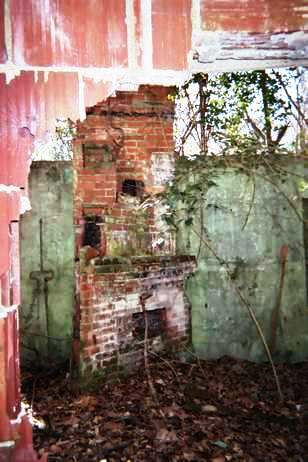 Georgia had statewide prohibition from 1908-1935, a span much longer than federal prohibition, which lasted from 1920-1933. So, South Carolina decided to meet the demand, in spite of some serious protest by the Temperance Movement, by building a package store, which could sell alcohol, just below the 13th St. bridge. As a result, the area under the bridge, just before you come to the brick factory, had a reputation for being somewhat unsavory. Even worse were the streetcars that passed by, often filled with drunk men. The women of the area stayed off the cars at certain times and days to avoid harrassment. In addition, every day, hundreds of people walked across the bridge, some for work, some for alcohol. It's amazing to imagine; there's nothing below the bridge now and hardly anyone crossing over. It's desolate.
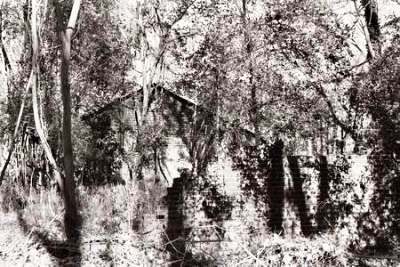
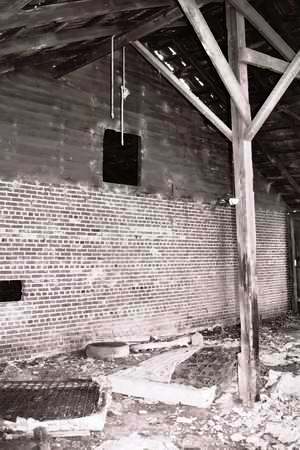 The package store operated for a long time, decades after Georgia repealed the prohibition laws. The building itself survived until relatively recently. About a decade or so ago, I believe, it burned down, the result of arson. Yes, you're absolutely right if you think that annoys me. I would've loved to have gotten into it. All that remains now is some cement flooring. However, it won't be long before even that is gone. They've got big plans for the area. This is a photo of the largest of the buildings in the factory complex.
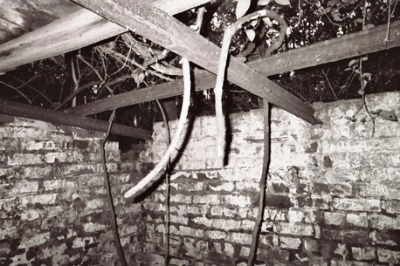
Even the ruins of this old brick factory are not long for the world. The city of North Augusta has broken ground on a massive development that will consume most of the woodland west of the bridge, all the way up to the river bank. There's going to be residential development, paved streets, apartment complexes, and even a huge convention center. Check out these drawings. Sure, I prefer it the way it is, but I don't think my bad attitude is the only reason the word "failure" springs so quickly to mind. Um, folks, Charleston is a bit farther east.
One of the most unsettling things you find around abandoned buildings (and also train tracks, deserted parking lots, river banks, etc.) are women's shoes. They're usually high-heels or something dressy and often in much better condition than the surrounding debris.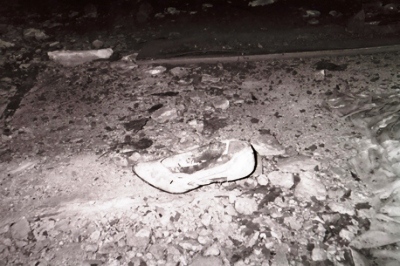 They're shockingly ubiquitous and it simply can't be good. In this instance, it appeared that a woman had lived in one of the smaller buildings in the complex. Judging by some of the other items left around it's possible she was a prostitute. I simply can't imagine that she brought customers to the factory. But I can say that most people would lose their minds if they had to spend a single night out here. Brutal. Did I mention that we're no longer doing the family-oriented posts?
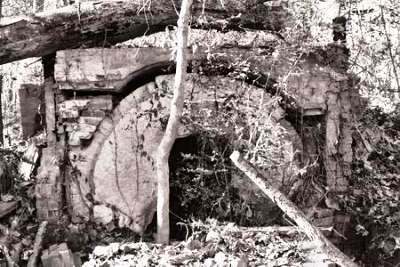
This kiln above actually not part of the larger brick factory complex, but some distance away. It was probably part of another factory altogether. I wish someone had written the history of Augusta's brick factories so I'd know what some of this was. In any case, there were many brick factories in the area because of the nice red clay. There are also remnant clay pits nearby, all soon to be filled-in for parking lots or whatever. I may post some photos of those later.
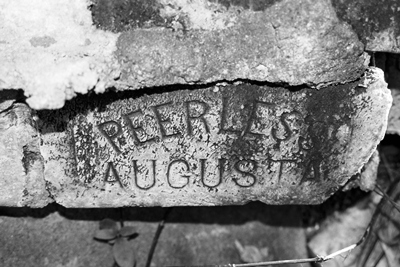
So, that's probably the most comprehensive overview of the area's remaining brick factories that you're going to find. Not much, eh? If anyone knows anything more, please contact me. Actually, if anyone ever knows anything more about any of the things I'm posting, don't hesitate to leave a comment. I'd love to hear about it.
2013 UPDATE: During my return to the Central Savannah River Area in 2012 for the Augusta Photography Festival I was told that this brick factory may have gone by the name Hankinson and Haugh Bricks. Also, it would seem this entire area is now in serious jeopardy. Not from the massive Hammond's Ferry Development, which for some reason hasn't encroached yet, but from a minor league baseball stadium that looks like it would be put right on top of the brick factory (and maybe on top of the very nice Brick Pond Park, too). Sorry, I just can't get behind it.
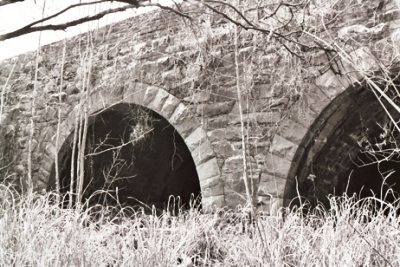
Rae's Creek drains the area to the south of the Augusta Canal. In 1845 an aqueduct was built to carry the canal over the creek. However, it was built of wood and didn't last more than 5 years. Masons were brought in from Italy to build a fancy stone aqueduct in 1850. Here's a picture of it. Apparently they still open the thing from time-to-time, which would've made for a more interesting shot. Actually, a child was drowned about 50 feet behind where this photo was taken and I believe it was due to just such an event.
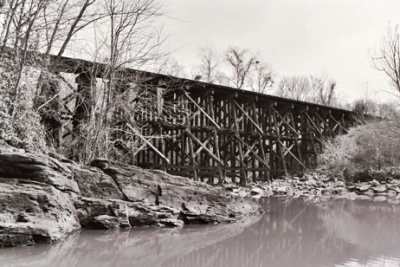
The area below the aqueduct looks downright picturesque, huh? From here Rae's Creek flows into the Savannah River. On the other side of the canal the creek is dammed, forming Lake Olmstead. Olmstead, who'd worked on the Eerie Canal, was one of the engineers hired to enlarge the canal, right around 1871. The enlargement of the canal was said to be "a work in width and depth in excess of any similar work in the world, save the Suez Canal." This was not true, but sounded good. The plan was to make Augusta the Philadelphia of the South. Did it work?
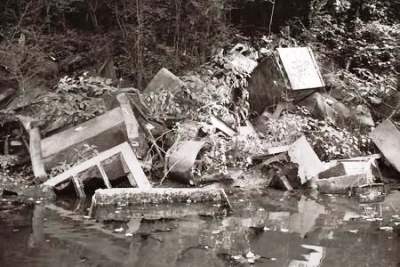
Apparently the banks of Rae's Creek were once used as a dumping ground for large appliances discarded by the citizens of Augusta. As you head down the creek toward the river you can see literally countless washing machines and refrigerators rusting into the earth. Even more are obscured by kudzu. They oughta bring some school kids out and get them to clean the place up for Earth Day. Get 'em used to heavy lifting.
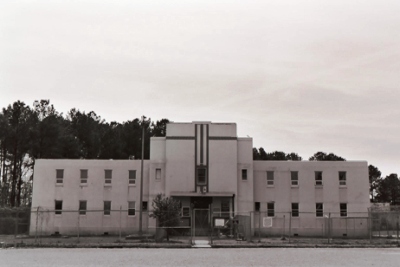 Isn't this jail just the cutest thing? Who wouldn't want to be incarcerated in an Art-Deco jail built for 10 inmates on the banks of the Augusta Canal? It makes you want to go out and do some crimes. But the only inmates now are wayward cats and dogs--the Humane Society of Augusta has taken it over.
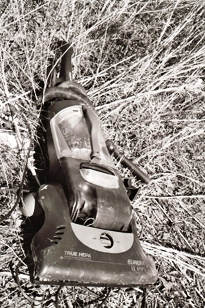 If you cross the canal by the pump house, go under the bridge, then beyond the baseball fields, past the deserted radio station, and down a dirt path strewn with junk that runs along Riverwatch Parkway (and, really, who wouldn't do that?) you'll find the small appliance graveyard. There's lots of dead lawnmowers back here, some small engines, a weed-whacker or two. There's a few bed frames and several bicycles, as well. Also, the occasional vacuum.
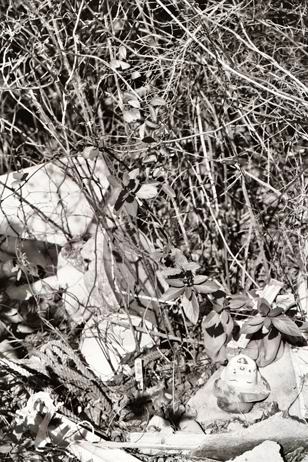 Who doesn't love clowns? Yeah, well, me. So, it was a real treat to find this guy discarded and peeking out of a raspberry bramble. In addition to being a dumping ground for small applicances, there's a surprising number of children's toys. Stuffed bears, plastic swimming pools, toy cars, it's all to be found amongst the dented gas cans and catbriar vines. Whatever happened to preserving the treasured items of youth? That "No Dumping Allowed" sign is really getting the job done.
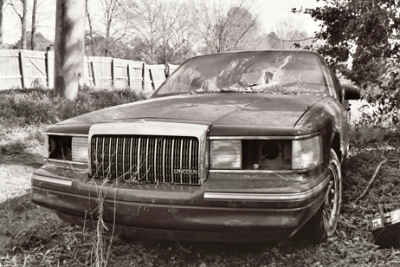 It's now time to head out of Augusta proper and cross the Savannah River into North Augusta, South Carolina. Ahead is the old brick factory, the nightmarish Hamburg honky-tonk/mission, Getzen's Pond (formerly a reknowned swimming hole, now deserted), and many other weird and alluring sights. Stay tuned.
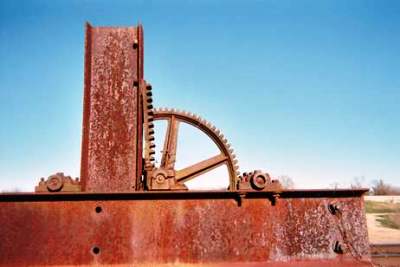
I think I'm going to back off a bit with a couple "family-oriented" posts. Don't worry, there's plenty of danger yet to come, but I'd like to get some photos of the Augusta Canal up, hardly a gritty topic. Or maybe it is kinda gritty. Anyway, Augusta might be even more desolate than it is now without the canal. Built in 1845 by Augustan Henry H. Cumming, it gave Augusta an economic out when the surrounding land could no longer support cotton or tobacco cultivation.
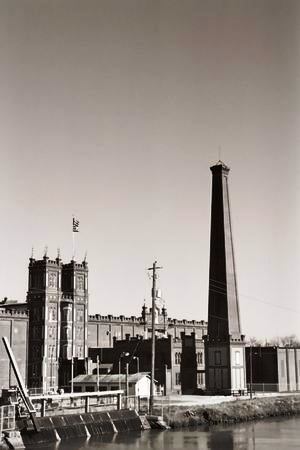 The canal was vital during the Civil War. The only buildings constructed by the Confederate States of America were part of the Confederate States Powderworks, which stretched for 2 miles along the canal and provided much of the munitions used by the Confederate Army. See that big obelisk? That's the only remnant of the powderworks. After the war, which left Augusta relatively unscathed due to Sherman's mistaken belief that Augusta was well-fortified, the canal became a boon for industry, particularly mills. This is the Sibley Textile Mill off Goodrich, one of the last functioning mills in the city. The King, which is also still in use, is half a block away.
In 1875 the canal was widened for industry, largely by Chinese immigrants who stayed in Augusta and formed one of the few Chinese communites in the South at the time. Working for the mills back in the late 1800's meant working for the man and the man was going to bleed you dry. 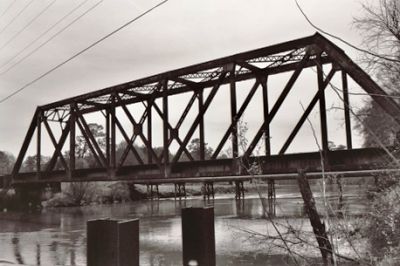 Children began working in the mills as early as age seven and days could be 11 1/2 hours long. This is back in the days before air-conditioning, ventilation in the mills was poor, and inhaling textile fibers might take years off your life. If you didn't like it you didn't work and good luck finding a job anywhere else. The mill companies generally owned the houses of the workers and when workers tried to organize they were soon out on the street. I hope I'm not giving Wal-Mart any ideas.
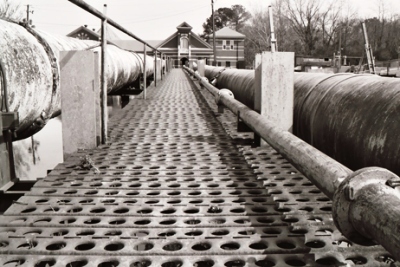
Augusta has gotten it's drinking water from the canal since the canal's contruction. This pumping station was built in 1892 and replaced an even earlier one. The canal generated enough power to make Augusta the first southern city with streetlights and electric street cars. There's a darn good mountain bike trail just off to the right of this photo.
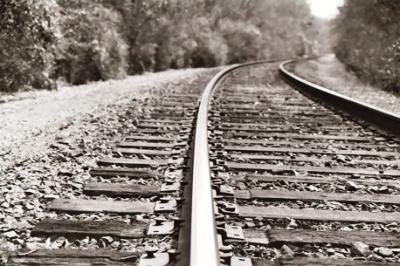
Where there's a canal there's bound to be train tracks. These tracks are still in use, although no longer carrying much product from the mills. The trains are a frequent obstacle while trying to get to the aforementoned mountain bike trail. Also, as far as I could tell, they're routed through the poorer neighborhoods right around the morning and evening rush hours. Pretty wise, that, since everyone knows poor people are never in a hurry.
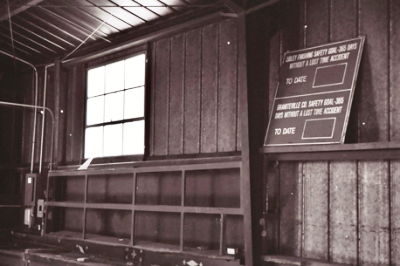
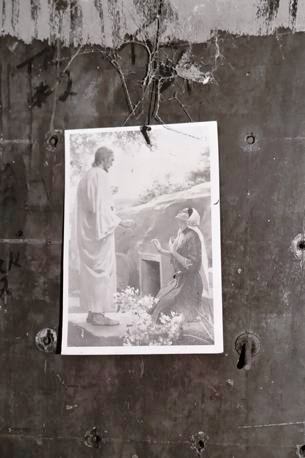 These two pictures are from the inside of what I think was a little dispatch building for the trains, although I don't know for sure. Pretty much everything along the canal began to fall into disrepair in the 1970's. Apparently there was almost no activity along the water. At least none that was legal. The future didn't look bright, but citizens wanted to preserve the area for recreation and worked hard to keep developers from doing their thing. For once the developers were put-off and the ball really got rolling in 1989 with the creation of the Augusta Canal Authority. Now its one of the most popular jogging/biking/dog-walking areas in the city, a museum has been built, and interpretive boat tours were started in the summer of 2004.
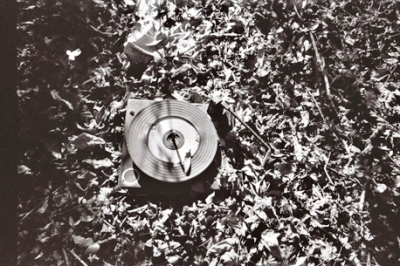
For centuries Augusta was frequently finding itself underwater. The contruction of a levee eased the problem and the canal was straightened in the 1920's and 30's, when spillways and taller embankments were also created. Even so, you can still find odd things in the river bottoms. There's lots of housing going up on the river banks, a testament to people's faith in modern engineering. They just better hope there isn't one of those 500-year floods that happens every 30 years. Additional information on the canal can be found here.


