skip to main |
skip to sidebar
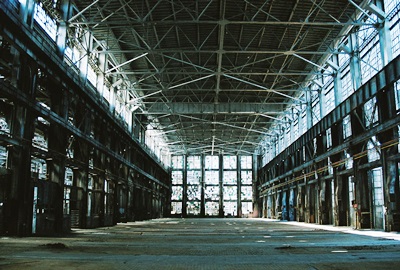
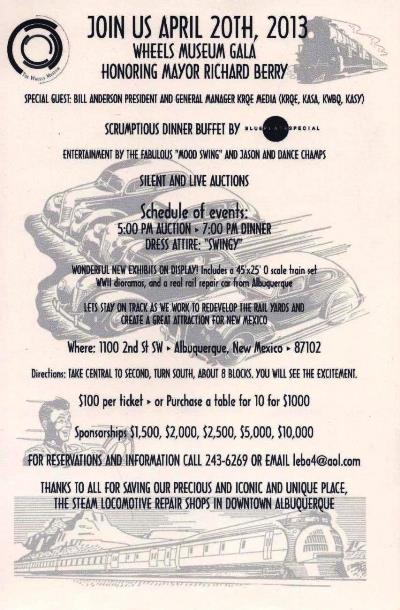
My favorite place to photograph in Albuquerque--by far--is the long-vacant Atchison, Topeka, and Santa Fe Rail Yard. A couple years ago I did an epic post on this “industrial cathedral,” recounting its storied history and featuring lots of photos. A short time later I collected my favorite rail yard shots and made a small book. So, I’m very pleased to announce that I’ll be selling framed prints of the rail yard at this year’s WHEELS Museum Gala Dinner honoring Mayor Richard Berry.
The gala will be held on April 20, 2013, beginning at 5PM with an auction. The event is also a fundraiser for the WHEELS Museum. For years, WHEELS has worked tirelessly to keep the rail yard in the public eye and ensure that any development plans incorporate the incredible buildings that make the place what it (still) is.
Now, tickets to events featuring the mayor don’t come cheap and the going rate is $100/plate or $1000/table. If you can't quite swing that just drop me a line at the e-mail address associated with my profile and I bet we can work something out.
I’d like to thank everyone at the WHEELS Museum for this great opportunity. More information can be found below or at WHEELS WEBSITE. I hope to see you there!
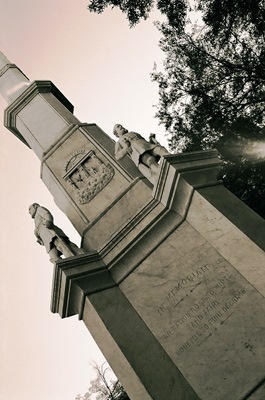 Before we leave Georgia, let’s take a quick look at the Augusta Confederate Monument, located in the grassy median of the 700 block of Broad Street, across from the Marion Building. Seventy-six feet tall with a Georgia granite base and the rest entirely of Italian marble, the monument is fairly imposing. Financed by the Ladies Memorial Association, it cost $17,331.35 to build, which wasn’t chicken feed in the 19th Century. But I admit that I drove past it every day for two years and never knew anything about it. I'm sure I wasn't the only one.
Monuments to the Confederacy can be found throughout the South and Augusta’s is considered to be the most striking in Georgia. Dedicated on Halloween 1878, 10,000 people attended the unveiling. The four statues at the base are of Generals Robert E. Lee, Thomas J. “Stonewall” Jackson, William H. T. Walker, and Thomas R. R. Cobb. But perhaps of most interest is the more obscure figure at the top, Private Berry Greenwood Benson, born across the Savannah River in Hamburg, South Carolina in 1843. If you want to read more about that infamous (and now entirely disappeared) town and the controversial memorial that commemorates a particularly bloody day in the summer of 1876, a year after Augusta's Confederate Monument was commissioned, you can see my post on Hamburg HERE.
But I digress. Private Benson was initially a member of the Hamburg Minutemen. He was captured by the Union in 1864 while fighting for Robert E. Lee’s Army of Northern Virginia and sent to Point Lookout in Maryland. Benson escaped by swimming two miles across Chesapeake Bay. After rejoining the fighting, he was captured again and eventually sent to a military prison in New York from which he tunneled out and then walked back to his regiment. Following Appomattox, Benson returned to Augusta with his rifle, having refused to agree to the surrender. Regardless of your feelings about the Civil War, you have to admire the guy’s tenacity. It’s what made him "the man on the monument," after all.
The inscription in the photo at the very top reads:
In Memoriam. No nation rose so white and fair: None fell so pure of crime.
Make of that what you will. But, in 2009, the monument was vandalized with spray-painted phrases that included, "I hate whites" and "cracker killers," amongst others. What d'ya know? I guess some people do read the thing. Interestingly, public opinion largely attributed the graffiti to white kids.
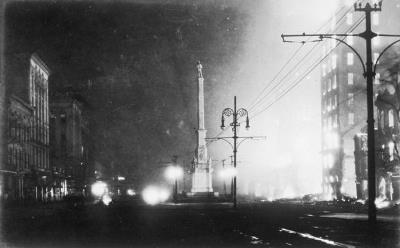
Probably I should have gotten some more photos of the monument, including a shot of Benson’s statue (duh), but instead I'll use the incredible shot above, taken while the Marion Building burned in March 1916. Other inscriptions on the monument read:
Worthy to have lived and known our gratitude
Worthy to be hallowed and held
In tender remembrance
Worthy the fadless fame which
Confederate soldiers won
Who gave themselves in life
And death for us
For the honor of Georgia
For the rights of the States
For the liberties of the South
For the principles of the Union, as these were handed down to them,
By the fathers of our common Country.
Our Confederate Dead
Erected A.D. 1878 by the Memorial Association of Augusta,
In honor of the men of Richmond County,
Who died in the cause of the Confederate States.
You can find more information about Augusta’s Confederate Monument on Wikipedia. Also, ‘Gusta in the Wa’er provided some useful tidbits. The picture of the 1916 fire came from the Augusta Chronicle. The Augusta Chronicle also did a piece on the 2009 defacement.
Now it’s over to South Carolina to investigate the night life of the 1940’s and 50’s.
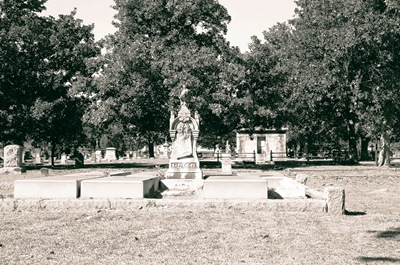
In 2005, I wrote a piece about Magnolia Cemetery and some of the people buried there. One of the most interesting stories was that of Wylly Barron. At the time, I didn’t have any photos of Wylly’s grave. But I paid him a visit last fall and finally got some shots. So, I think it’s worthwhile to reprise the tale of Mr. Barron, now with the proper photographs to accompany.
Magnolia Cemetery, designated as such in 1818, is the oldest boneyard in Augusta. In fact, the first grave was actually dug in 1800. Wylly Barron, once the gambling manager at the Atkinson Hotel on Ellis Street, not far from the Genesta Hotel, is literally cemented into a concrete mausoleum there, the bitter end of his sad story.
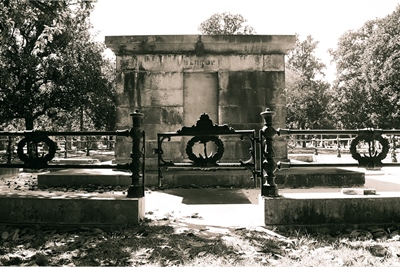
The story goes that a gambler at the Atkinson killed himself following some heavy losses, but before he did he cursed poor Wylly, saying, "You have taken everything I have. When you die, may you not even have a grave to shelter you." This spooked Wylly to no end and he started enforcing all sorts of regulations in his parlor to ease his conscience. People that handled money for their jobs couldn't gamble (they might steal), nor could minors. He also secretly gave money to anyone that had fallen upon hard luck and asked him for help. But, perhaps most importantly, in 1870 he had a mausoleum built in Magnolia Cemetery so he'd be certain there WOULD be a grave to shelter him. Good thing he did, too.
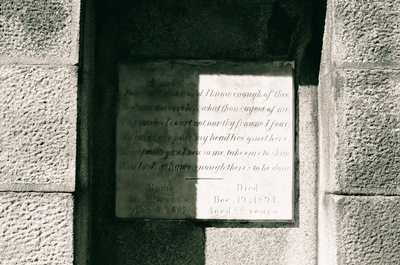
While Wylly Barron had led an extravagant life in his younger days, by the time of his death on December 18, 1894 at age 88, he'd lost all of his wealth. He was so broke a proper coffin couldn't even be purchased and his body was simply sealed up in the mausoleum. Then the keys to the mausoleum door--which was sealed shut anyway--and the encircling iron fence were thrown in the Savannah River, as he'd decreed in his will, so no one could ever remove him from his sheltering grave. His final epitaph reads: “Farewell vain work, I know enough of thee. And now am careless what thou sayest of me. Thy smiles I court not, nor thy frowns I fear. My cares are past, my head lies quiet here. What faults you knew of me, take care to shun. And look at home, enough there’s to be done.”
And that's how Wylly Barron beat the curse of a vengeful gambler.
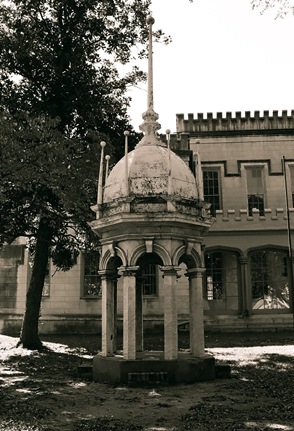 In the last post, which featured the Genesta Hotel, I mentioned the importance of Union Station in the development of 8th (aka Jackson) Street, once known as the “White Way” for its bright streetlamps, which burned all night long, guiding travelers to and from the nearby trains. Union Station itself was at 525 8th St., on Walker, and designed in the Spanish Renaissance style by Frank P. Milburn. Construction was completed in 1903 and the building fronted a leafy public space known as Barrett Square.
Union Station served the Atlantic Coast, Georgia, Southern, Central of Georgia, Charleston & Western Carolina, and Georgia & Florida railroads. That’s a lot of trains coming and going and, indeed, the station was large and majestic. So, naturally, it was torn down in 1972, four years after the last passenger had disembarked, and now a post office occupies the site.
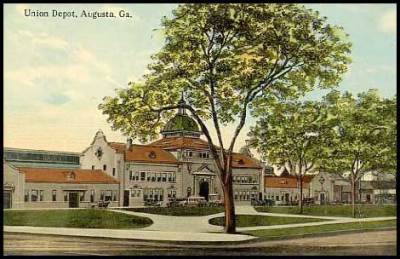
There is practically nothing in Augusta that would indicate that Union Station, once one of the most important buildings in the city, ever existed. I say practically nothing, because one thing does exist. Tucked unceremoniously into an out-of-the-way piece of tree-obscured lawn on Telfair Street, right in front of the Old Academy of Richmond County, stands the original cupola. You can even climb inside and imagine that you’re on top of Union Station, looking out at an early 20th Century scene, perhaps marveling at the smoky, bustling city and trying to remind yourself that in about 80 years you really should buy some Microsoft stock.
The historic postcard picture came from Rail GA, a website which seems to have disappeared. That’s also where I got much of the information for this post. The Old Academy of Richmond itself, seen in the background of the top photo, has been recognized by the National Park Service’s Historic American Buildings Survey. You can read more about the place HERE.
Next post we’re going to (re)visit a dead man.
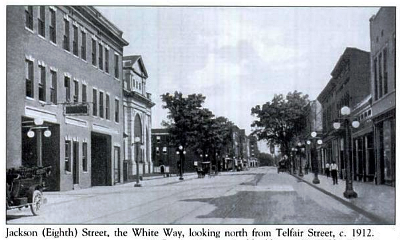
Eighth (aka Jackson) Street was once one of the most bustling thoroughfares in Augusta, Georgia. Union Station, a large railroad depot built in 1903, was located at 525 8th Street and all along 8th, from the station to the Savannah River, there were hotels and restaurants to serve the constant stream of passengers. In fact, 8th became known as the “White Way” because of its many street lamps burning all night long, guiding weary travelers. In the picture below, the Genesta would be up two blocks and on the left.
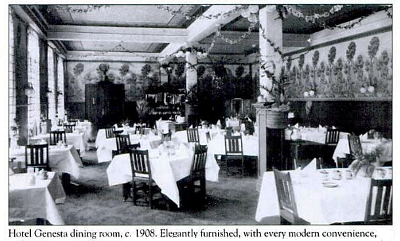
In 1905, two years after Union Station was constructed, the Genesta Hotel opened. At that time, it would’ve been one of many hotels on 8th Street, but it stood out for its elegance. In fact, on August 6, 1908, a supper party was held at the Genesta to celebrate that afternoon’s marriage of baseball great Ty Cobb to Ms. Charlie Lombard. Miss Lombard’s family was well-known in Augusta and quite successful. They paid for the party, although Ty would be soon raking in the big bucks himself. You see, there’s always been money in sports.
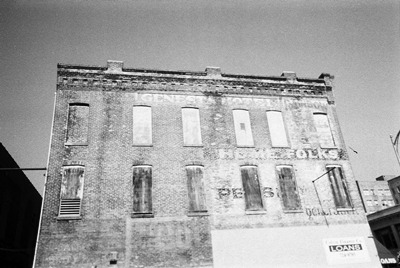
The Genesta Hotel burned in 1923, but was restored and, in 1932, renamed the Clarendon. Since then, its history has disappeared into the mists of time. For years the building has stood empty next to the Art Deco Woolworth’s, which was built in 1945 and has been vacant since 1992. As far as I know, the Genesta is the last hotel standing along the now-lamp-less White Way, with only the view from Ellis Street, which clearly shows the fading paint of the old sign, giving any indication as to what was once inside.
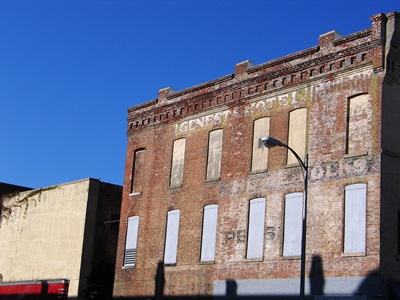
Union Station closed in 1968 and was torn down in 1972. Ellis Street, which I profiled with some photos back in 2005, sees little activity and even Eighth Street is mostly quiet these days. If you hope to hear the constant bustle of travelers and the conversations of the rich and famous as they dine at the Genesta Hotel, you’ll only be listening for ghosts. As for me, I just wish I’d found a way inside to hear them better.
I got some info on the Genesta from an Augusta Chronicle article mentioning a silver tablecloth crumber from the hotel being added to the Augusta Museum’s collection. Some facts about Union Station came from Rail Georgia. The historical pictures of the Genesta and the White Way are from Augusta in Vintage Postcards by Joseph M. Lee III. Finally, I learned the nugget about Ty Cobb’s wedding supper from Ty Cobb: Safe at Home, by author and Central Savannah River Area historian Don Rhodes.
Three posts ago I said that I had four more locations to document from last fall’s trip to the greater Augusta, GA area and then it would be back to the Wild West. Well, I can’t always be believed and I’m nothing if not a completist. So, to ensure that all bases are covered and no mediocre photo goes unused, we’ll do a few more transmissions from the Classic South than I’d originally envisioned. Here’s one from the historic Harrisburg District in west Augusta.
If you want to know where Harrisburg is, travel west on Broad Street from downtown. You’ll soon encounter the Sibley Mill. Now look all around you. Harrisburg! The neighborhood is quite old and its beginnings can be traced back to namesake Ezekiel Harris, whose home--now a museum--at 1822 Broad was built in 1794. According to the Smithsonian, it is the "finest eighteenth century house surviving in Georgia." In 1800, the area officially became known as the Village of Harrisburg and for several decades was not very populated. That all changed in 1875 with the construction of the nearby Augusta Canal and its attendant textile mills. Soon, industrial and economic growth had Harrisburg booming.
After over 50 years of prosperity, mill work had begun to slow by the 1930s and what had formerly been company houses for millworkers were sold to private individuals. This was the start of a long decline which hasn’t quite been arrested yet. In 1972, a number of homes were simply demolished in the name of “urban renewal.” A big blow came in the 1980’s, when the John C. Calhoun Expressway was constructed, essentially cleaving Harrisburg in two. You know your neighborhood isn’t high in the social hierarchy when they put a major road through it.
But now something interesting is happening. The Augusta National Golf Club has reportedly been buying property in the Harrisburg District with an eye toward creating accommodations for golfers, particularly during the Masters. What had previously been weedy lots or dilapidated residences selling for a pittance are suddenly getting more valuable.
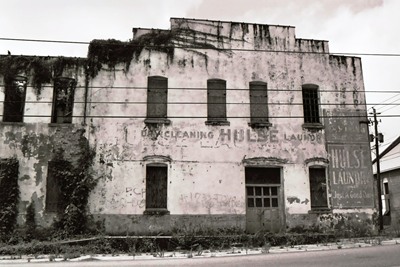
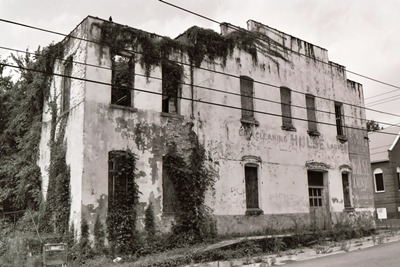
On this particular trip, the goal was to pay a return visit to the Hulse Laundry building at 1976 Ellis St., in view of the Sibley Mill. Hulse Laundry was established by Frank Hulse and his son in 1910. They moved into a building originally built in the 1880s for the Rufus and Carter Tobacco Company and, in the 1960s, changed their name to Hulse-Taylor Dry Cleaners. (JANUARY 2024 UPDATE: Thanks to an anonymous commenter below, who wisely consulted Sanborn Fire Insurance Maps, the establishment of Hulse Laundry has been pushed back to before 1904. At that time, it was on the opposite side of the street from the Rufus and Carter Co. Further, they dated the building shown ehre to 1921, the original Rufus and Carter building having burned on June 20, 1918. City of Dust thanks them!) They often used the somewhat unusual slogan, “Just a Good One,” in their advertising. But by the 1970s, after over 60 years in business, Hulse Laundry finally went under, leaving the building vacant. In 1984, the property was gutted by fire. And so it remained, still majestic despite the 20 years of slow decay that had passed, when I last saw it in 2004.
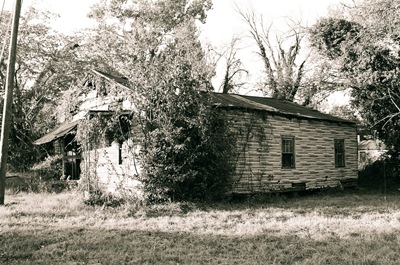
Twenty years is a long time for a vacant building to stand. Twenty-eight even more so. Still, I was a bit surprised to be driving around Ellis St. unable to locate Hulse’s, not quite convinced it was actually gone. Eventually, a homeowner wondered why in the world someone was wandering around his neighborhood with a camera and stopped to see what was up. His house appeared to be adjacent to the lot where Hulse’s once stood and he was fairly certain the old laundry had been torn down shortly before he bought his property for…$4000. Since then, he’d been offered $40,000 from the Augusta National folks, but had turned it down. His wife thought maybe they should sell, but he said, “This is my home now and I don’t want to leave it.”
Years ago, the National Park Service designated these Harrisburg - West End neighborhoods as an historic district. As far as I can tell, this has had no real impact on the area good or bad. But golf? Who knows what that will do?
There’s not much information out there on Hulse’s. A now-off-line article in the Augusta Chronicle was all I could find. But it’s a good article if you can find it, too! If you want to see what the National Park Service has to say about Harrisburg, some of which I paraphrased, go HERE.
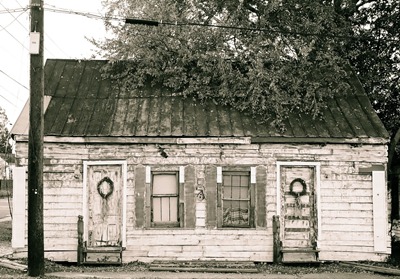
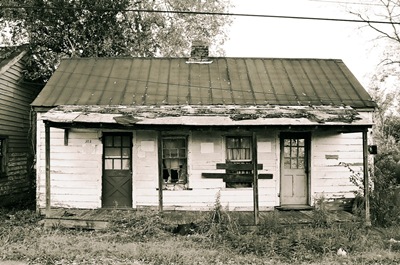
The photos at the top and bottom of this post are outtakes from my original piece about the neighborhood. The new shots are from nearby streets that for decades and decades would’ve brought customers and employees to and from Hulse Laundry. These streets have been much quieter for years now, but it seems that might soon change.
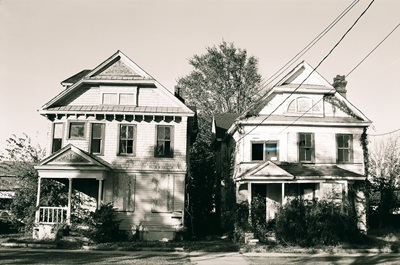
In the over eight years that I’ve been doing City of Dust, rarely have I ever used the same photo in more than one post. The few times that it’s happened have mostly been mistakes. Hey, I’ve taken a lot of shots; sometimes I forget what I’ve put where.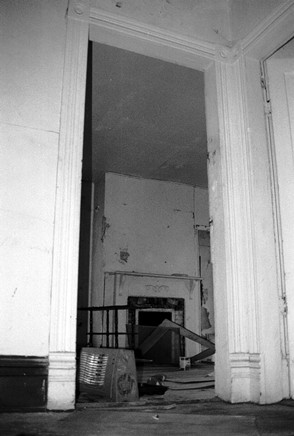 However, in this post I’m going to re-use some stuff. In the spring of 2010, I was back in Augusta for a couple days and visited what are known as the “Upper Broad Street Houses.” A short time later, I used the photographs I took, which were a bit gritty (hey, there’s a surprise), to illustrate a charming tale called “The Housecleaner.” I thought they worked well with the story and, frankly, I didn’t know much about the history of the old homes. In the interim, I’ve learned more and, since there is also one less of them, I took a few additional photographs last fall. One must always document while one can.
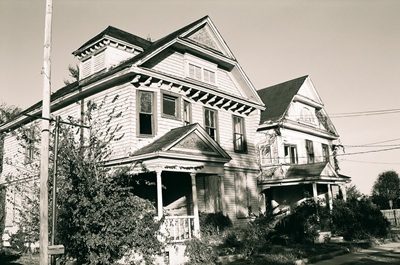
Located at 1425, 1427, and 1429 Broad St., the Upper Broad Street Houses were built in 1896 by the J.B. White department store company as residences for their employees. At one point, there were at least 20 such homes along Broad and tenants were eventually given the chance to purchase them. A February 2, 1919 article in the Augusta Chronicle mentioned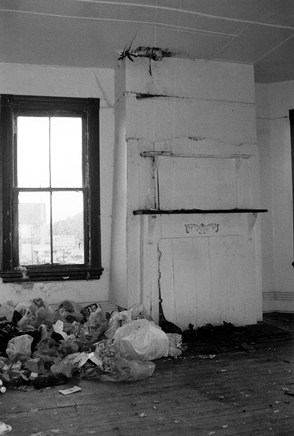 that there were three different types of houses selling at three different prices. Houses were to be first offered to the employees who already resided in or near them, with the Chronicle noting that interest was to be expressed to the J.B. White Estate via the Alexander-Goodwin & Garrett Agency by March 10, 1919 or properties would be sold to someone else. One block north, on Jones St., J.B. White had constructed 20 tenement houses for African-American tenants. For some reason, it seems these were not to be sold until the occupants on Broad St. had made up their minds to buy or move out. On June 9, 1919, the public was notified of their “last chance” to buy an Upper Broad Street House. Prices ranged from $4000 to $4500.
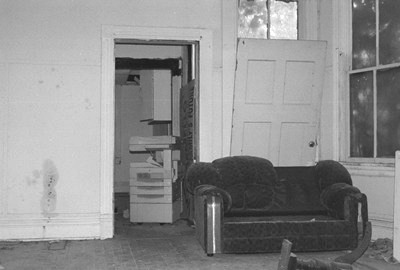
Of the three, the house at 1429, built as a duplex, is the largest. Decorative designs on the front façade gables are visible and the windows that remain are said to be original.The middle house, 1427, is also a two-story home,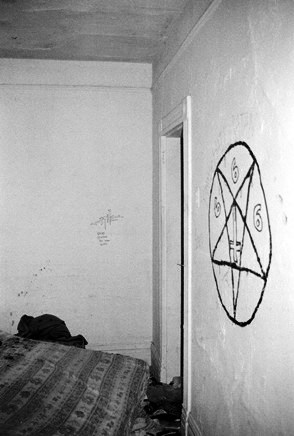 but was built as a single-family residence. On the corner, the house at 1425 was another duplex and contained six rooms. As of 2011, it was considered to be in the best condition of the three. Then, in October of that year, a fire, probably started by a homeless man, gutted 1425 and it was soon torn down. All three homes had long been threatened by the construction on St. Sebastian Way and it seemed no one could decide what to do with them. But, since flames work quicker than city government, there are now just two vacant 19th Century homes awaiting their fate.
Besides 1427 and 1429 Broad St., there are two additional J.B. White homes still standing. Both are occupied, which is a nice change of pace.
Most (if not all) of the interior shots are from 1425. Where one finds Slayer graffiti, one will often soon find destruction. Interesting, that. We've also got two different film stocks. As usual, the cheap stuff developed at Walgreen's looks better.
Almost everything I know about these houses I learned from Historic Augusta, who had just listed them as endangered properties when 1425 burned. Also, the Chronicle did a short piece on the houses after the fire.
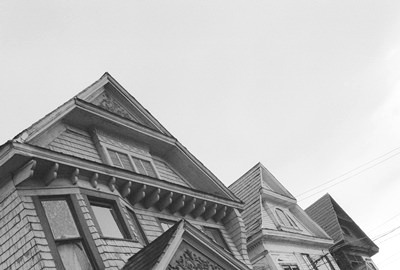
“Photographers deal in things which are continually vanishing and when they have vanished there is no contrivance on earth which can make them come back again.” Henri Cartier-Bresson.
You know, it’s hard to argue with Cartier-Bresson. But perhaps that’s because what he said is simply a truism. It’s not just photographers that deal with things that are continually vanishing, but every human being every second of the day. You want your grandparents back? Nope. Your high school girlfriend? Gone. How about today’s lunch? No dice. Unless, of course, you had the foresight to take a picture of it with your phone and post it on Facebook. Then you, too, can feel like an artist on par with Cartier-Bresson. You know, sometimes this art gets a little high-falutin’ for me.
So, with that out of the way, let’s make a stop at the former house of the Reverend Charles T. Walker, 1011 Laney-Walker Boulevard, Augusta, GA. The Reverend has vanished, but the impact of his work remains. As does his church. And his house. But while the former is doing fine, the latter is in some trouble.
Reverend Walker was born into slavery near Hephzibah, GA in 1858. An orphan by the age of 8, he found Jesus while hoeing cotton and would later eat only two meals a day to pay for his studies at the Augusta Theological Institute.
On August 21, 1885, Walker was the driving force in establishing the Beulah Baptist Church in Augusta. Three days later he asked that the name be changed to Tabernacle Baptist Church. And so it was. The first congregation numbered 310. By 1889, membership was at 2,000, largely thanks to Walker’s sermonizing. People began to call him the “Black Spurgeon,” a reference to British Baptist minister Charles Spurgeon, then known as the “Prince of Preachers.” Indeed, Spurgeon invited Walker to give a sermon in London, where it was said Walker enraptured the crowd with his fiery and erudite style. So, Walker was good. In fact, President William Howard Taft, John D. Rockefeller, and Booker T. Washington all came to hear his services.
Walker was also a very early pioneer in the civil rights movement. In 1891, after visiting the Holy Land, he began to criticize the “separate but equal” doctrine ever more vehemently. Commenting on black migration after the Civil War, he said, "It was a mistake for blacks to leave the South, since prejudice was national and not sectional.” And at a speech in Carnegie Hall before 8,000: "The Negro is an American citizen. The amendment to the Constitution did not make us men; God made us men before man made us citizens!" Bear in mind, Walker was saying these things at the turn of the 20th Century. Very brave, indeed.
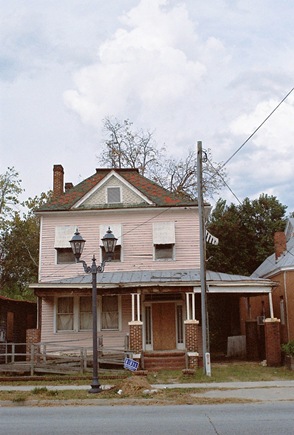 At first, the Tabernacle Baptist Church was a two-story brick building on Ellis St. that held 800 worshippers. In 1915, a move was made to a striking building on Laney-Walker Boulevard with twin sanctuaries which could seat 2300, just a couple blocks from Walker’s home, shown at left. The church has been restored and is where Walker was buried when he died in 1921. His obituary appeared in the New York Times with the headline, “Augusta Pastor Was Called Greatest Negro Preacher of His Time.”
So strong did Walker’s influence remain that the Tabernacle Baptist Church could not help but become a focal point in the Civil Rights struggles of the 1960’s. In 1962, Martin Luther King, Jr. spoke at a meeting of the Southern Christian Leadership Conference held there, the torch having clearly been passed.
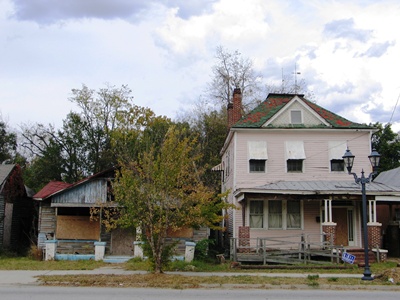
So, that is just some of what’s known about Reverend Charles T. Walker. All I can tell you about his house is that it’s been painted pink and is in a very bad state. The house next door, pictured above, has burnt and it seems only a matter of time before a similar fate will befall the former home of the Black Spurgeon. Some things that can be photographed might disappear, but other things that are harder to see with the eye may not.
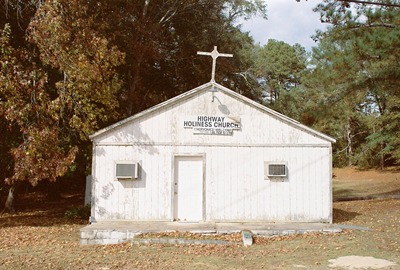
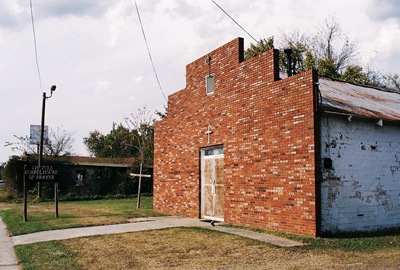
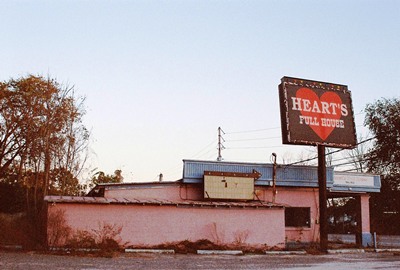
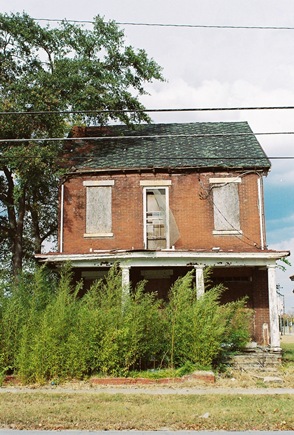
I’ve never taken a picture of the Tabernacle Baptist Church, which is dumb. But the photo at the top of the Highway Holiness Church was shot near the junkyard on the Aiken-Augusta Highway. The Full Gospel House of Prayer is on Sand Bar Ferry. The Deacon asked me just what I was doing in front of his church after I took that photo. I don’t think he was very impressed when I told him. Sorry, Deacon, there was no disrespect intended. I hope that's clear from the photo. Heart’s Full House might once have been a house of a different type of worship, but its soul has disappeared. The house below would be the next on the left in the shot above. So, you can see that the problems in the neighborhood are not exactly isolated.
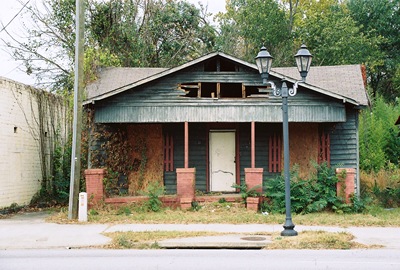
If you want to read more about Reverend Walker, his biography is available on-line right HERE. The wonderful quotes came from an article in the Augusta Chronicle which is no longer on-line. I grabbed a bit of background from former Congressman Barrow's old website and a long-gone Georgia tourism page.
 One of the buildings I really wanted to visit on this last trip to Augusta, Georgia was Lam Brothers Food Store at 1024-1026 D’Antignac St. Jack Lam, whose family emigrated from China, opened the store with his father and brother shortly after their arrival in 1941. I believe the building was already there by then, having been constructed in what was once an Irish neighborhood prior to Jim Crow zoning laws really sinking in their teeth early in the 1900’s. Eventually, Jack’s father and brother moved on and he ran the store solo, sometimes working “twenty-four hours a day.” Jack Lam also helped other Chinese people come to the U.S. and become citizens, earning himself an award from the Daughters of the American Revolution in 1972 for his work. Lam thought a hand-painted sign in the front window of the store symbolized his journey and success. It read, “Old-Fashioned Butcher Shop.” I guess he liked the old ways. Some information would indicate that they even served dim sum at the store.
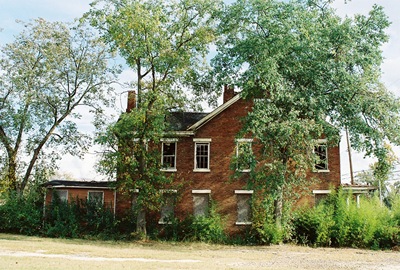
Lam ran the business for just over 50 years, meaning he probably left the building in the early 1990’s and, as far as I know, no one else ever moved in. I have to wonder if Lam drove past his old store every now and then, watching it slowly decay as vandals and drug addicts took it over. He is said to have loved driving through town in large automobiles. Or maybe he stayed away, knowing he’d only become saddened by what he saw.
Lam died on July 7, 2006 at the age of 85. It was certainly a blessing that he did not have to hear of the murder of 31-year-old Lawanda Person Tanksley nearly five years later in the place where he’d done his life’s work. It was May 15, 2011 when Ms. Tanksley’s body was found in Lam’s Store. As far as I know, her murderer has never been found.
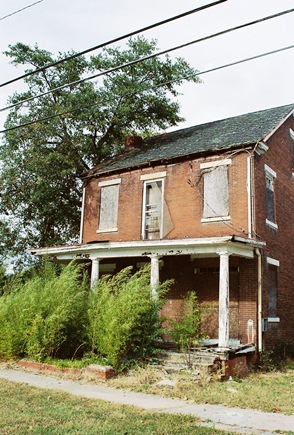 Lest anyone think that my last post was overly dramatic or that roaming around vacant buildings—even historical vacant buildings—is without a very real risk, I would submit the example of Lam’s Store. Exploring old buildings is not something I have EVER recommended to anyone. It is often unwise and much better left to the pathologically compelled. To come upon a dead body would be bad enough. To come across the murderer might prove fatal.
That said, Lam’s was a unique and beautiful building with a long history. Having missed a chance to visit pre-murder, when I was back in Augusta in the spring of 2010, I was looking forward to finally checking it out. However, another drawback of documenting abandoned buildings is that they tend to unexpectedly disappear. Such was the case with Lam’s Store. Aside from its structural problems, after the murder the building’s reputation was so tarnished that there wasn’t much left to do but take it down. Now there’s just grass where Jack Lam spent over 50 years of his life.
The only photos I've ever seen of the inside of Lam’s Store are HERE. Note that the photographer strongly dissuades anyone from visiting and was clearly unnerved by the murder and the drug paraphernalia scattered over the floor. But they also found the remains of an old piano and, hey, that’s pretty cool, right?
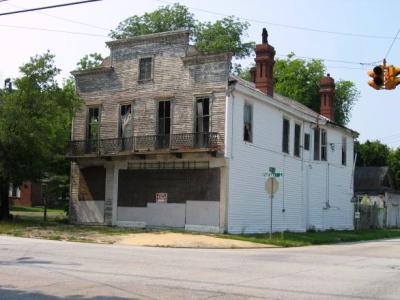
So, instead of stepping into Lam Brothers Food Store, you mostly get photos taken at 811 D’Antignac St., just a couple blocks away. Also vacant for years, 811 D’Antignac was built somewhere between 1850 and 1870 in the Greek Revival style. Its owner was Atlanta Gas Light Co. as late as 2006 and I suppose they might still own the place. Beyond that, I can find no record of who has lived in the house or what they might have done with their lives. Anyone?
I got some of the background for this post from this article on Augusta's African-American landmarks, but mostly I used Jack Lams' obituary and a crime report. The Lam’s Store photo is from the Chronicle and it physically pains me to put it here knowing I never got a shot of the building. Like I said, pathologically compelled.
We’ll make one more quick stop at an historic house I didn’t get into and thus walked away from with nothing but a few mediocre external shots. That will make three. Then, we’ll re-visit the remaining two of the original three upper Broad Street houses and, for our final Central Savannah River Area post, we’ll check out the empty field that was once a major concert destination in South Carolina to see if we can hear the ghosts of Duke Ellington and Cab Calloway on the wind.
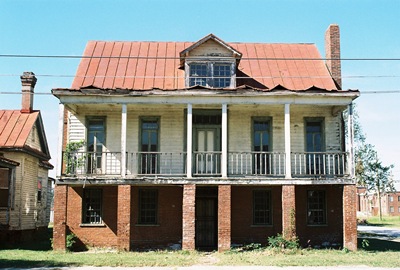
Back in 2005, I wrote a post called Access Denied in which I described why I hadn’t photographed a particular part of Augusta, Georgia. This area included streets to the south of Walton Way and north of Laney-Walker Boulevard, bounded by Augusta’s famed medical colleges to the west and East Boundary to the, uh, east. Historically, this rectangle of neighborhoods was known as “The Terry,” a contraction of “Negro Territory.” This is where James Brown grew up and, at the time, I lamented not feeling that I could safely visit Twiggs St., where his childhood home had been, as I’d been told it was amongst Augusta’s “poorest and most dangerous neighborhoods.” I’d heard rumors ranging from the streets being unpaved to police not bothering to patrol. I sheepishly mentioned that I had at least driven through those streets. And they did appear to at least be paved.
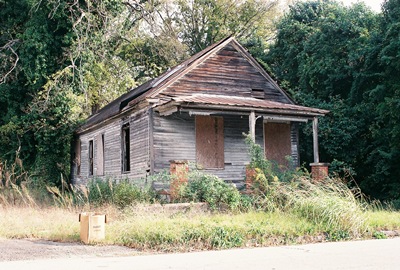
A short while after I posted that piece, a commenter took me to task for not only believing what I’d been told, but for letting my wariness get in the way of visiting some historic places and taking some photos. This person dispelled many of the rumors and told me of the friendly, hard-working people that lived in the vicinity. The commenter wrapped-up by inviting me to visit these neighborhoods with them and see for myself the streets they‘d known most of their life. Of course, they were absolutely right. Mostly.
While my visits to Augusta since have been brief, not allowing me the time to contact the commenter and see if their offer still stands, I have gotten to know the neighborhoods I was referring to rather well. I even did an entire post on the address where James Brown grew up, his actual home, which also housed his aunt’s brothel, having long-since been torn down.
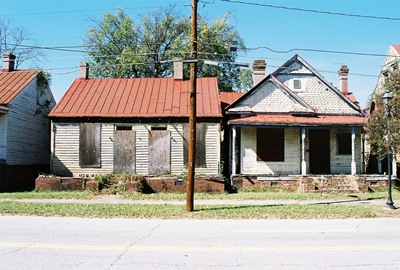
In Access Denied, I referenced “Stranger with a Camera,” a documentary about a film crew that ventured into rural Kentucky in the 1960’s to juxtapose the poverty there with footage they’d captured in more affluent parts of the country. While some people were happy to be filmed, hoping that the exposure might bring attention and federal aid, others were not so thrilled to have outsiders meddling in their business. On the last day of filming in Letcher County, Hobart Ison, a landlord who owned some houses where families were being interviewed, shot at the crew, killing Scottish Canadian photographer Hugh O’Connor. Ison was never convicted of any wrongdoing, the photographer, after all, having been on his property.
“Stranger with a Camera,” is required viewing for anyone interested in the fine line between documentation and exploitation, empathy and intrusion. Many of the messages of the film remain pertinent, among them this: “If you have a camera, be careful where you point it.” While it might have been silly of me to be intimidated by the things I’d heard about The Terry, that doesn’t mean that prudence was unwarranted. If that was the case in the neighborhoods I just described, it’s even more true farther south on Twiggs, where the historic Dr. Scipio S. Johnson House can be found.
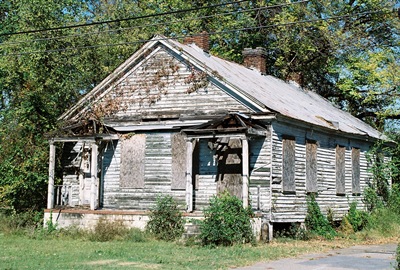
Located in a part of Augusta known as the Bethlehem Historic District, this stretch of Twiggs, near where it becomes Martin Luther King, Jr. Blvd, is about as blown out a collection of streets as a person could find. The reasons include the usual socio-economic ones that plague many American cities. The history of this district is indeed rich, as described by the National Park Service in a piece that doesn't quite show the whole picture, I'd say. I would certainly love to know more about the district and the fascinating buildings that line its streets, now mostly empty shells. But this is where I have to depart from my commenter just a bit. For me to blithely roam around Old Savannah Rd. or 12th St. or parts of Wrightsboro Rd. on my own, poking my head in the open doorways of vacant buildings, rental car parked at the end of the street, camera around my neck, would be a kind of naivety that I’m just not a fan of. It might even be disrespectful. But I had a look at the S. S. Johnson House, feeling much as I did when I heard the stories of the film crew in Kentucky, “If something goes wrong, at least you shouldn’t say that you didn’t know what you were getting into.”
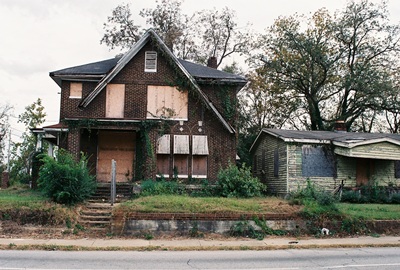
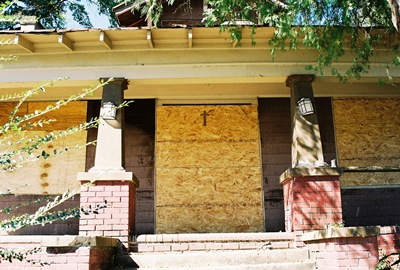
Now, Scipio S. Johnson was an African-American doctor who lived at 1420 Twiggs St. (pictured above) from the time the house was built in the 1920’s until his death in 1932. Dr. Johnson was a graduate of the Haines Institute, the Lincoln Institute, and Georgetown University. Nearby Johnson St. is, in fact, named for him. He was also a pharmacist and for a time ran a drug store right out of 1420. The two-story, Craftsman-style brick home is one of the largest in the Bethlehem District but it’s in pretty bad shape. The windows, which were considered historic in themselves, have been replaced by plywood. At least the boards were nailed-up tight enough not to tempt me. And that second story porch in the photo below is rather rickety. Who knows what’s gone on inside at this point? In late 2011, the house was added to Historic Augusta’s Endangered Properties List.
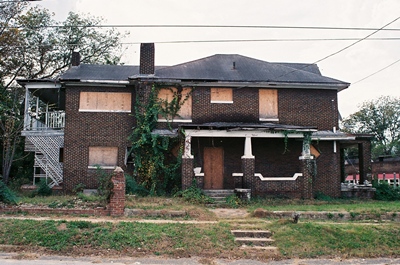
However, there is hope for the place. The Augusta, Georgia Land Bank Authority currently owns the property and intends to restore it as part of the Laney-Walker/Bethlehem Revitalization Project. That project will preserve another historic structure on Twiggs, the W.S. Hornsby House, while removing many adjacent structures. The plan calls for Twiggs St. to eventually be widened and the surrounding streets to be included in a “Twiggs Circle” development. Whether this will play out to the ultimate good of those who currently live in the area is anyone’s guess, but the problems have certainly attracted attention. In the meantime, if that commenter happens to read this: I’d still like to take you up on your offer of a tour, but maybe we could also check out some of the Bethlehem Historic District. It sounds like many of these buildings aren’t long for the world. Any chance?
Information for this post came from Historic Augusta and the Augusta Chronicle’s piece on the Laney-Walker/Bethlehem revitalization plan. The photos were all taken on or near Twiggs St. The shot at the very top is of the Denning House at 905 7th St., just before 7th becomes Twiggs. Built in the 1860's, it was on Historic Augusta's 2007 Endangered Properties list and looked a little better back then.
Who would’ve thought I’d come back from a few days in Augusta with so much material? Next time we’ll head back north a few streets to 811 D’Antignac, a vacant house built in 1870 which served as a consolation prize for me after my main structure of interest was torn down.
Back in the 1830’s, just a few years after the dawn of photography, when people were making images on pewter and glass (actually, I think I’d like to make some images on pewter and glass right now), one of the two major pioneers in the field, William H. Fox Talbot, said that photography documents “the injuries of time,” particularly when a contemporary photo is set side-by-side with an earlier shot. The guy had a strong point.
Looking back over City of Dust, I guess most of my photography is explicitly concerned with the “injuries of time.” And even though I rarely have a “before” picture for comparison, the injuries are still pretty obvious. In the case of Augusta, Georgia's Goodale Inn, I don’t need a photogravure of the house made thirty years after its construction in 1799 to witness the ravages of time. I can simply compare a photo I took this past fall with a shot from a visit less than a decade ago. So, let’s take another trip to the Goodale Inn, probably the oldest four-sided brick building in Georgia and possibly one of the oldest largely unaltered structures in the state, period. Although, as you will see, alterations are taking place whether anyone wants them to or not.
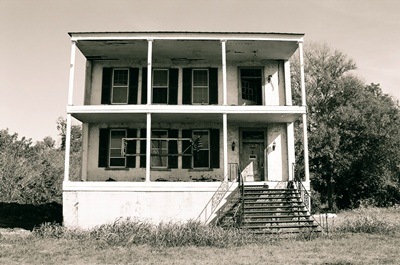
Located way out at 745 Sand Bar Ferry Rd., the Goodale Inn was once the first structure travelers saw when entering Augusta from South Carolina, the state line being somewhere in the Savannah River just to the east, the crossing still known as Goodale's Landing. Imagine how many people have gone past the Goodale Inn on horseback and by carriage, including aging Revolutionary War veterans and Civil War soldiers. However, the house may never actually have been an inn.
The building is on land that was owned by Thomas Goodale as part of the 500-acre Goodale Plantation. Goodale also operated the Sand Bar Ferry, bringing travelers across the river. The Goodale Inn might have been built by Charles Goodale, or maybe it was built by Christopher Fitzsimmons, who is reported to have bought the land around 1799-1800. There is some mystery in that chronology, actually. Later, the property was given by Fitzsimmons to Governor Wade Hampton III’s father as part of his daughter Ann’s dowry. The place has quite a history and if you want to read more and see a few photos depicting a less battered Goodale, you can find my original post HERE. Of course, a building this old has to be haunted and the resident ghost is supposedly that of a little girl who turns on lights and slams doors, amongst other things. Particularly in the attic. Well, it is true that the attic light was often on when I’d drive past at night.
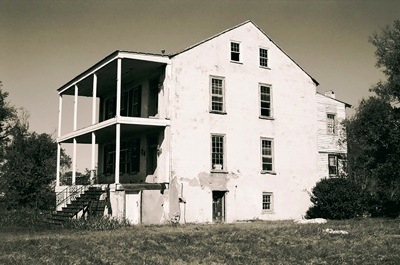
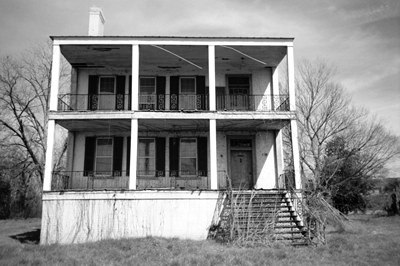
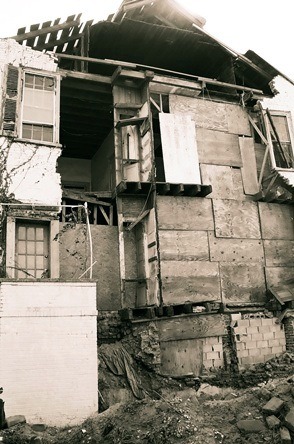 Inside the Goodale are ten rooms and five fireplaces to keep warm. Some bricks have now been pulled out of those fireplaces by “treasure hunters” (read: vandals) who believed there might be Confederate gold or something sealed up in the chimneys. Rumors of a previous owner digging up "Indian mounds" in the backyard while searching for said gold may or may not be exaggerated. Now, if you look closely at the photo that starts this post, you will see that one of the metal treads at the top of the steps is missing. Hopefully this has just been removed by the owners and not actually stolen and recycled for 0.50/lb. You will also see a rectangular wooden frame on the lower part of the front porch. This used to hold a banner that read, “Save the Goodale.” But now even that is gone. All of this is actually small potatoes to the major injury that has befallen the Goodale, shown in the photo just above. Yup, the entire western wall has collapsed leaving one side of the building open to the elements and very vulnerable.
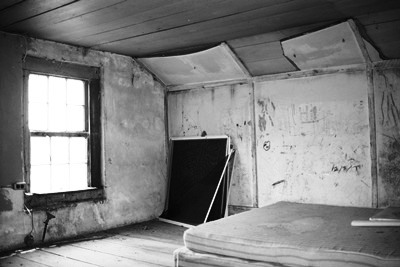
Now, before you say, “This is outrageous! The owner of the Goodale Inn should be ashamed for letting this historic structure crumble! Where can I find him so that I might give him a piece of my mind?”, let’s step back for a moment. When I visited the Goodale in 2004 it was long-vacant and long for sale. Following a couple foreclosures, the property was finally auctioned off in 2009 to an Alabama investor with hopes of restoration. This investor paid less than $20,000, which is a fair step down from the original asking price of $250,000. If you think that buying a house built in 1799 for $20,000 might somehow indicate that there are problems, I suspect you’re right. That's the little girl's attic in the photo above, taken in 2004.
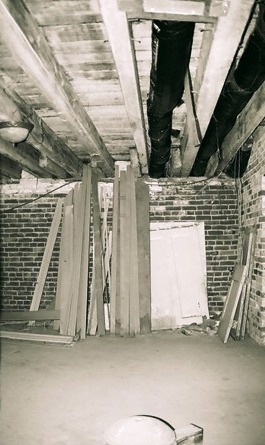 It was August of 2011 when the wall collapsed. Since then I’ve been in touch with people that have worked on the house who've said that some of the river rock used for the foundation has turned into a fine powder that now sits in little piles along the bottom of the basement walls. The heart of pine floors are held together with wooden pegs. Cool, but not easy to upgrade. In short, this is no simple fixer-upper. To me, it seems that those that own the Goodale Inn and are working for its restoration have their hearts in the right place. Remember, literally no one else wanted the place. Not the city, not the county, not the state. NO ONE. As for the slow progress on the restoration, I’ve heard that money doesn’t grow on trees. Those are some heart of pine beams above. Below is the Goodale Inn circa 2004. Note the presence of the chimney.
But there is some hope yet. A recent structural survey, financed by a $5,000 “intervention grant” from the National Trust for Historic Preservation, found that most of the house is still basically sound. At least it doesn’t need to be torn down. Also, ownership of the house will apparently be transferred to a new non-profit, the Historic Home Preservation Society, allowing better access to grant money that’s available for restoration projects. So we shall see. If anyone reading this has some extra funds lying around and would like to help the Goodale Inn, I’m sure you can contact the owners through their Facebook page, Save the Goodale. The ghost of a shy little girl would most certainly thank you.
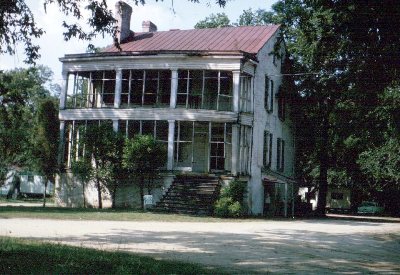
Information and inspiration for this post came from an article entitled, "Engineers Say Most of Goodale House Still Stable," in the Augusta Chronicle on the positive outcome of the structural survey. More about the collapse of the wall is HERE. As usual, Historic Augusta has some good background, too. I got the great old shot above from the Save the Goodale Facebook page where it was uncredited. Try to guess the date (note car at right). It appears to pre-date the period in the 1970's when the Goodale was a "free school" prior to a restaurant being put in the basement. I hear the restaurant served a delicious peanut butter pie on pewter dishes, which brings us all the way back to where we started.
Next time we’ll head into south Augusta to see the historic Dr. Scipio S. Johnson House at 1420 Twiggs St. It ain’t looking good.


