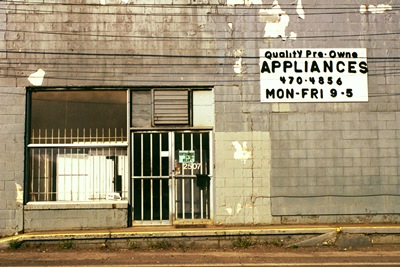
Sunday, June 07, 2015

Independence Day


It was the middle of the morning on the Fourth of July and the rain was pounding down. Dirty, gray clouds hung low in the sky. Lightning flashed across the horizon and thunder rumbled ominously. I’d loaded the last of my belongings into the bed of my beat-up Ford Ranger and covered it all with a tarp. I hoped I’d done a good job with the tie-down and that the tarp wouldn’t leak and let the rain damage my cheap, particle-board furniture. Then I thought maybe it didn’t really matter after all.

I was leaving Greenville, South Carolina for Knoxville, Tennessee. I was happy to be getting out of Greenville, but not so sure I really wanted to be going to Knoxville. I’d accepted a nine-month appointment as a research technician in the Department of Chemistry at the University of Tennessee and figured, in the worst case, that it would buy me some more time to plot my next move. I’d just gotten onto Highway 276 outside of town when I saw a man walking up ahead on the shoulder of the road with his thumb out. The rain was relentless and the wipers struggled to keep the windshield clear, especially the passenger side one, which was rotted and squeaked gratingly.
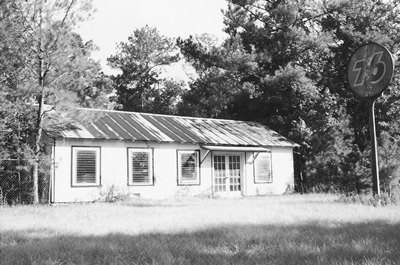


I’d picked up hitchhikers in the past, usually out of boredom or a passing sense of recklessness. Only occasionally had a little bit of compassion entered into it. Every hitchhiker I’d ever given a ride to was at least a little crazy, and usually to the point where you felt you best pay close attention and not let the situation get away from you. But it was always an interesting experience. Once I picked up a guy in Baton Rouge who combined poignant stories of the family he missed badly back in Chattanooga with seamless interjections about a UFO attack he believed was imminent. I thought it took not just a little artistry to pull that off. There was another time someone actually wanted to be taken to a mental institution. He’d managed to wander out of the dayroom and, after a night spent roaming the streets, didn’t know how to get back. He gave me the name of the place and I recognized it. I’d had a cousin that spent some time there. I dropped the man at the front door within 20 minutes. By then the police had been searching for him for hours.

This time I was feeling bored AND reckless. As I passed the man I saw the water running down his face and into his thick beard. No hat. No jacket. That rain was cold. I guess then I felt a little compassion, too. I pulled to the shoulder and flicked on the hazards. The man ran up to the car, swung open the door, and dropped into the seat. He was soaked to the bone. He put a small, very wet, army green duffel bag on the floor. Hitchhikers and their bags. The man’s long, brown hair was plastered to his skull. He was wearing only a blue, flannel shirt, and I could see some tattoos peeking out around his wrists and neck. A lighter shirt would’ve been rendered transparent, providing a better look, but what ink I could see didn’t appear to have been done by a professional. He was also sporting a paunch that hung over his sopping jeans.


“I apologize,” he said, out of breath. “I’m gettin’ your truck all wet.”

“Don’t worry about it,” I replied, pulling back onto the highway. “If this truck gets either of us to where we want to go we can consider ourselves lucky. Speaking of which, where are you going?”

“Knoxville.” Then he began to cough violently and needed a little time to recover. After wiping his mouth with the back of his hand, he continued: “I’d ‘preciate whatever help you can give me in that direction. Only, when you drop me off, could I ask that you leave me at a gas station or someplace dry? I’m gonna die of pneumonia out there.”

The windows of the truck were quickly fogging up. I turned the defroster on full blast. “I’m going to Knoxville myself. I can take you all the way.”

The man seemed to somehow unspool from inside himself. He sank down into the seat with relief. “Brother, you’ll be doing a man that’s down on his luck a solid.” Then he held out his hand. “Name’s Terry, but my homeboys call me T-Dawg. You should, too.”

I shook his hand. It was rough and calloused and ice cold from the rain. “I’m Jack,” I told him. “Where are you coming from?”

T-Dawg didn’t miss a beat. “Prison,” he said. “A seven-year stretch.”


I couldn’t even pretend to be surprised, although I was a little alarmed. “Sorry to hear you were away. How long have you been out?”

He looked at his cheap plastic digital watch, seemingly still functioning despite the deluge. ”’Bout four hours. They transferred me to Greenville last week from Perry for some reason. They just let me out the door this mornin’ and I been walkin’ ever since.”

Now I was even more concerned, but I thought I hid it well. “So, this really is Independence Day for you.”

He paused and then laughed loudly. “Shit! I hadn’t even thought of that! You’re right. Hell yeah it is!”

I wanted to ask why he was in prison, but thought better of it. Instead, I said, “Did you do it?” and instantly regretted the words. I thought it would come off as funny, yet it only struck me as a much worse question.

But T-Dawg laughed even louder. “Man, NO ONE in prison did it. NO ONE!” Then he turned to the side window and wiped away some condensation. “But, yeah,” he added, somberly, “I did it.” As soon as he finished speaking he began to shiver and I switched over to the heater. He rubbed his hands in front of the vent. “Now I just want to see my ex-wife’s old lady and maybe cut the grass at her place, patch the roof, find out where my boy is at.”


Conversations with hitchhikers always seem to swing from jovial, if not entertaining, to dark and disturbing without a moment’s notice. Was T-Dawg really going straight from prison to mow the grass at his ex-wife’s mother’s house? And fix the roof, too? If he didn’t know where his boy was, then he must not have called ahead. I wondered what kind of trouble I was helping instigate. I only nodded.

T-Dawg dug into the top pocket of his shirt and pulled out a soaked pack of Camels. He opened the pack, saw there was no hope, and put it back in his pocket. I thought he’d want to know if I had a cigarette, but instead he asked, “So, how do you make a living?”

“I’m going to do some work for the chemistry department at UT-K. Just a nine-month contract and then who knows? The long-term is uncertain. Story of my life.” I thought the last two sentences might establish some sort of common ground between us. Maybe I was going to need it. But T-Dawg didn’t acknowledge any common ground. Instead, he leaned excitedly across the console. “Chemistry?! That so? Would you have access to maybe a pound of potassium nitrate?” I could’ve sworn he then bit his lip solely to keep from implicating himself further. He chewed at his beard for a few moments, as if deep in thought. “There’s this stump at my ex-wife’s mom’s place that I’d love to blow out of there.”

Again I nodded. “Well, I’d like to help, but I’m working with computers mostly. Data management and stuff. Plus, I haven’t even started yet.”

T-Dawg was clearly disappointed. “Ah, well. Maybe I can ask around a little.” Then he began to cough again.


We continued north through Hendersonville and the rain only seemed to come down harder. “This is going to put a damper on holiday picnics and fireworks,” I offered.

“No shit,” T-Dawg replied. “Do they still do the big display in K-Town? The one where they light the whole damn bridge up?”

I told him I thought that was “Boomsday,” the Labor Day fireworks display in Knoxville, said to be the biggest in the country. But it’d been years since I’d spent any real time in the town and I couldn’t be sure anymore. It seemed impossible to think that they’d be able to have any fireworks at all in weather like this.

T-Dawg stopped shivering and eventually tiny dry patches began to form on his shirt. His hair was drying, too. Walking in that rain must’ve been exhausting, and with a little warmth now T-Dawg fell asleep. His head was against the window, mouth open, and every now and then he made a noise that was something like a groan. I wasn’t about to wake him until it was necessary. As we neared Asheville and I-40 westbound, I felt more relaxed with T-Dawg asleep.

When we approached the outskirts of Knoxville I gave T-Dawg a light tap on the shoulder. I let him take a few moments to remember where--and, perhaps, who--he was, and then asked how to get to where he wanted to go. He told me to exit I-40 at Western Avenue and head northwest. Then, as we came beside the railroad tracks, he indicated a narrow dirt road. We turned right and crossed the tracks into a trailer park that seemed to have been dropped haphazardly into a scraggly pine forest. The rain would’ve kept anyone inside but, judging from the number of satellite dishes, the gravel lanes might’ve been empty of people most of the time anyway. At the end of one street T-Dawg told me to pull onto a worn patch of grass in front of a worn-looking mobile home. I did, but rather than get out, T-Dawg sat there looking at the beaten trailer, saying nothing. Finally, he put his hand on my arm and said, “Come on in. I’d like you to meet someone. Maybe get you a drink, too.”


I searched for an excuse, but with no one waiting for me and nothing much that needed doing, I went blank. Before I could make something up, T-Dawg squeezed my arm and said, “You really oughta come inside.” He looked at me intently, his long, dirty hair and matted beard masking his true expression. Somewhere in this seemed to be the air of a threat.

“Ok,” I said, and opened my door. At least the rain had begun to let up. T-Dawg grabbed his duffel and swung out of the passenger side. As we walked to the trailer, he pointed to the wet grass which, while sparse, did approach my knees in places, making my shoes and jeans damp.

“See this shit?” he said. “I knew it’d still be like this. Always needs mowing. There just ain’t been no one around can do it.” Then he motioned toward the hacked and weathered remains of a pine tree along the side of the trailer. “There’s that fuckin’ stump. If I cain’t blow it out, maybe I can dig some ‘round the roots and chain it to a truck.”

As he ascended the rotten wooden stairs to the warped and peeling door, I dropped back. I couldn’t guess what was about to happen, but I kind of expected it to be bad. T-Dawg knocked and we waited. In a few moments, the door opened slightly and a woman with long, curly, blonde hair peered out while leaving the chain latched. From that brief glimpse I guessed she was in her 50’s, but it was hard to tell. She might’ve been younger. It looked like life could age you fast around this place. All at once her eyes got big and her mouth made a large “O”. The door slammed shut and I immediately felt queasy. I had no idea what I would do if things turned violent. Then I heard the chain rattle and the door swung open. The woman stepped out, threw her arms wide, and yelled, “Oh, my God! Terry!” She was crying. T-Dawg wrapped his arms around her tenderly and I looked away. Not far off a crow was perched in a pine tree, keeping dry in the rain. It was watching us, tilting its head this way and that, quizzically. It wasn’t the only one that was bemused.


It seemed that entire minutes passed before the woman stepped back to take in T-Dawg. Her face was red and damp. She was a little overweight, but now seemed friendly and warm. She was wearing a blue Wal-Mart employee vest. I couldn’t see T-Dawg’s reaction to any of this.

“Why didn’t you tell me?” the woman finally said. “You know I would’ve found a way to get you.”

“I couldn’t trouble ya,” T-Dawg answered. “Ya’ll got enough to do. Anyway, I figured it might best be a surprise.” He stopped and turned to me, still standing below the steps. “My friend Jack gave me a ride. He was heading this way anyhow.”

The woman looked at me as if I’d appeared out of nowhere. “Oh!” she exclaimed, but didn’t go further.

I took a couple steps toward her and extended my hand. “Jack Crawford.”

“Betty Johnson,” she replied, taking my hand very lightly. “Thank you for bringing Terry home. It’s nice to meet you.”

“You, too, ma’am.”

“Well, let’s not stand ‘round gettin’ wet.” T-Dawg motioned us inside as the rain started again. Part of me wanted nothing more than to turn around and get back in my truck but, on the other hand, what was going on between T-Dawg and Betty had gotten my attention.

Inside the trailer were plastic pails and buckets of all sizes and descriptions positioned here and there over the stained and buckled linoleum of the kitchen, scattered across the dingy carpet of the living room, and no doubt trailing off into the bedrooms, and probably the bathroom, too. As the rain strengthened, “plops” seemed to erupt from every direction, a soft, percussive effect without apparent pattern or rhythm at first, but then somehow seeming to cohere. Betty offered me a yellow vinyl chair that was torn, exposing a dirty piece of foam.


“Now, what can I get you after that drive?” she said. “Beer? Iced tea? How ‘bout a sandwich?”

Though I was hungry I couldn’t imagine asking Betty to make me a sandwich, so I just answered, “Iced tea, please.”

Betty dug around in the refrigerator, the back of her blue vest emblazoned with the white words, “How May I Help You?”

T-Dawg asked, “Where’s Tammy?”

Betty began to pour some tea from a big plastic jug. “Memphis, last I heard from her. But that was about six months ago.”

“How’d she sound?”

“About the same as last time you all talked.” Then Betty put the glass in front of me and glanced quickly at T-Dawg. “Maybe a mite worse.”

T-Dawg chewed on his beard and rubbed his hands. Betty asked if he wanted anything, but he shook his head. I took a sip of the iced tea. Plops seemed to be coming from everywhere at once now as the rain pinged harder on the roof. After a few more moments, T-Dawg said, “Can I see Cody?”

Betty was quiet. More rain came down from the sky and more water fell in the buckets. “Of course,” she answered, finally. “I think you need to.”

Then she went off to the back of the trailer and, while T-Dawg and I waited, I heard her talking to someone on the phone. But she spoke quietly and I couldn’t make out the words. I could see T-Dawg straining to pick up the conversation, but then he seemed to give up and leaned toward me. “Hey, could you gimme a lift to one other place? It ain’t far.”

I felt like I had no choice. “Sure. No problem.” I took another drink of tea.

Betty came back out looking serious. “You can go over anytime you want. They’re at home. I’d take you now but I’m afraid I’m already going to be late for work. They don’t accept no excuses at that place.”

T-Dawg made a noise that seemed to be an affirmation and told Betty that I’d drive him. To where, I didn’t know. I finished my tea as T-Dawg grabbed his bag and moved toward the door. He told Betty he’d see her shortly. I stood up and thanked Betty and then we were back outside in the rain, walking quickly to the truck.


We backtracked to I-40 and went south across the roiling, brown Tennessee River on Highway 441. T-Dawg told me to exit on Maryville Pike, but aside from the few directions, he said nothing and only stared out the window at the gloom. Every now and then he coughed a bit more. It sounded like it was getting worse. The wipers swooshed and squeaked. I wasn’t about to say anything.

Finally, T-Dawg told me to slow down and then pointed out a narrow street. I made a left turn and we quickly pulled up beside another trailer. This time the yard was well-manicured with a garden gnome sitting by the front steps and an ornamental wrought iron deer underneath an adjacent pine. It didn’t look like T-Dawg would need to do any work at this place.

I shut off the car and T-Dawg clutched his bag. “Betty’s older sis, Mary, lives here.”

Now at least I knew where we were. It seemed like he wanted to say something more, but he opened the door and got out into the rain. I did likewise. I saw a prim-looking woman’s face through a window and then the door opened before T-Dawg could knock. Mary was thin, dressed in jeans and wearing cowboy boots. Her brown hair was cut short and she looked younger than her sister. She put her arms around T-Dawg, but the reaction was cooler than Betty’s. If she was at all surprised to see him, she didn’t show it.

“This is Jack,” T-Dawg said, pointing to me still standing on the walk, getting wet. I just waved. I felt better closer to the truck.

Mary seemed to be trying to size me up. She was probably wondering why I was there at all. Then she gave a slight shrug, said, “Nice to meet you,” and told us both to come inside.


The trailer was immaculate and warm. A crockpot burbled on a counter in the kitchen and the smell of beef stew was heavy. My stomach rumbled. A framed piece of needlepoint by the door read, “God Bless This Home and All Who Enter,” and some country music played low in the background. “Dixieland Delight” by Alabama.

Mary offered me a seat, then looked at T-Dawg and said, “I’ll go get him.” She went down the hallway and in less than a minute returned with a boy beside her. He was thin and his black t-shirt said “TENNESSEE” across the front in orange block letters. His hair was exactly the color of T-Dawg’s and as unruly. His eyes were wide, although he avoided looking directly at anyone. He couldn’t have been ten years old and he was scared. Mary stopped directly across the kitchen from us and put her arm around the boy’s shoulder.

“Cody, your daddy’s here.” The boy seemed to draw up into himself. “He’s come to see you.”

T-Dawg put his duffel down and took a few slow steps toward Cody. Then he put a hand on his son’s head, tousling his hair gently. “How you been, lil’ man? You taking care of things while I been gone?”

It seemed impossible, but the boy’s eyes got wider. His mouth opened, but instead of speaking he pulled away from Mary’s side and ran back down the hallway.

T-Dawg looked stunned, and then like he might cry. He made a movement toward the hall but Mary stopped him. “Let the boy be. He needs some time. He’s just scared.”

T-Dawg snorted. “Scair’t of his own daddy.”

Suddenly it was like a dark cloud passed over Mary’s face. “The last time he saw you he could barely say ‘daddy’,” she hissed, coldly. “You’re lucky he even remembers you enough to be scared.” T-Dawg put a hand against the wall as if to brace himself. “Why wouldn’t you let him see you all these years, anyway? A boy needs his father, even if his father’s in prison.”


T-Dawg stared at the shiny linoleum floor. He seemed dissipated. “Because I didn’t want him to see me there. I didn’t want him to have memories of his daddy like that.”

“So you thought no memories at all would be better?” T-Dawg just shook his head. “He’s acting out at school, you know. Gets in fights. Won’t do what the teachers ask him. ADHD was what the doctor said. He gave us some medication.”

T-Dawg took a minute to process this. “Does the medication help?”

“It seems to, I think. At least when I can get him to take the pills. Sometimes he hides them under his tongue and spits them out when I’m not looking. Now I make him open his mouth and show me.”

T-Dawg went back to staring at the floor. Mary softened. “But he’s a good kid. He’s got a good heart. You’ll like him. You just need to make sure he likes you.”

T-Dawg truly did start crying. Now I stared at the floor.

“What are your plans, Terry?” asked Mary, after a while.

“Oh, I ain’t going nowhere,” said T-Dawg with a sniffle.

“Good,” Mary replied, then repeated, almost at a whisper: “Good.”

T-Dawg started coughing again and walked through the kitchen and out the door without another word. Mary watched him, then turned and went back down the hall. I didn’t know what else to do, so I followed T-Dawg outside. The rain had eased again. He was sitting on the bottom stair step. The aluminum storm door rattled, but he didn’t seem to hear me. I stopped as he pounded his big fist into his right thigh. Hard. Then he did it again. I waited a few moments before scuffing my foot on the wooden step to get his attention. He turned and looked at me like I was a ghost, then ran his palm quickly across his face. “Hey, man, I want to thank you. You been good to me.” He reached out his hand and I took it. I felt an unexpected surge of emotion. I came down the steps and wasn’t sure what to do. “Have a good Fourth,” I said, and instantly felt like an idiot.

T-Dawg looked confused but then grinned, his stained teeth showing behind his beard. “Yeah, God bless America, man!”

Then I walked to my truck, got in, and pulled away. T-Dawg gave me a wave. I was barely back to Maryville Pike when the rain started falling harder once more. It was beginning to get dark so I decided to make a quick stop at Taco Bell and then head over to see what was going on at World’s Fair Park. I‘d finally remembered that that was where they had the Fourth of July celebration in Knoxville, and I wanted to know if maybe they’d come up with a way to shoot off fireworks even in rain like this.
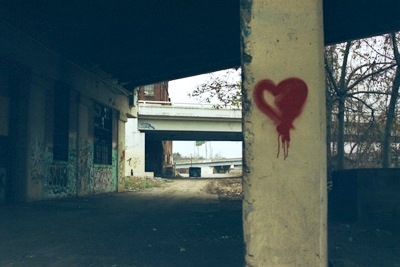


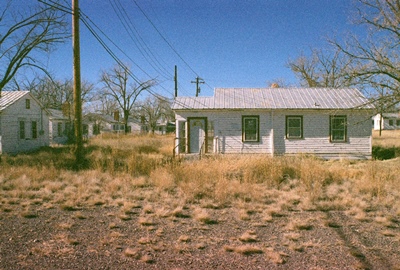
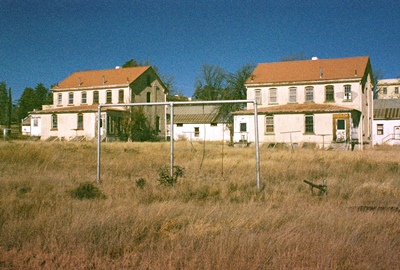
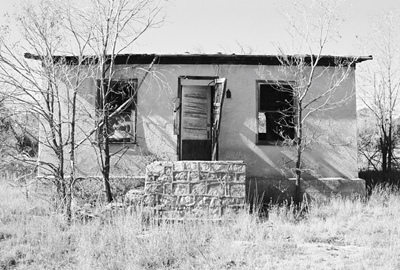
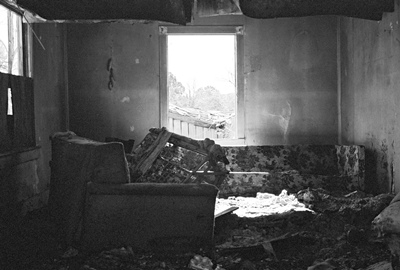
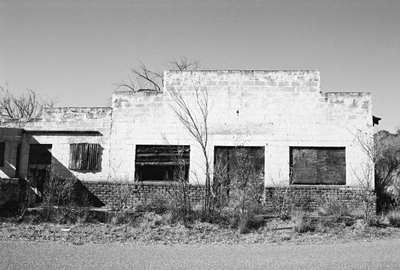
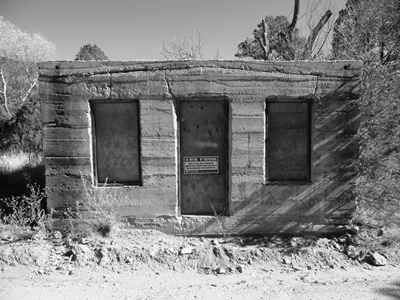
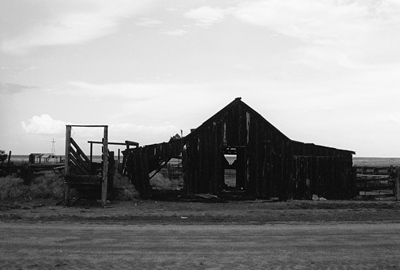
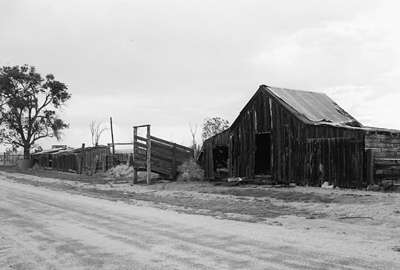
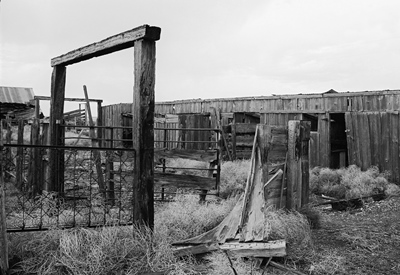
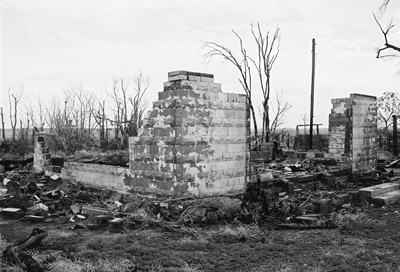
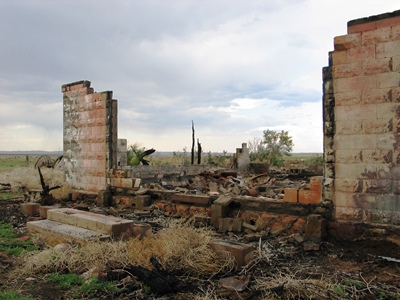
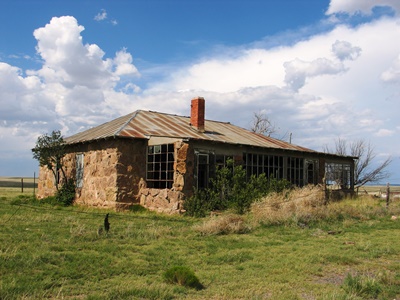
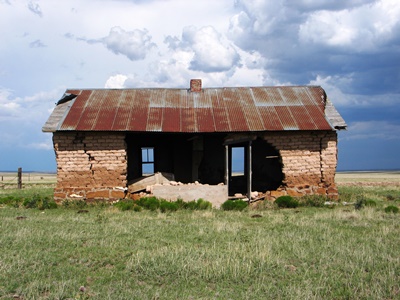
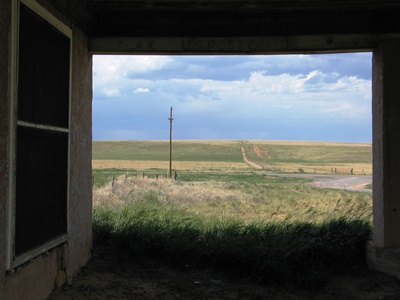
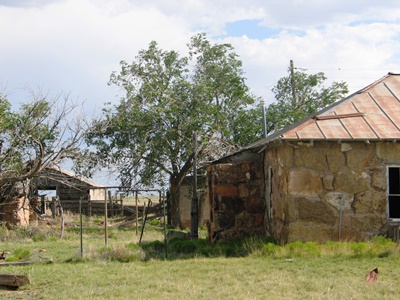
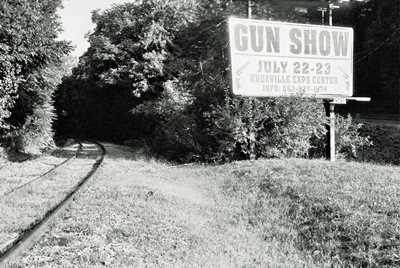
It's been a long time since I stepped back from ghost towns for a moment and posted a story. February 21, 2014, to be exact, when I put up a piece set in Socorro County, New Mexico, called "The Monsoon." Not only does the story above take place (mostly) in Knoxville, Tennessee, but the photos all came from there, as well. On the perhaps rather off-chance that you want more of this kind of thing, you can always check out the City of Dust collection, A Loss For Words, on Amazon.com.

Next time we're off to the ghost town of Lake Valley, New Mexico, once home of the famous Bridal Chamber Mine.

Tuesday, May 26, 2015

For Sale: Fort Bayard, New Mexico


For this installment we’ll be featuring a place you can actually buy if you’ve got some money and a whole lot of gumption: Fort Bayard, New Mexico. Located ten miles east of Silver City, Fort Bayard was established in 1866 as a direct result of the discovery of gold in nearby Pinos Altos in 1859. As gold brought miners and prospectors to what’s now the region of the Gila Wilderness, the Warm Springs Apache did the best they could to drive the new arrivals either back to where they came from or into their graves, whichever happened first. So a fort was built and named after Brigadier General George D. Bayard, a frontier fighter with the First Cavalry who died in the Civil War at Fredericksburg, VA.

Initially, Fort Bayard was comprised of some huts made out of logs and adobe. Not exactly a formidable defense. But by the time serious campaigns were launched against Mangas Coloradas, Victorio, and Geronimo, it had grown considerably. The Army often sent African-Americans, sometimes referred to as Buffalo Soldiers, to battle Native Americans in the West, and such was the case with Fort Bayard.


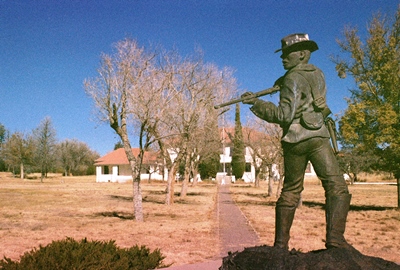
A monument to one Buffalo Soldier, Corporal Clinton Greaves, of Company C, 9th U.S. Cavalry, stands in the center of the fort. In addition to a statue of a rifleman in action, which may or may not be Corporal Greaves, there is a plaque which reads, “On June 27, 1877 while on patrol in the Florida Mountains near Deming, New Mexico Corporal Greaves performed an act of heroism saving six soldiers and three Navajo scouts from attack by forty to fifty Chiricahua Apache. Corporal Greaves was awarded the Congressional Medal of Honor on June 26, 1879.”

However, in 1886, following the capture of Geronimo, the Apache threat subsided. The 400-acre post remained active until 1900, and then Fort Bayard became an Army sanatorium and research center for tuberculosis, the climate of the area being quite salutary for TB sufferers. The hospital was briefly transferred to civilian control before a new one, the first built under the auspices of the Veterans Bureau, was constructed in 1922. Here, in a modern facility with a 1,250-patient capacity, victims of mustard and chlorine gas attacks in WWI used mirrors to reflect the plentiful desert sunshine "into" their lungs in the hope it would heal them. During WWII the fort even housed German prisoners of war. The hospital closed in 2010 with completion of the nearby (but off-property) Fort Bayard Medical Center. And then there were none.


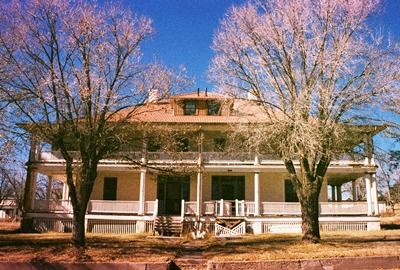
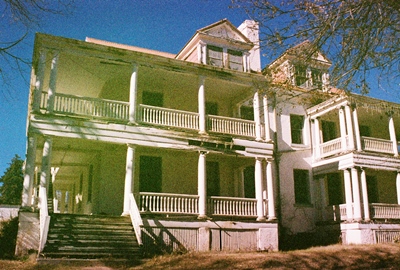
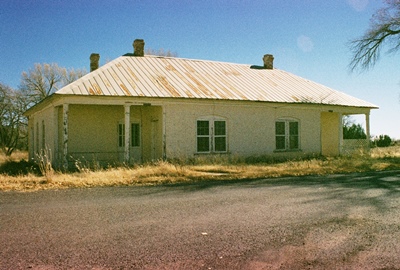
To me, the most striking part of Fort Bayard, which is both a National Historic Landmark and National Historic District, is Officer's Row, a shady avenue comprised of several derelict officer's residences which, aside from one that's a museum, resemble abandoned mansions. They were built in the 1920's to replace the shoddy original officer's quarters. Numerous smaller homes for enlisted men can also be seen, as well as a historic theater and various intriguing outbuildings. The 145,000-square-foot hospital, now boarded-up, reportedly costs about $100,000 annually to maintain and is the first thing slated to be demolished. It may already be gone as of this writing, but I wouldn't bet on it. Even demolition was estimated to cost $4.3 million. (5/28/15 UPDATE: The hospital does indeed remain and there is no evidence of imminent demolition. Thanks, readers!) (SECOND UPDATE: The hospital was demolished between April and July of 2016. Alas.)


Essentially, the state of New Mexico, which has owned the property since 1965, can hardly afford to tear anything down, let alone fix it up. Even the trees are dying from lack of caretaking. So Fort Bayard is on the market. Solicitations for expressions of interest from potential buyers, sort of fancy “For Sale” ads, have appeared in the Wall Street and Albuquerque Journals. How much might a nearly abandoned 19th century fort cost, you ask? Well, don’t reach for your checkbook just yet; there is no asking price, but NM General Services Secretary Ed Burckle is considering all serious proposals, of which there have been so few to date that you could count them on one hand. In fact, part of the reason the hospital is first in line for demolition is because it's thought the removal of the asbestos-filled building will make the fort more attractive to a future buyer who would then (hopefully) preserve the other structures.


There have been many worthy ideas for re-purposing Fort Bayard, with its lovely old buildings and beautiful, open grounds. These include a treatment center for veterans with post-traumatic stress disorder, a workforce development center, a business and industrial park, and a mixed housing development. Others have suggested that the fort be turned into a shelter for homeless vets, a private military academy, or a ghost-hunting destination. The latter might be one way to meet Corporal Greaves and his companions.

Currently, believe it or not, the Fort Bayard Historic Preservation Society offers guided tours of the old fort every Saturday throughout summer and twice monthly in winter, providing a bit of access and plenty of history. Unfortunately, despite the many people that love the place, not least among them the aforementioned preservation society, Fort Bayard proves that the Beatles were incorrect in at least this instance. It’s not just love the old fort needs, but money, and lots of it.


Information for this post came from The Place Names of New Mexico, as well as very informative articles from the Albuquerque Journal (“NM’s historic Fort Bayard up for sale”) and Silver City Sun-News (“A new day dawns for Fort Bayard”). I’d also recommend paying a visit to the Fort Bayard Historic Preservation Society Facebook page. If you want to know (a lot) more of the fort's history, newmexicohistory.org will keep you busy for a couple hours.

Next time we’ll have a brief fictional interlude, the first since I posted The Monsoon over a year ago. This one is my ode to hitchhikers.

Wednesday, May 06, 2015

Zinc Town: Hanover, New Mexico

Just three miles southeast of Fierro, New Mexico, the town featured last time with back-to-back posts, is Hanover. Hanover was named by local prospectors for the Hanover Mines near Fierro, which were, in turn, named for Hanover, Germany. Hanover was the hometown of Sofio Henkel/Henkle/Hinkel, who is credited with discovering iron and copper in the area in 1841, but he was forced out by Apaches two years later. More on that story can be found in the initial post on Fierro.
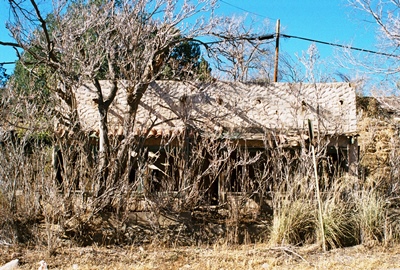
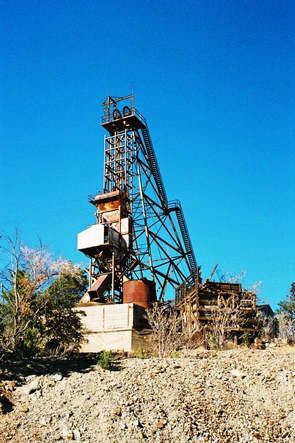
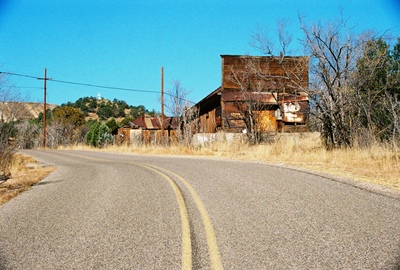
Hanover, however, wasn't known for copper or iron, but zinc. The post office opened in 1892 and operates to this day, although it has moved a few times from its original location. It’s now in the old railroad depot, beside Hanover Creek. But mining didn’t begin in earnest until decades later, and Hanover still lies in the shadow of the massive Empire Zinc Company headframe (shown above), built during the First World War. From WWI through WWII and on into the Cold War, zinc was Hanover’s bread and butter. But then, in the fall of 1950, things got volatile, bringing outside attention to the remote little town.


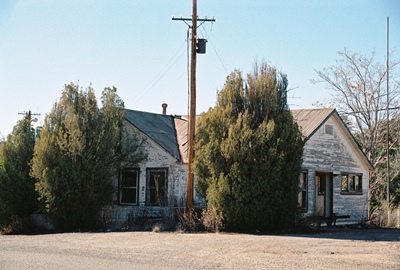
(Above is a store and previous location of the Hanover Post Office.)

For some time, Hispanic miners had been angry that the Empire Zinc Company, a subsidiary of the New Jersey Zinc Company, paid Anglos more for doing the same work, officially known as “dual wage rates.” Hispanics were also the only ones given the more dangerous underground duties, and were assigned the lowest quality company housing. So, on October 17, 1950, 140 miners walked off the job. These were members of the International Union of Mine, Mill, and Smelter Workers (aka Mine Mill), whose leadership was suspected of being communist. Then eight months passed.


On the eighth month the strike got even more intense. That’s when the Empire/New Jersey Zinc Company hired strikebreakers and a federal judge issued a restraining order prohibiting further picketing by miners. At that point, the miners’ wives and children took over picketing. Because they were not miners, this was technically not a violation of the restraining order. It’s said the local sheriff was quickly confronted with a “horde of screaming, singing, chanting women and children.” Sixty-two of these women and children, including a one-month-old baby, were jailed until evening on the first day.


The miners’ families continued picketing for another seven months. One wife of a miner said, “Everybody had a gun, except us. We had knitting needles. We had safety pins. We had straight pins. We had chile peppers. And we had rotten eggs.” The strike ended 15 months after it began, in January 1952, with miners receiving a modest wage increase along with life insurance, health benefits, and hot running water in their company homes.

The whole episode resulted in a movie, "Salt of the Earth," released in 1954. Hanover’s name was changed to “Zinctown,” and no filming was done in the real Hanover, although some scenes were shot in Fierro. Actual mine workers played roles similar to those they’d had in real life, carrying sidearms to protect themselves while doing so. That's because the film was written, directed, and produced by members of the Hollywood Ten, a group blacklisted for refusing to testify before the House Un-american Activities Committee (HUAC). So, for many years it was almost impossible to actually see the movie due to its perceived communist associations. Now, of course, it’s not very hard at all. The entire thing is on You Tube.


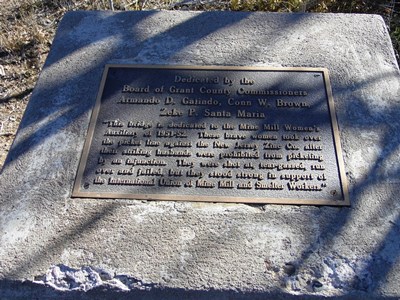
It seems a little late in the day to argue about whether communism played a somehow insidious role in the strike in Hanover. Fifteen years later, the International Union of Mine, Mill, and Smelter Workers would merge with the United Steelworkers of America. But you can imagine that in the early 1950’s there was controversy. Nevertheless, in a shady little corner of a rarely-used bridge at the southern end of Hanover, there’s a plaque dedicated by the Board of Grant County Commissioners, Armando D Galindo, Conn W. Brown, and Zeke P. Santa Maria. It reads:

“This bridge is dedicated to the memory of the Mine Mill Women’s Auxiliary of 1951-1952. These brave women took over the picket line against the New Jersey Zinc Co. after their striking husbands were prohibited from picketing by an injunction. They were shot at, tear-gassed, run over and jailed but they stood strong in support of the International Union of Mine Mill and Smelter Workers.”


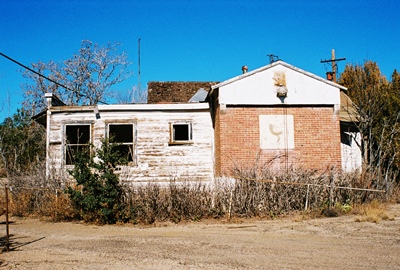
We can’t leave Hanover and Fierro without a quick mention of Villas Dry Goods Store No. 2, which used the slogan, “Shoes Ready to Wear.” The old false-front sits on a slight rise above Hanover, just before Fierro, in an area that may once have been a separate community known as Union Hill. And where was Villas Dry Goods Store No. 1, you ask? Why, 150 miles away in El Paso, naturally.


As usual, most of what's in this post was found in "New Mexico’s Best Ghost Towns," “Ghost Towns Alive,” and/or "The Place Names of New Mexico,"

Next time we’ll do one more post from this general vicinity and visit Fort Bayard, a beleaguered outpost originally manned by Buffalo Soldiers to guard against Apache attacks after the Civil War.

Monday, April 27, 2015

Postscript-Maize and the Mexican Mafia: The Graffiti of Fierro, NM


Yesterday’s post on the ghost town of Fierro, NM was heavily historical. In the introduction, I painted a portrait of Fierro as entirely vacant, quiet as a stone, a place where humans rarely tread these days. While that is relatively true, it’s not the entire picture, even aside from services at St. Anthony’s Mission Catholic Church and the occasional family reunion. Fierro does get visited and, judging by the evidence, its visitors are an interesting bunch. So, I thought it would be worth taking a look at who’s been there recently and what they’ve left behind. There might even be something here that'd be useful to know if you’re thinking of making the trip yourself.


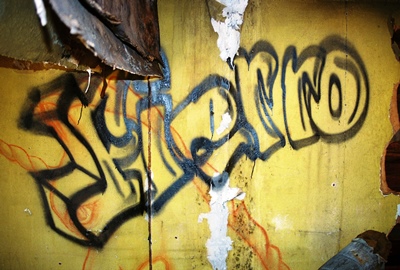
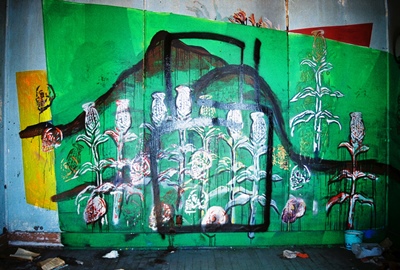
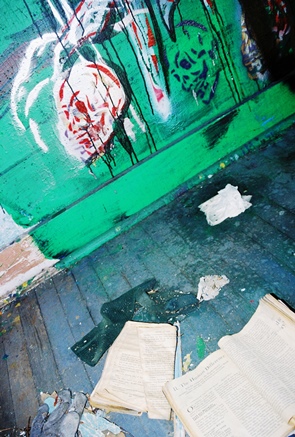
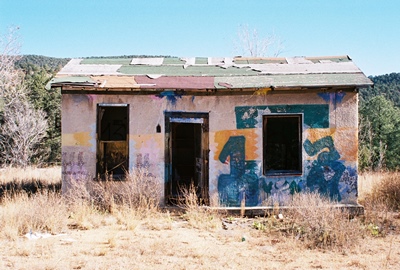
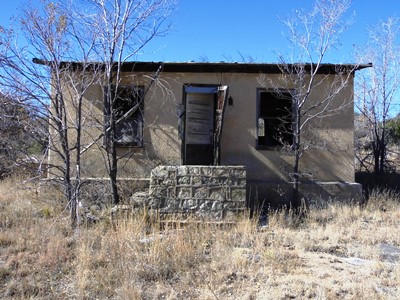
Most of the graffiti in Fierro is in the house shown at bottom, which was last owned by the Araujo family, who also operated Araujo’s Grocery in the building next door. The Araujo’s rented the home out, but one person that probably didn’t sign a lease was whoever painted the green wall of skulls and maize set against the backdrop of a mountain shown above. The artist clearly spent some time in Fierro and, in fact, the room was swept clean and full of the evidence of a fairly prolonged stay. That evidence included some unusual reading material, such as a book about the influence of computers on society which lay open to a chapter titled, “The Human Difference.”
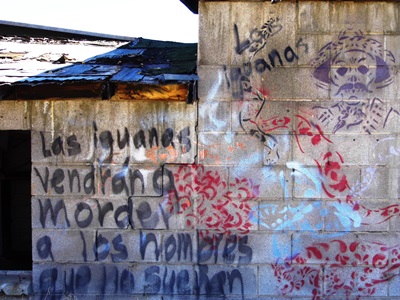
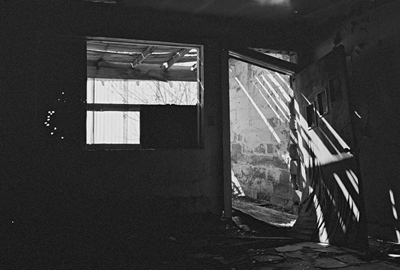
Judging by the stencils, it’s possible the same person wrote this stanza on the back of Araujo’s Grocery itself: Las igyanas (sic) vendrán a morder a los hombres que no sueñan. This is a slight rearranging of a line from Federico Garcia Lorca’s poem, Ciudad sin sueño (Nocturno del Brooklyn Bridge), written in 1929-1930. The translation is: “Iguanas will come to bite the men who do not dream.” Lorca’s work is often pretty surrealistic, but, to me, he is inciting his reader NOT to sleep, but to do, in which case being bitten by iguanas is, in fact, a worthy and motivating experience.

Lorca was executed by a firing squad loyal to Spanish fascist dictator Francisco Franco in 1936, and appears in The Clash tune Spanish Bombs. (“Federico Lorca is dead and gone.”) The Pogues composed an entire song to him, "Lorca’s Novena," in which his corpse walks away. Seeing Lorca’s words as graffiti in a ghost town is quite rare.


Other visitors to Fierro would seem to include members of Sur 13, the Sureños, a prison gang allied with the Mexican Mafia, MS-13, and the Crips. Their tag is visible in the shot above, as well as elsewhere inside the house.


So, while for many ghost towns it is their history that compels, it’s also true that these places have a present and a population of sorts, even if transient. As always, it is only the future which remains uncertain.

Sunday, April 26, 2015

Iron Town: Fierro, New Mexico


I might as well stop saying that I’m going to post more often because the more I say it the less I actually post. Maybe I’ll just say that I would like to post more often and leave it at that. Could this be seen as a quality over quantity issue instead? Well, whatever the case, after a couple quiet months let’s finally pay a visit to Fierro, New Mexico, in the southwestern part of the state, a few miles due east of Pinos Altos. For a true ghost town, it’s still got a good number of buildings which, while certainly falling, aren’t completely down and out yet, and it has plenty of lonely charm. All you’re likely to hear while exploring is the occasional sound of wood scraping tin when the breeze picks up and maybe the caw of a crow or two flying overhead.

Fierro is an archaic form of hierro, the Spanish word for “iron,” and iron is the reason the town was born in the first place. The mining history goes back to 1841, when Sofio Henkle (or Hinkle), a German immigrant living in Mexico, went looking for copper deposits. He found both copper and iron on a mountain a few miles north of the big copper mine in Santa Rita and named the mountain and its new mine Hanover, after his former home. The town just a couple miles south of Fierro would also be called Hanover (we’ll go there next time).


Henkle, however, was soon driven out by Apaches and lucky to escape with his life; he’d been warned of an imminent attack by a friendly Apache woman. Henkle returned years later after New Mexico became a U.S. Territory, believing that he’d be alright now that the army was guarding mines. But then the Civil War required most Federal soldiers to head east and Apaches and Confederates started raiding. So Henkle gave up for good and lived the rest of his life in the Mesilla Valley to the south.

As the 19th century wound down, with the threat of Apache raids gone, and the railroad already having arrived at Silver City—about 15 miles southwest—by the early 1880’s, Colorado Fuel and Iron (CF&I) took an interest in the iron ore deposits of Fierro. A post office was established in 1899, about when the railroad reached Fierro itself, and as much as ten carloads of ore started getting shipped out each day to Pueblo, Colorado, where CF&I were based.


(Above is a home I believe was originally owned by the Bacon family and then the Drakes. Its last owners were the Araujo family, who rented it out.)

The population of Fierro was 750 in 1920 and probably never much over 1,000, even during the peak years between WWI and the start of the Great Depression, by which point six million tons of iron had come from Fierro’s mines. Seventy-eight percent of Fierro’s population was of Mexican descent in 1920, and that percentage increased, reaching the high nineties once the mines closed.

The mines shut down in 1931, although the large Continental Mine ran intermittently and, tragically, in 1947 four miners were killed near it in a “short fuse” accident. While the Cobre Mining Company resumed operations, now with an emphasis on copper, and some residents stayed at least into the 1990’s, Fierro never recovered from the economic blows of the early 1930’s, when people began to leave quickly, many for gold mines in California.


The Gilchrist and Dawson Store, Mrs. Rel’s Rooming House, Filiberto’s Variety Store, McCoy’s Store and post office, John Oglesby’s silent movie house, Sheriff Mac Minter’s pool room; these places were frequented by the miners and their families. Now they’re all gone. Some of them burned in a fire in 1923 when a miner from Mogollon went to sleep at Mrs. Rel’s following a fandango next door and kicked over a kerosene lamp in his room. Without a fire department, and with some buildings even having sidewalks made of wood, much of Fierro’s early commercial district burned fast.

(Below is the Phoenix Mercantile (aka La Tienda del Finicas), which even sold fine furniture. Later it became Araujo’s Grocery and housed the post office. Sitting on the steps waiting for the mail was a common pastime in Fierro.)


Another building of interest is the little jail by the railroad tracks, near the arroyo that runs through the town (pictured below). In Black Range Tales, James McKenna recalled visiting Fierro in the 1880’s and noted that mining towns punished wrongdoers by tying them to a thick log which had been sunk in the earth with eight feet remaining above ground. Normally prisoners would be released once they’d sobered up and/or calmed down. That could easily take all night. Fierro reportedly did away with its log in the early years, even though the sturdy concrete jail probably never held any true desperadoes.


Fierro was known for its love of baseball, with three different fields being used during the town’s history. In the late 1930’s, the team went by the seemingly unusual name “Peru Miners.” Basketball was also popular, with games being played on the school’s dirt court until it was paved in the 1930’s. Fierro even had a Boy Scout troop as late as the 1940’s.

One interesting tradition in Fierro was El dia de las Travesuras, The Day of Pranks, which was a replacement for Halloween. On that night there was no trick-or-treating in Fierro. Instead, kids played pranks, the most common of which was to tip over outhouses. One man spent a night in his outhouse with a shotgun to prevent any hi-jinks, only to have his bathroom toppled anyway when he went back to his house at 2AM for a quick cup of coffee. This never happened to the managers of CF&I as they had indoor plumbing and even electricity. Later, it’s said that a popular prank was swapping around railroad and highway signs, which might cause problems regardless of income bracket.


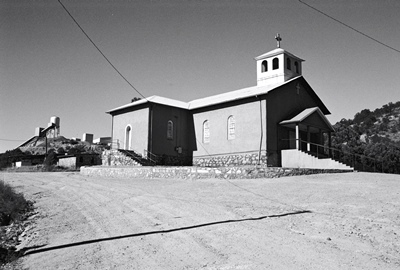
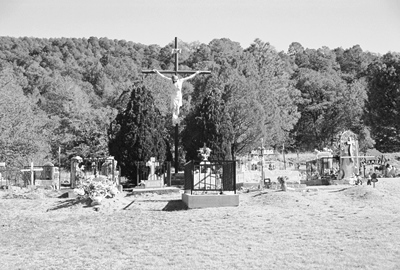
While Fierro is a ghost town now, two places that are very much alive are St. Anthony’s Mission Catholic Church (above), built in 1916 and later enlarged, and, ironically enough, the cemetery, which covers four acres and is lovingly maintained these days. Aside from regular services, a celebration and mass is still held each year on June 13th, the Feast of St. Anthony, and many of those for whom Fierro remains important meet to reminisce and once again walk the quiet streets of the old place.

AUGUST 2017 UPDATE: A Facebook page has been started to document the history of Fierro and the lives of its residents, both through photos and stories. If you're interested in Fierro I highly recommend giving it a look and a "like." The page can be found HERE. As if that wasn't enough, a wonderful photo video showing much of Fierro as it looks today can be found HERE on You Tube. A second video, focused on the shrine behind St. Anthony's Church, is HERE.

Some information for this post came from "New Mexico’s Best Ghost Towns," “Ghost Towns Alive,” and "The Place Names of New Mexico," but the best place to learn about Fierro is “Remembering Fierro (Again) (Revised Edition)" by Frank Ramirez, now available only at the Silver City Museum. It’s not very often that an out-of-the-way ghost town has an entire book dedicated to it, but I’m certainly pleased on the rare occasions when it happens. Mr. Ramirez passed away in 2011 and this post is dedicated to him.


Next time we’ll go back just a couple miles south and check out Hanover, NM. (Well, after this little POSTSCRIPT on the graffiti of Fierro.)

Tuesday, February 24, 2015

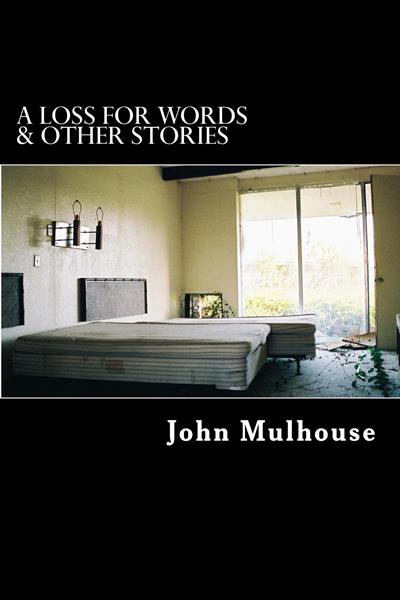
A Loss for Words & Other Stories: Excerpts from 10 Years of City of Dust

I decided to start 2015 off here at City of Dust by collecting all of the NON-HISTORICAL posts from the last 10 years and putting them in a book. While I hoped to actually START 2015 this way, I found it's a bit challenging to compile a book. So, now I'm ALMOST starting 2015 with this anthology.


A Loss For Words & Other Stories: Excerpts from 10 Years of City of Dust, collects all the fiction, random stories, and vignettes that I've published here since 2004 (although the first of these didn't appear until 2005) and puts them in one place, rescuing them from obscurity, if you will. Here's the jacket description:

"A well-known novelist in free-fall returns to his former life only to play a role in its final, heart-rending destruction. What he does next throws his own survival into question, and may decide the fates of near-strangers that he has quickly grown to care about. A disturbing episode in a crowded Waffle House pushes a faltering relationship past its breaking point. An elderly man pays yet another visit to the site of a tragedy that has colored his entire life. A Loss for Words & Other Stories collects 10 years' worth of such tales, often depicting the human side of decay and abandonment. A journal of the author's frequently harrowing experiences while performing vegetation surveys throughout the remote Cumberland Plateau region of eastern Tennessee is also included.

"In 2004, John Mulhouse started the City of Dust blog, dedicated to photo-documentation of the numerous derelict historic buildings and abandoned places along the Georgia-South Carolina border. Over time, occasional fictional (and not-so-fictional) pieces began to make their way onto City of Dust. The majority of these are contained in this anthology."

Copies of the book can be obtained for $15.00 + shipping through AMAZON. You can also get it for KINDLE. I do have copies to distribute myself, as well, and if you'd like a signature and/or inscription I'd be happy to do that. I can also sell a bit cheaper than other sources. Books directly from me are $15.00 with shipping included. If you're interested in going that route, just drop me a line at: jmhouse(at)cityofdust(dot)com.

Thanks everyone for your continued interest over the years. Here's to another ten!

Sunday, January 25, 2015

A Tale of Three Lucy's: Lucy, NM


Let’s start 2015 by getting back on Highway 60 and driving just a little bit west of Negra to the ghost town of Lucy, New Mexico. Like Negra, Lucy is on the south side of the highway, tucked back beyond the railroad tracks, so you could drive past day-after-day and never even know it’s there.

There are three versions of how Lucy got its name and no one knows which is correct, although they all involve the railroad. The first is that Lucy was named for the wife of James Dunn, chief engineer of the Atchison, Topeka & Santa Fe (AT&SF). The second is that it was named after the mother of an attorney for the AT&SF. The third is that the town’s namesake is Lucy Myers, daughter of railroad construction engineer Frank Myers. Maybe they're all true. Oddly enough, despite these three stories, Lucy’s original name was the Spanish Lucia and the town only became Lucy in 1914, nine years after it had been established by homesteaders. Makes a person wonder who Lucia was, doesn’t it?


By 1916, Lucy had a post office (est. in Lucia in 1908), two general stores, a one-room schoolhouse, a 16’ x 40’ Santa Fe depot, and almost ten homes. A four-room hotel was built in the fall of 1917. Lucy actually had three schoolhouses over the course of its life, the first being used only until 1910. A second school operated into 1920 and had an average attendance of 18 pupils, all the children within a radius of nine miles. Or, at least, the children that wanted to go to school. The last school was fairly large and used from 1920 into the 1940’s. These schools were the center of community in the town.

Church was also held in the schools and often the congregations of Lucy--Methodist and Baptist--had to lead their own services, ministers not making it to town every Sunday. It’s said there was a lot of singing in town and much of the population would head down to the depot to see the passenger train come through from the east once each day. Flour sacks often provided material for clothing Lucy’s citizens.


But by the 1920’s and 1930’s, it started to get more difficult to make a living in Lucy. Families began leaving and during the Dust Bowl it became nearly impossible for farmers to tough it out. Often a homestead would be abandoned in the middle of the night, the residents unable to pay their debts. This was quite a blow to store owners, who had extended credit in many cases and now had to try to absorb the losses. Other homesteaders sold to ranchers.

By 1940, there were no longer enough students to justify keeping the Lucy school open and soon the few children in the area began to be bussed to nearby Willard. The post office closed in 1942. The rail depot was moved to Estancia and later ended up on a local ranch. The last event of real note in Lucy was a train wreck on April 14, 1979, in which 42 cars derailed, spilling Lincoln Continentals and Ford Broncos all over the tracks.


I got to Lucy in the summer of 2014, just in time to realize that I was a bit late. The beautiful skeletal concrete remains of the 1919-1940’s school had been taken down by a new property owner. Also, the A.D. Formwalt home, at the north end of town, had recently burned. I don’t know what caused the blaze, but there was very little left of what looked like a once-wonderful old farmstead.

One of the worst things that can happen to a ghost town hunter is to find they’ve missed the opportunity to visit some historic structures. Most houses in town were built on a foundation of rock or even bare ground and not a trace of them remains. Luckily, the large, wooden Lucy Ranch was still standing and very photogenic. Also, the Lucy Cemetery has recently undergone an extensive and loving restoration, so there is activity yet in this little ghost town, one of the many forgotten places along Highway 60.


There’s not much information out there on Lucy, but what exists can be found in the rather spendy “Torrance County History” and Dixie Boyle’s excellent and much-less-expensive (UPDATE: Not anymore!) “Highway 60 & the Belen Cutoff.”

Next time I believe we’ll go way down to the southwestern part of the state and visit Fierro, a mining ghost town in Sierra County. See ya then!

Wednesday, December 10, 2014

Paying a Visit to the Williams: Negra, NM


It’s time to head south out of House, New Mexico, drop down off the Llano Estacado, and into the town of Taiban, home of one of the most photogenic churches I’ve ever encountered. From there, we travel Highway 60 west for quite a stretch, past Fort Sumner, Yeso, Vaughn, and Encino. But then, five miles past Encino, we find Negra. So, at the gravel road, let’s turn south and have a look.

Negra, in Torrance County, was established, as were a number of other towns along Highway 60, when the Atchison, Topeka, and Santa Fe Railroad (AT&SF) constructed the Belen Cut-off. This enabled trains to pass through the flat plains and avoid climbing into the northern mountains through Raton Pass. The cut-off came through about 1905 or 1906 and Negra’s post office was established in 1909. However, the post office didn’t last long. It shut down in 1918 with mail to those few still in Negra even then going to Encino


There are a couple stories about how Negra (“black” in Spanish) got its name, including one about a black dog hanging around the early townsite. Robert Julyan suggests the town got its name because of the black soil in the area and mentions the presence of a black water tank. The tank is notable because Negra must’ve had good water and plenty of it. For instance, Encino once got their water from Negra. I was told that a man named Tenorio used a small tanker truck to haul water to town and sell it to the residents. Of course, the steam-powered locomotives would’ve stopped in Negra to get water, as well. After the conversion to diesel engines, Vaughn bought four wells near the tracks from the railroad and, at some point, even Duran, 20 miles away, got water from Negra.

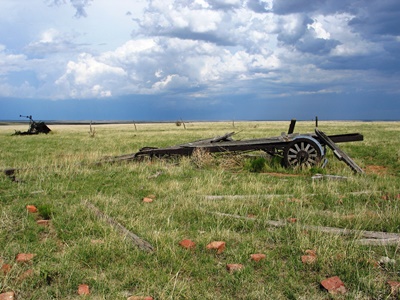
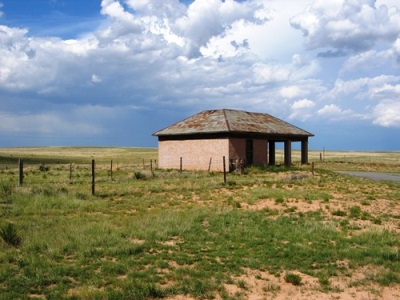
Beyond the above, there’s not much information available on this little town. Nearest the highway is a vacant but nicely intact filling station that might be from as early as the 1920’s. It’s pictured below. (Note “U.S. POST OFFICE” written near the roof. Perhaps this was salvage material.) Behind it is an old tourist court. Both were built by C.E. Davenport, Negra’s first postmaster. A working ranch--the Davenport Ranch--is adjacent to the south. Even farther to the south, across the still-active railroad tracks, there’s a cemetery. To the west, where most of the community once was, only a couple buildings remain. Two, which are not much more than piles of sticks now, were an old school and a teacher’s residence. An adobe structure with a big hole in the middle (shown above) might’ve been a more recent school.


But the gem of Negra is the wonderful rock house, built on the site of an old grocery store, and its attendant barn and outbuildings. Despite the paucity of historical documentation, in a happy twist of fate it’s known who once called this lovely place home. In my post on Encino, I mentioned that there were once four beautiful murals on the walls of the high school gymnasium, which had sadly been torn down. Those murals were done in the very early 1940’s by Hallie Williams, and it is she and her husband Albert (nickname "Ollie") who lived here. Hallie also painted at least one other mural and I’ve been told it still exists, in a store built by Mr. Williams in the 1950’s, also in Encino.


Mr. Williams ran a filling station in Negra—likely the vintage one just mentioned. He also operated a mercantile that fronted the railroad tracks in Encino. This store contained a reportedly very smelly stuffed buffalo head on a wall. Later, in the mid-1940’s, Mr. Williams built a smaller store on the north side of Highway 60. His third store in Encino, then, would be the one containing the mural.

Now, there are some abandoned places that legitimately feel creepy and leaving them brings with it an undeniable sense of relief. Then there are other locations, like the Williams’ homestead, that are peaceful, if not downright soothing. With the sun and clouds playing across the flat land of the eastern plains and a cool breeze rustling the grass, I could’ve stayed there—and, indeed, in all of what remains of Negra—for many more hours than I did. I hope to return soon. I feel like there’s more to be learned out there.


About the only published documentation of Negra that I’ve come across is Dixie Boyle’s "A History of Highway 60 and the Railroad Towns on the Belen, New Mexico Cutoff” It’s a fantastic source for all kinds of info on the towns along the highway. Of course, Robert Julyan’s “The Place Names of New Mexico” handled the naming story, per usual. I even got a few facts, particularly about water, from comments left on the City of Dust Facebook page. Finally, Henry R. sent me a fascinating message about Encino and Negra, as well as background on Mr. Williams, his various stores, and his buffalo. As Henry R. was there back then, his is a fantastic first-person account. His full letter can be read as an update on my post on Encino, which I first published in 2013. Photos of Hallie Williams' now-destroyed murals can be found there, too.


Alright, we won’t have far to go to get to Lucy, the next stop on our never-ending journey.


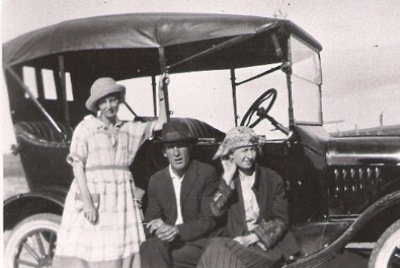
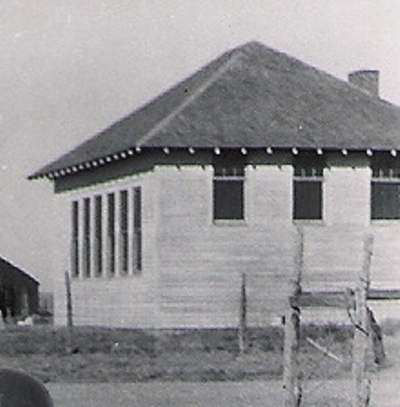
DECEMBER 2014 UPDATE: As she did by contributing her photos of Hallie William's murals to my post on Encino--the only known shots of those murals, I might add--Dixie Boyle has significantly increased the worth of this post by sending in two great old photos and providing a bit more information on Negra, and the Williams family, in particular:

"Hallie and her sister, Carrie Walker, taught at the Negra School (pictured below) when it was first built, and then in later years Hallie taught music and art classes at her house, which was across the road from the school. The kids would walk across the street to her home for classes. The pile of wood in the middle of the others was the Negra School. During this time the kids made up a wonderful puppet show that Hallie and her students took to other schools. Her daughter, Carrie, still had the puppets when I interviewed her.

"Carrie and Hallie actually moved from Texas to Negra to homestead land together. They built a shack to the south of the school somewhere. Ollie also moved to Negra to homestead. Hallie had a degree from Baylor University and had taught in Texas a few years before arriving in Negra. You can find Hallie and Ollie in the Encino Cemetery.

"In front of the car (above) it's Carrie, Ollie, and Hallie. I just love this picture of them."

Many thanks to Dixie Boyle for yet again providing photos and information that are nearly impossible to find elsewhere. The best place to get this stuff is directly from Dixie's books, in this case, particularly "A History of Highway 60 and the Railroad Towns on the Belen, New Mexico Cutoff", which would almost surely be of interest to anyone reading this post.