skip to main |
skip to sidebar
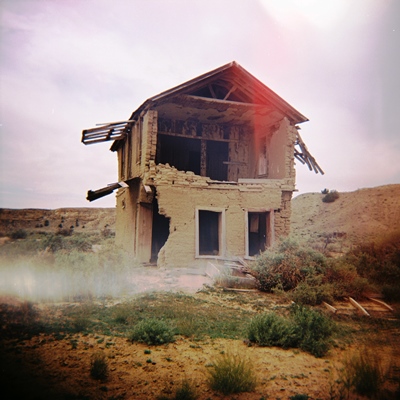
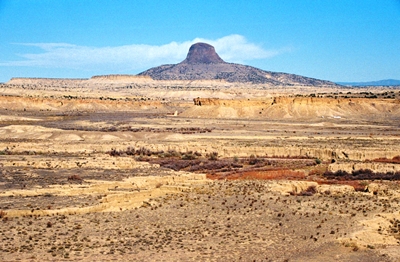
Since the previous post was a special one on the Río Puerco Valley featuring the recollections of historian and folklorist Nasario García, it only seems appropriate to stay beside the banks of the Puerco and explore the history of Guadalupe, New Mexico, where Mr. García spent his boyhood. This vast, empty landscape, punctuated by mesas, canyons, and volcanic plugs, is one of my favorite areas in the entire state to explore.
The remains of the village of Guadalupe—also known as Ojo del Padre—are south of San Luis on Country Road 279, which intersects Highway 550 north of San Ysidro. It is remote, requiring a drive of many miles down dirt roads in varying states of maintenance to find it. So much the better then! The village was named for the Virgin of Guadalupe, while the earlier moniker, Ojo del Padre (“spring of the Father”), referred to a nearby water source. Oddly enough, when a post office was opened in 1898 the name used was “Miller,” but no one can remember why. That name lasted until 1905, when the post office became Ojo del Padre.
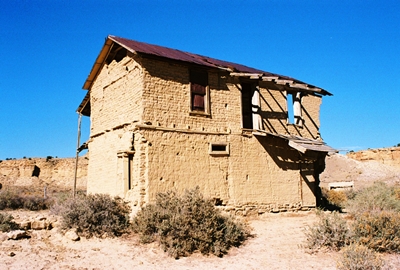
The first thing that one notices upon rounding the corner into Guadalupe, aside from majestic Cabezon Peak looming in the distance, is the wonderful two-story adobe building listing precariously on the side of the road. Built around 1905, this was the home and store of Juan Córdova and it’s often said there was a dance hall behind it. However, Nasario García refers to the lower floor of this ruin as not only a store, but the dancehall itself when the occasion called for it, with Mr. Córdova’s family living upstairs. It’s hard to argue with someone that was there, so perhaps this big adobe, which once had an impressive balcony, served all purposes. However, everyone agrees that the dances at Juan Córdova’s were major events. In the 1920’s, 350 people lived in the immediate area, mostly farming and raising livestock, and these dances, which began at sundown, could go on until four in the morning. Jose Tafoya would play the accordion while his brother Luis handled the guitar.
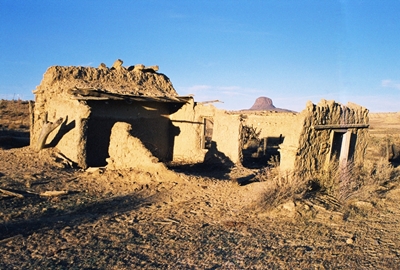
Yet just a short time later, in the early 1930’s, Guadalupe, like so many parts of the country, was hit by staggering drought. A full half of the cattle died. Then, around 1938, the log-and-brush dam which had captured water from the Río Puerco for local irrigation gave way. The government said rebuilding was too expensive a project for federal assistance and the communities along the Puerco were too impoverished to do it themselves. Then throw in the lasting effects of the Great Depression and the lure of employment in larger cities and Guadalupe didn’t really stand a chance. The school, the post office, and Córdova’s store all closed in 1958 as the last family left.
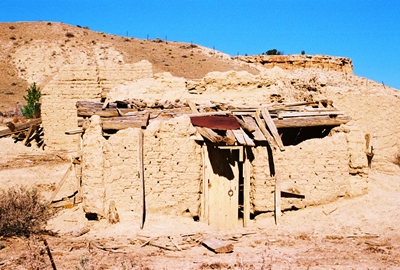
While a lowered water table and generally challenging landscape have kept people from returning to Guadalupe, you may find a couple folks hanging around. In fact, at least two structures are maintained and lived-in, one being the old schoolhouse. It’s not wise to go roaming around on private property out here, but if you see anyone nearby it’s worth introducing yourself and stating your business. Guadalupe’s few present-day residents are friendly and you’ll usually be given permission to take all the photos you want of the ruins on either side of the road, which include other old adobe homes slowly melting back into the landscape.
And that’s most of what I know about the history of Guadalupe. You can find a chapter on Guadalupe in “Ghost Towns Alive: Trips to New Mexico’s Past,” by Linda Harris and another tidbit or two in "The Place Names of New Mexico" by Robert Julyan. But I would highly recommend October 2017’s City of Dust post, “Nasario García Remembers the Río Puerco,” for some wonderful firsthand accounts. If you want to get deeper into the Río Puerco Valley, Mr. García’s book, ““Hoe, Heaven, and Hell: My Boyhood in Rural New Mexico,” cannot be recommended highly enough.
Speaking of getting deeper into the Río Puerco Valley, that always sounds like a good thing to do and so next time we’ll visit Guadalupe’s movie star neighbor, Cabezón, which sits just below the volcanic plug from which it got its name.
Until then, Happy New(ish) Year!
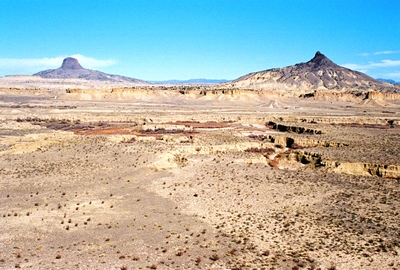
Over the past few years the Río Puerco Valley has become one of my favorite places in New Mexico. About an hour northwest of Albuquerque, with majestic Cabezon Peak always in sight and miles of the Continental Divide Trail close at hand, here you'll find the villages of San Luis, Cabezón, Guadalupe, and Casa Salazar, some of which are essentially ghost towns. No, there aren’t many people around the Puerco Valley anymore and not a lot of its history has been recorded.
However, one person who has done more than any other to ensure that the Río Puerco Valley is not forgotten is historian and folklorist Nasario García. Raised on the banks of the Puerco, Nasario is the subject of a brand new documentary, “Nasario Remembers the Río Puerco,” and following are four of his stories that do not appear in the film, each recollection inspired by photographs from the area.
I’m very proud to feature these stories here and I want to thank Director and Producer Shebana Coelho for making this happen, as well as Nasario García himself, of course. The broadcast premier of “Nasario Remembers the Río Puerco” will be this Thursday, October 12, 2017, at 7PM on New Mexico PBS/KNME Channel 5. I’ve seen the movie and it’s truly wonderful. I highly recommend it to all. For more information, visit Nasario Remembers.
Now, without further ado, City of Dust presents Nasario García and New Mexico’s Río Puerco Valley:
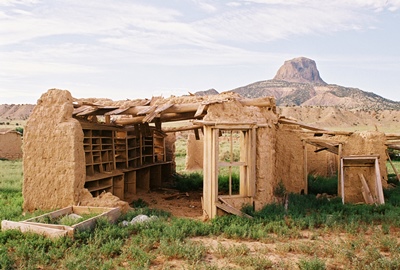
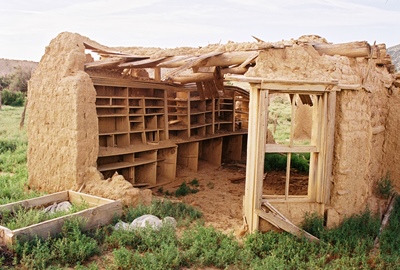
Sal Lovato General Store. Cabezón, New Mexico.
“This store was owned by the Salomón Lovato family. He is one of the contributors to my book, ‘Recuerdos de los Vijeitos.’ You can see where they had different merchandise: canned goods, dried goods and so forth.
“The kind of merchandise they had in these stores was foodstuff that you could not grow, that you could not raise from the land. Here you came and bought, say, lard, even though that wasn't always the case because there was lard from the matanzas. Baking powder, sugar, salt, and some canned goods started coming into existence, as well as dry cereal such as oatmeal. Also, any number of other things—flour, for example. When corn began to become scarce, people would come in the Lovato Store and buy sacks of flour. Those sacks were very important because once the flour was gone the sacks were used to make blouses for the women, blouses for the young girls. In many cases, a young girl would show up at a dance with a rose on the back of her blouse that came from the flour sack. Nobody really looked at you as being odd. That was the moda—fashionable—among many of the families.
“I imagine the store was especially busy on weekends. Of course, a lot of Navajos came from the reservation on weekends. Probably the high point of trading was during the lambing season through the sheering of sheep, which was in May and June. The selling of cattle—those who had cattle—occurred in late September or in October, perhaps even early November. People would make money selling their cattle, selling their sheep. Naturally, that's when they would come to buy a lot of merchandise. But it didn't matter the time of year because many merchants sold on credit. People would pay their bills, say, once or twice a year, whenever they sold their sheep, their wool, their cattle.”
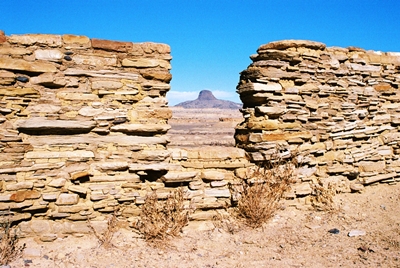
View from Enchanted Mesa Looking Toward Cabezon Peak and Nasario’s Grandpa’s Corral.
“The Enchanted Mesa was right across the Río Puerco from where we lived. That’s the mesa that my paternal grandmother would tell us never to visit because, if we did, we were likely to be turned into goats. My grandmother referred to it as La Mesa Encantada. Many years later, after I left the valley, archaeologists discovered that it was a Chaco Canyon outlier. Now it’s called the Guadalupe Ruins.
“In the evenings, while we were shucking corn, Grandma Lale—her nickname—would tell us stories with the Enchanted Mesa in sight—stories that had to do with the local culture, the local folklore, such as the white donkey, a rarity among donkeys. As she and my Grandpa Lolo, as we called him, told us, they were coming from the placita at night, perhaps after a dance, when suddenly a white donkey appeared and kept pestering the female horse—la yegua—and my grandmother says, as she's telling the story, ‘Look there, I wonder where it came from.’ My grandpa said, ‘I don't know. I know all the donkeys in the valley and I've never seen a white donkey.’ The donkey kept pestering and pestering. ‘Furthermore,’ says my grandpa, ‘there are no white donkeys around.’ My grandmother says, ‘But I am glad this one's here, because a white donkey means good luck. It doesn't mean evil like a black donkey.’
“She would weave these stories, and, in the meantime, we are on pins and needles wondering what's going to happen next. At the end of the story, my grandmother asked my grandfather, ‘Now, truly, what do you think about this white donkey?’ They said they’d turned their heads and the donkey was gone. They never saw it leave. It was stories like this that she liked to share with us grandchildren. She had many, many others.”
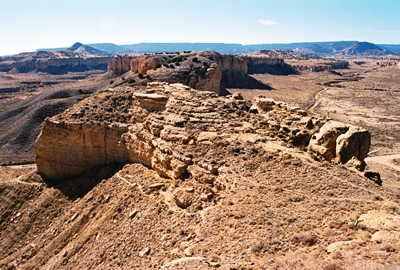
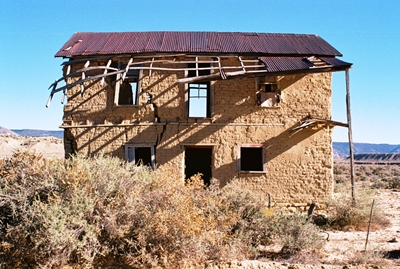
Córdova’s Dancehall. Guadalupe, New Mexico.
“This two-story house was in my village of Guadalupe—Ojo del Padre. The bottom floor was used as a dancehall. This is the only two-story house in the entire Río Puerco Valley that I know of. In fact, today there's probably only a handful left in villages like mine throughout all of New Mexico. This house was built around 1905 by the Juan Córdova family. He was a local merchant. He and his family lived upstairs and downstairs was a store that was periodically turned into a dancehall. There was competition from time to time between this dancehall and the Romero Dancehall. A cousin of mine and I, we were small. I was about seven and my cousin about nine years old. We were supposed to spray water on the dirt floors after every dance because of the dust. Of course, as the men drank more and more and people had more fun, we started bringing in buckets and dousing the floors. By the time the dance was over, these people couldn't move because of all the mud that we had created. My cousin Juan and I had a lot of fun.”
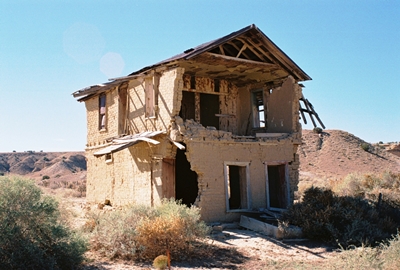
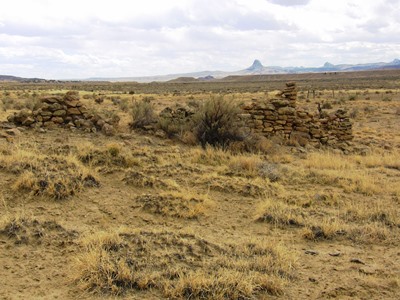
Photo: Shebana Coelho
One-Room Schoolhouse. Guadalupe, New Mexico.
“This was the one-room schoolhouse where I started school. There were about 25 kids from grades one to eight. There were two windows that faced the mesa, but no windows towards the back. That’s where the blackboard was and where the teacher’s desk sat. And towards the middle of the school there was a potbelly stove that the boys had to keep feeding wood into in the winter to keep the room warm. That was our responsibility. The girls had to keep the little barrel of water full. It was wrapped in burlap with a dipper—jumate—hanging from a nail. We all used the same dipper to drink water. We didn’t even wipe it clean the way priests do today when drinking wine from a chalice.
“When I started school here, one teacher taught all the grades and she would line up the boys in one row and the girls in another before entering. There were other times when she would start with the bigger kids. They would walk in first and then the little kids. But most of the time she would line up the younger kids—the first, second and third graders—first, and the older kids were at the back of the room. We had desks that seated two students, usually two boys or two girls.
“The older kids a lot of times would teach the younger how to read, how to do math. So the older kids where helpful. They became teachers. It was very much a communal educational setup. And, believe it or not, we learned. We learned because we learned from one another. Of course, we were supposed to be learning English, but most of us spoke Spanish. When we would read in English we did so with a Spanish accent. We had a book about a dog named Spot. I remember students reading, including myself: “Rrrrrrrrun Espot, rrrrrrrrun.” Because we would pronounce the initial “r” like you would in Spanish and the “s” as in “escribir” —to write. Thus “Rrrrrrun Espot, rrrrrun.”
“And some of the adobes, as you can see, are still here. The school was called, appropriately, “La Mesa School” because of Black Mesa east of the school.”
And so some of the adobes do indeed remain in the Río Puerco Valley, if barely, while many are already gone. Of those shown here, the ruins of the one-room schoolhouse were captured by Shebana Coelho, who was kind enough to allow me to include her shots. Somehow I missed those particular adobe and stone walls myself…for now. Sal Lovato's General Store and Juan Córdova's Dancehall were photographed by me, as were the three views from Enchanted Mesa.
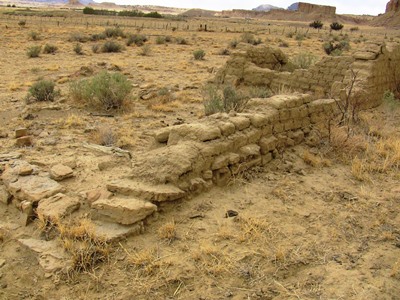 Photo: Shebana Coelho
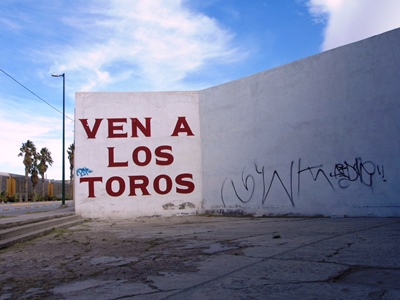
(Ven a los toros - Come to the bulls.)
Blood spills out on the streets
And bodies are missing for weeks
Both sides keeping a close eye
Watching the bullets fly here
On the crystal frontier – Calexico “Crystal Frontier”
While my first day in Ciudad Juárez started with a stroll through the pocked neighborhoods around the International Bridge, followed by a history lesson on the city and Mexico itself, the second began as countless others in Juárez surely have: with a Bloody Mary. But getting to that Bloody Mary required a walk past the 112-year-old bullring, Plaza de Toros Alberto Balderas, the oldest building in the city. A newer but even more famous bullring, Plaza Monumental, was torn down in 2006 to make way for a Walmart. Is it better for a bull to die in a ring or end up as a frozen patty in a warehouse chain?
I won’t answer that question, but I will mention that during the years of greatest violence in Juárez the Plaza de Toros Alberto Balderas remained shuttered, only opening again in 2012. As we were walking past we noticed a couple workers out front of the Plaza de Toros and my tour guide, Rich Wright, asked if we could poke our heads inside. I can’t deny that crouching under the empty stands to peer across the dirt arena at the bull pen door was evocative, but Ernest Hemingway could probably articulate it better than me.
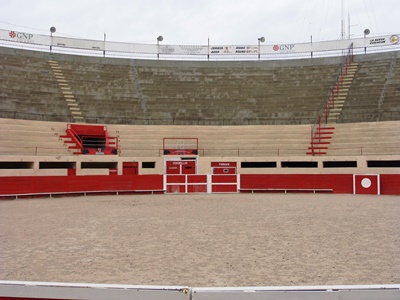
(Plaza de Toros Alberto Balderas.)
Leaving the bullring, we walked a short distance to an unmarked, entirely non-descript building at the corner of Madero and Dieciseis. Opening the door was like stepping into another world, possibly from 1921, when the El Recreo opened. All carved, dark wood and hushed shade, El Recreo, the second-oldest bar in Juárez, after the previously-described Buen Tiempo, is the kind of place you don’t see much anymore, complete with bartender in suit and bow tie.
While the Bloody Mary was delicious, it’s the sotol that may raise an eyebrow at El Recreo. Currently gaining a reputation as the mysterious cousin of tequila and mescal, sotol is made from the plant of the same name, sometimes known as desert spoon, and comes mostly from the state of Chihuahua. Sotol is not an agave, as is often thought, but a member of the asparagus family. The drink is also hard to find; in a city as big as Juárez you will only encounter it in a couple venues. I believe the brand El Recreo serves is El Oro de Coyame and the taste is rough, with plenty of gravitas, the effect perhaps not unlike inhaling campfire smoke that can numb your tongue.
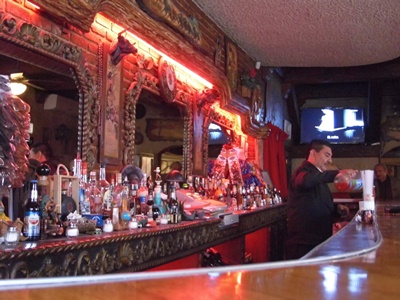
(El Recreo.)
Back out in the glare of midday it was time to put something in our stomachs. Burritos El Negro was recommended by a passerby and turned out to sport a jarring, baseball cap-wearing mascot not far removed from the age of minstrelsy. The restaurant is located in what was once a bustling tourist area, but the tourists stopped coming when the bullets started flying. While the bullets began to slow in 2011, the tourists have not returned. This near-absence of tourism is part of why you can get a massive, phenomenally tasty chile relleno burrito for about a dollar at Burritos El Negro. Follow a Bloody Mary and bit of sotol with two of them and you may regret it.
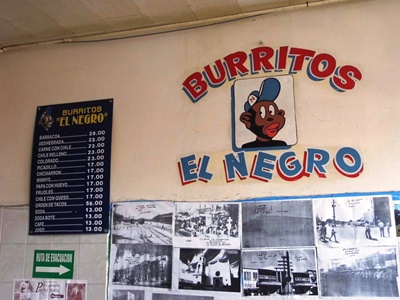
(Burritos El Negro and its unfortunate mascot.)
As we walked down a crowded street after lunch, the noisy bustling heightened by the crunch of a truck driving into the back of a packed bus, a man brushed past me and, in a stage whisper, trilled, “Gggrrriinnnggooo,” not condescendingly, but apparently amused. I mentioned this to Rich, who told me, “We’re like unicorns down here.” Indeed, in two days in Ciudad Juárez I didn’t see another American that looked much like me, not even one hunting for a cheap dentist or discount pharmaceuticals.
I, however, was a tourist, and as such needed a souvenir. What better than a statue of Santa Muerte, or Our Lady of the Holy Death--who is essentially the grim reaper, sickle and all--from the Mercado Cuahtemoc? Said to currently be attracting more devotees than any other religious figure, Santa Muerte began to gain in popularity as drug violence escalated in Mexico and has found a loyal following among narco-traffickers. Not comfortable praying to the Virgin Mary for your cocaine shipment to arrive safely across the border? Make an offering to Santa Muerte. But Santa Muerte is also for those who feel too dirty and down-and-out to appeal to the usual saints. Or maybe you just want to ask for something that an archangel might frown upon. In fact, the Catholic Church frequently tries to remind people that it considers Santa Muerte blasphemous.
While I wasn't planning to ask much of Santa Muerte, I did want to cover my bases. You can buy statues in various colors depending on what you’re praying for, but I got a tri-colored one. White, gold, and red should, I believe, provide me with health, wealth, and love. Also, while a gringo like me wouldn’t necessarily know that Santa Muerte should come with additional “magic,” Rich luckily did, and made sure I got it. The vendor then proceeded to coat my statue in what appeared to be baby powder before liberally spraying it with something that smelled a little like floral air freshener. The strange, sickly-sweet concoction eventually leaked through two plastic bags and into my backpack, which I found surprisingly disturbing. But I’d been instructed not to release Santa Muerte for 24 hours to ensure the “magic” was properly absorbed, so I didn’t dare transfer Holy Death to a leak-free bag.
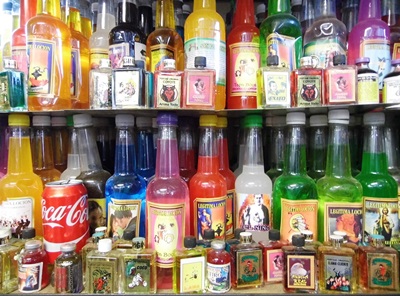
(Magic + Coca Cola.)
With Santa Muerte in tow we walked through an oddly delightful ramshackle alley devoted to Don Quixote, the walls of the buildings covered in graffiti portraying scenes from the 17th century tragi-comedy. Our last stop was El Club 15, named for the number of people that can fit inside. Like El Recreo, it was dark and cool, sold sotol, and featured a well-dressed bartender. The bartender’s name, Chuy, was constantly being called by patrons wanting to have their drinks freshened. Yet, instead of the ornately carved wood of El Recreo, the entirety of the walls and ceiling of El Club 15 were covered in dozens of vintage pin-up photos, bare-breasted women from forgotten eras smiling coyly from nearly every surface. A television in the corner played Pink Floyd’s Live at Pompeii film. Cognitive dissonance, or was Juárez becoming a little bit of everything?
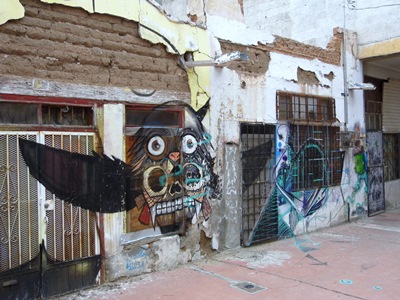
(Not scenes from Don Quixote.)
You see, Live at Pompeii was the first VHS tape I ever watched on a VCR, and I wondered what the thirteen-year-old me would think if he’d known that decades later there’d be that same shaggy Nick Mason pounding those same massive drums. But this time that boy was watching "Careful With that Axe, Eugene" in a tiny bar in a city that a handful of years earlier had been dubbed the Murder Capital of the World, surrounded by mid-twentieth century porn, pressed in on all sides by friendly locals speaking a language he couldn't understand very well, while sipping a Jack and Coke, now had in honor of the late Lemmy Kilmister. He might be kind of confused as to just what sort of path had led here, but I’m fairly certain he’d think Ciudad Juárez, a city trying hard to rebuild itself after some very dark times, was well worth exploring in 2017.
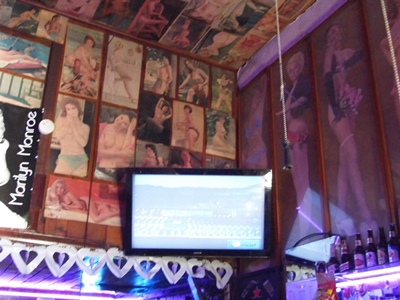
(El Club 15 and its trio of vices.)
Again, many thanks to Rich Wright, who showed me Juárez as I never could’ve seen it otherwise, even if given many years of roaming the streets on my own. I can’t recommend taking one of his walking tours highly enough. More information on those can be found right HERE.

(La vida es muy corta para tener miedo - Life is too short to be afraid.)
Juárez, I had a dream today
The children danced, as the guitars played
And all the violence up and slipped away
Goodnight, Juárez, Goodnight - Tom Russell "Goodnight Juárez"
Tom Russell recorded Goodnight Juárez in the fall of 2010, and by the end of that year 3,111 people would be murdered in a city of about 1.4 million. Ciudad Juárez was already coming to be widely known as the Murder Capital of the World and tourism from the north, for many decades so lively, if admittedly often bacchanalian, had effectively ceased in the few years since cartel activity had begun to spike in 2007.
However, 2010 would represent the bloody peak of brutality and, by 2015, there were just over 300 homicides. While it can’t be said that the violence has up and slipped away--and 2016 did see an uptick in killings--Ciudad Juárez is not the place it was several years ago. Yet most of the world hasn’t heard that, or at least doesn’t believe it, which makes Juárez an utterly fascinating, enchanting, and still, at times, sobering city to visit now.

(Groceries - The Shrapnel.)
This story starts when, while visiting El Paso in 2013, I ran into a man setting the old clock in San Jacinto Plaza. He told me that he’d given walking tours of Juárez for years and was thinking it was finally safe enough to resume them. On a subsequent visit I tried to see if the tours were being offered and, sure enough, there was a webpage touting guided trips to downtown Juárez. “Entertaining! Educational! Fun!” the ad read. And, in the biggest, boldest letters: “SAFE!” That was more than good enough for me. Sadly, it would take another couple years to get myself back again to actually take a tour, but in that time Juárez’s reputation for violence seemed to change almost not at all, even as the death toll continued to decrease.
As it turned out, Rich Wright, who has been running these tours, was not the man I met in the plaza. But he’s been going to Juárez his entire life, including during the years of greatest bloodshed, and, with a mutual acquaintance or two in the Minneapolis music scene of the ‘90’s, I couldn’t have asked for anyone more simpatico. Did I mention my Spanish is hardly serviceable?

(Taqueria el Tropíco.)
We paid our 50 cents to cross the Paso del Norte International Bridge and off we went, stopping to note a spray-painted marker on a train bridge below. This was for Sergio Adrian Hernandez Guereca, a 15-year-old shot there by the U.S. Border Patrol in 2010. A case to decide whether his family can sue is now at the U.S. Supreme Court, and the scrawled “Sergio” was an immediate reminder that battles do continue to rage, even if in 2017 some of the fiercest may be fought in hushed courtrooms and the shadowed halls of government.
Once in Juárez, our first stop was Ignacio Mariscal Street, long known as the infamous red-light district, La Mariscal. Rich pointed to an open plaza temporarily filled with brightly-colored amusement park equipment and recalled it lined with ancient bars, a scene now hard to imagine. The demolition is part of a widespread government effort to destroy the haunts of the cartels and generally clean things up, a process which has seen many historic babies going out with the druggy bathwater.
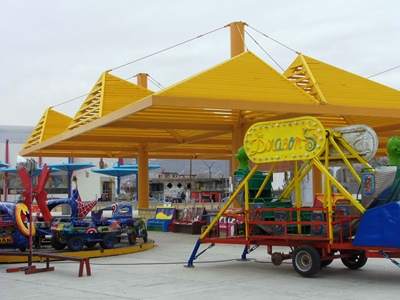
(Amusement of a less traditional sort at La Mariscal.)
Stunning murals covered many of the walls surrounding the plaza, but just before noon on a Friday the amusements were quiet and the plaza itself deserted. So we crossed the walkway to a neighborhood that had not yet been subject to razing or revitalization, which pleased me greatly as among the abandoned buildings was the former home of a brothel called White Lake. It was immortalized in Cormac McCarthy’s “Cities of the Plain,” if moved to a somewhat fictionalized location in the city. Nearby a man lay in a crumbling, concrete doorway sleeping, only his feet protruding into the gathering daylight.
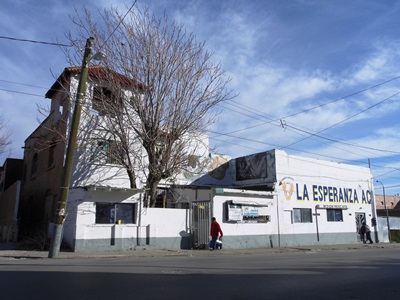
(Former location of White Lake brothel.)
The next stop was the Museo de la Revolución en la Frontera, a wonderful museum housed in the grand old customs building. Tracing the turbulent history of Mexico through the early years of the 20th century, it depicts the frequently harrowing tales of men of great and sometimes dubious intent such as Porfirio Díaz, Pancho Villa, Emiliano Zapata, and Pascual Oruzco, many of which were photographed in the very same building that now describes their legacy.
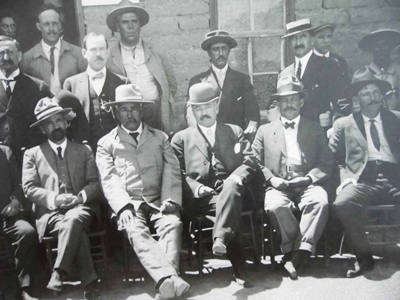
(Museo de la Revolución en la Frontera.)
While much has changed in Juárez, some things have not, and just past noon we found ourselves in Buen Tiempo on Vicente Guerrero, a bar operating continuously since the early 1920’s and thus now the oldest in Juárez, if only barely. With lime-colored walls and No Fumar signs that were hardly being taken as even a remote suggestion, the tequila came in chipped votive candle holders with little crosses on the bottoms and the Indio was cold. People I didn’t know asked me questions I couldn’t always understand and earnestly shook my hand. It all seemed right and proper. From there we headed to Mercado Cuahtemoc and then upstairs for a less liquid lunch. The chips and salsa verde were delicious, as were the chile relleno burritos. At this point, since entering the Buen Tiempo, we probably hadn’t spent 15 Yankee dollars between the two of us.
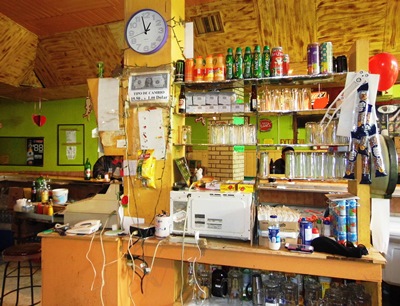
(El Buen Tiempo, the oldest bar in Juárez.)
The afternoon ended with the obligatory stop at the Kentucky Club, said to be the place where the margarita was invented. Once the haunt of the likes of Marilyn Monroe, John Wayne, and Steve McQueen, the Kentucky Club bills itself as world famous and is sometimes referred to as the oldest bar in Juárez. However, it seems that much that is reportedly true about the Kentucky Club may not be quite so and, in fact, the current building is not the original circa-1920 bar. That one was on Dieciseis, over by the train tracks, and not as close to the border. The margarita was good, no doubt about that, but I was perhaps more impressed by the $2.25 price tag.
After giving away whatever coins we had left to people gathered around the bridge, we paid our four pesos to get back to America with plans to return the following day for a “less-structured” tour, part of a lucrative syndication package City of Dust has worked out with El Chuqueño, Rich Wright’s excellent blog on El Paso, its environs, and desert living in general. Details of that second trip across the border will be coming up next.
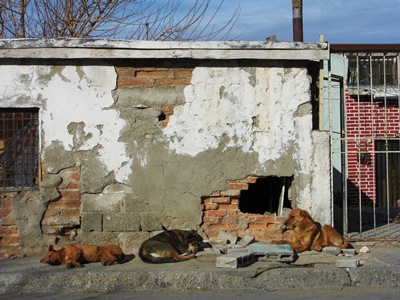
(Los perros de Juárez.)
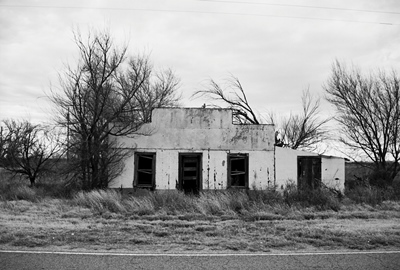
I might as well stop pretending that I’m going to post more regularly and admit that, modern life being what it is, time is always tight, and seemingly ever-increasingly so. However, one way to get new posts written is to take to my sick bed and thus find myself confined to the small space between the bedroom and kitchen table. As such is the case today, let us leave the hustle and bustle of modernity behind once again and step back into the past, this time to visit Lingo, New Mexico.
The little village of Lingo, which can still claim at least one family as residents, is on the eastern edge of New Mexico, just five miles from Texas. It’s a tiny dot on the map at the western extremity of the staggeringly vast Llano Estacado/Staked Plain plateau. As such, it sits among some other places we’ve visited in the region, such as Pep, Causey, House, and Highway.
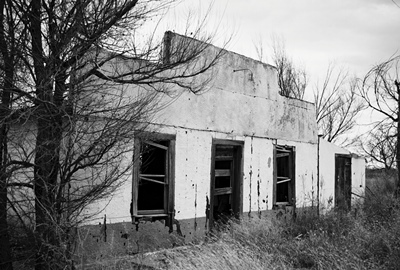
Jean M. Burrough’s “Roosevelt County History and Heritage” leads off with a handwritten letter about the Bilberry family’s arrival in what was not yet Lingo. They lived in a “two-room shack, dirt floor” and Finis Bilberry farmed and raised sheep. School was first held in 1916, the schoolhouse being a one-room dug-out at a place regrettably named Nigger Hill. Also known as Dead Negro Hill, this was where, in July 1877, a group of African-American soldiers and buffalo hunters abandoned their pursuit of some Comanche who had stolen stock and killed one hunter. Desperate and dying of thirst in the summer heat, the men began to search for water, some going 86 hours without a drink. Five would die in this incident, which was sometimes remembered as the “Staked Plains Horror." Finally, in 2005, the name of the rise was officially changed to Buffalo Soldier Hill.
Speaking of place names, in “The Place Names of New Mexico,” Robert Julyan notes that Lingo was known as Need in 1916, becoming Lingo in 1918. No one knows why it was originally called Need, but in 1918 the postal authorities thought the name too close to Weed, a settlement down south in Otero County. At that point, not only did Need become Lingo, but the post office got moved three miles to the north. I don’t know why the post office also had to move. Anyway, it’s been speculated that Lingo took its name from the way the people spoke (i.e., “the jargon, slang, or argot, of a particular field, group, or individual”), but more probably it references a family, now forgotten.
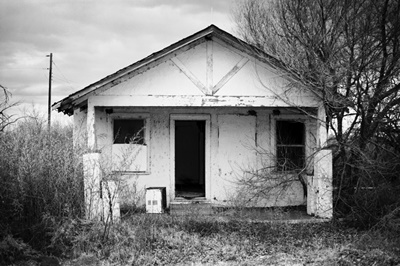
Now, I often feel like City of Dust is in a race against dusty oblivion as so many of the buildings documented on this blog are disappearing fast, and those in Lingo are no different. But unlike Lucy, NM, where I got there too late to photograph the old school or the Formwalt house, in this case I arrived just in the nick of time.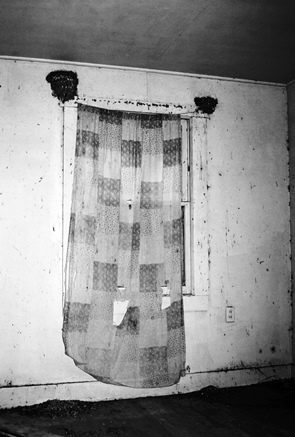 Shown above and at left is the post office, where around 1953 a Mrs. Balko was postmistress. Mrs. Fanny Brown took the position on April 20, 1968, staying until the post office closed in 1984 (possibly on November 2). I visited on December 12, 2015 and on Valentine's Day 2016 the old PO burned to the ground. Apparently someone was driving a pick-up with a BBQ grill in the back and hot coals became airborne. Numerous blazes were started, consuming a total of 1,083 acres in southeastern Roosevelt County, but at least no one was hurt and no other structures were damaged.
Below is the crumbling Lingo Baptist Church, reportedly also used by other denominations on occasion, possibly after a second church in town closed. The general store is shown at the top of this post. Other buildings included a café, hardware store, basketball gym, and a shop in a Quonset hut, none of which still stand.
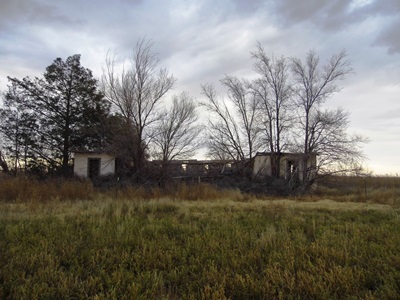
Fish fries and dances were held at the high school, which was across the street from the post office. The dances were a big deal as such stuff was not allowed in nearby Causey. However, Causey was where you would go to get your hair styled by the much-loved Lingo resident Edna Ashbrook. Lingo’s last graduating class was in 1945 and numbered five: Meryl Terry, Pete Rogers, Billy Joe Cunningham, Otis Foster, and Gene Collins. You can still find the blacksmith shop, but it’s fallen into a jumbled heap. Things are certainly much quieter than when Lingo could boast of the Hair twins--Judson and Jettie--and the Henry triplets--Anna, Bunna, and Lanna--although, you know, sometimes quiet can be nice.
Now I must return to my Theraflu.
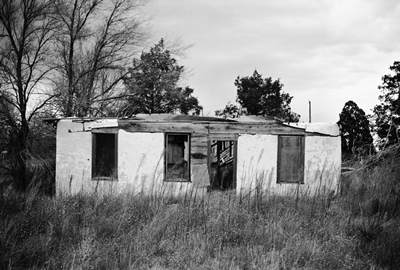
The only published sources of information on Lingo that I could find were Burrough’s “Roosevelt County History and Heritage” and Julyan’s “The Place Names of New Mexico.” Wikipedia has a long entry on the “Buffalo Soldier tragedy of 1877.” Everything else for this post came from the many good people that left their recollections of growing up and living in Lingo on a series of photographs on the City of Dust Facebook page. Those photos and the accompanying comments can be found HERE, HERE, HERE, and HERE.
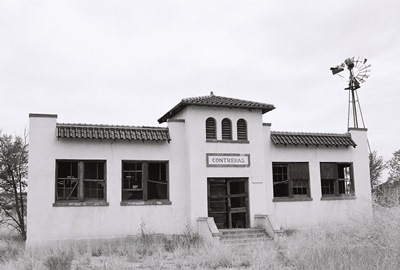
In Socorro County, New Mexico, tucked off a side road that parallels I-25, not far from a muddy stretch of the Rio Grande, is the little village of Contreras. This was where a man named Matías Contreras once raised cattle and sheep and gave his name to a small community. A post office opened in 1919 but closed in 1935.
Not far south of Contreras is La Joya, the literal end of the road, and, in fact, a map from 1918 has Contreras as Los Ranchos de la Joya. La Joya’s recorded history post-European contact goes back much farther, to 1598, when Juan de Oñate's expedition found a Piro Indian pueblo there and called it Nueva Sevilleta because the setting reminded the Spanish explorers of Seville, Spain.
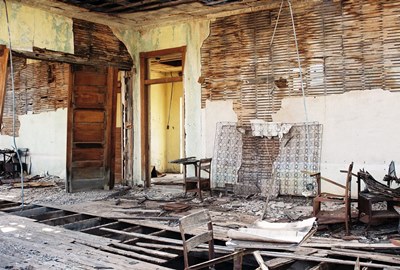
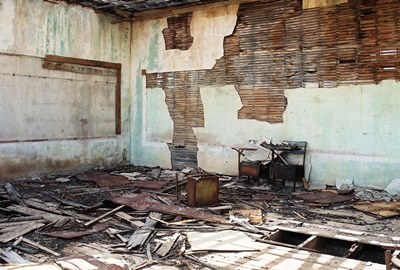
To me, the most striking building in Contreras is the old, long-empty school, naturally. I don’t know much about it, but I do know that students were attending classes there in the 1930’s. So perhaps it's one of the many Works Progress Administration (WPA) structures built in the area around the time of the Great Depression. Nearby Alamillo has a WPA school that became (and might still be) a residence, although it looks quite different.
There used to be a plaque to the right of the front doors (see top photo), which I somehow managed to miss. Later I was told it commemorated some local folks involved with the school, but before I could get back to look more closely it had been removed. I don’t think it was stolen though; probably it was taken off because the building is in such poor condition. Maybe whoever has it will read this and tell us what it says! I should mention that I photographed the school a few years ago and not only is it in worse shape now, it's also been fenced-off.
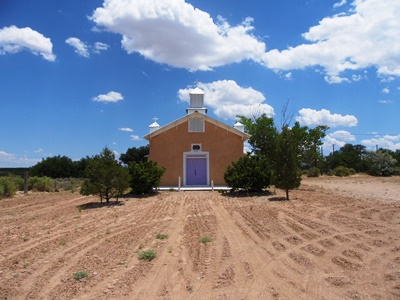
Otherwise, the San Jose Catholic Church, part of Our Lady of Sorrows Parish, is well-maintained and hosts a fiesta in March. There are no going commercial or civic concerns, but there are some well-kept homes and, if you visit whilst under the vengeful eye of the relentless afternoon sun on a parched, triple-digit day, plenty of dust. Of course, as this is the blog for connoisseurs of dust, everything is as it should be with this trip to Contreras, New Mexico.
There’s not a lot out there on Contreras, so pretty much all the historical information for this post came from Robert Julyan’s trusty “The Place Names of New Mexico.”
I have a backlog of so many small towns and villages in New Mexico that I may well never get to them all at this rate. But I can keep trying! Next time I’ll just reach my hand into the hat and see what I pull out.
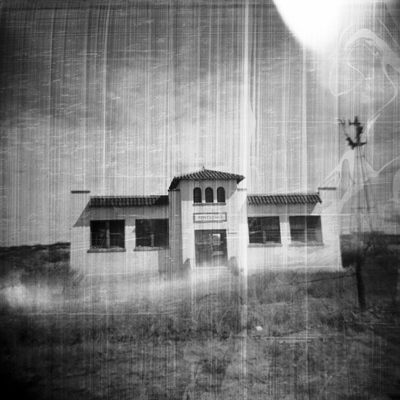
MARCH 2023 UPDATE: I am beyond thrilled to be able to make available here one of only two known firsthand descriptions of life in Ricardo, New Mexico. This account, spanning from 1908-1916, is contained within Zorene Thompson's wonderful memoir, "OUR LITTLE HOUSE ON THE PRAIRIE." In addition, there's an ADDENDUM TO CHAPTER 5, which goes deeper into the story of Della Carley, who shot two people at the Ricardo post office in 1912. To download the PDF's, just right-click on the file names above and do the ol' "Save Link As..." trick. A big City of Dust thank you is due to Zorene Thompson's son, Ray Mack Thompson, for assembling his mother's rare story and making it available to all, a true labor of love! Thanks also to Jacalyn Carley, the granddaughter of Della Carley, for generously providing a chapter from her own family's history in Ricardo!
Ricardo, New Mexico, is yet another of the many towns that came to life seemingly overnight as the Atchison, Topeka & Santa Fe Railroad (AT&SF RR) built the Belen Cut-off through the east-central part of the state. Located in De Baca County, a few miles south of Highway 60, the recorded history of Ricardo appears to be scant at best. The village’s name is thought to have been that of a railroad official, and Ricardo, right along the tracks, was an AT&SF RR section house and water station.
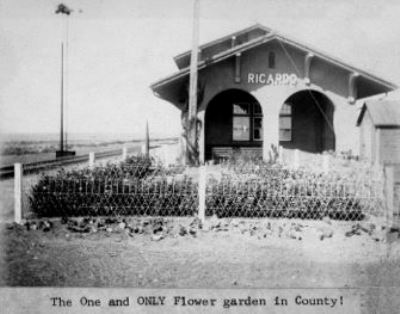
Sadly, on the night of May 6, 1908, a massive fire started in the large Grosh and Strayhorn store, spreading to the Ricardo Hotel, the barbershop, and most of the town. The Santa Fe New Mexican said that Ricardo was "reduced to ashes." However, rebuilding commenced, and the post office opened the same year, doing business until 1956, after which point the mail went to Fort Sumner. There was also a schoolhouse, which I’ve been told was comparable in size to the First Presbyterian Church of Taiban. In the late-1950s, the school was purchased and hauled away so the lumber could be reused. A vintage photo of the train depot would seem to indicate that Ricardo at one point had "the one and ONLY flower garden" in De Baca County.
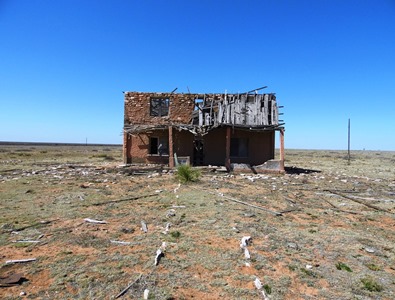
While virtually none of Ricardo is as it was (the post office became part of a ranch home; a general store collapsed), one gem does persist—at least for now—and that is a wonderful and spacious two-story rock and plaster structure, which may have been contructed in 1908 as a tuberculosis sanatorium that never held any patients.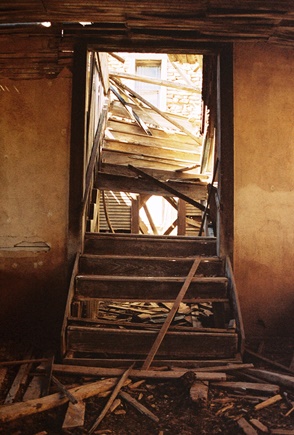 In the late 1920s, it's said that locomotive firemen who provided assistance shoveling coal to get freight trains up the long hill to Vaughn were briefly stationed here. It was headquarters to the adjacent ranch, as well. A later renovation for a family home was found to be impossible and now it is quite near collapse. However, having become the lone sentinel over this small part of the eastern plains, much of its old charm and majesty somehow remains. It’s not hard to imagine a family tending the stone walkway, or perhaps lounging on the porch of a fine spring morning, the wildflowers blooming way-off into the distance. If you’re quiet, beneath the prairie wind you can almost hear boots slowly climbing the shattered wooden stairs.
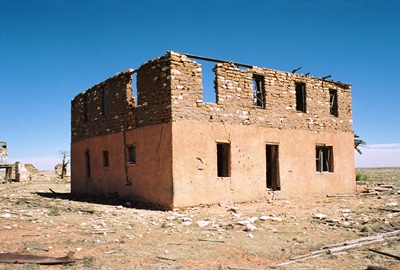
You don’t have to be quiet to hear cows though, a couple dozen of which may be quite excited to see you until they learn you have no food. Then they just seem vaguely hostile. I assume the concrete structure below was once used to water such cattle, but I’m not certain. Perhaps someone can provide some insight.
I should also mention that not only is Ricardo remote, it's on private ranchland. At one time I thought it might've been owned by the railroad, but that's not the case. So unless you have an invitation and a way with cows, it is best not to just show up on the porch of the last house in Ricardo.
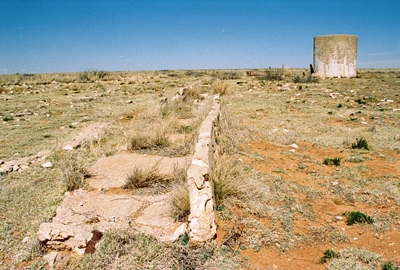
And that's all I know about the ghost town of Ricardo. I would love to hear more from anyone that might have something to tell, so please leave a comment if you do. For now, “The Place Names of New Mexico” has the most to say, and I picked up a bit more info from some knowledgeable viewers of the City of Dust Facebook page. The short news piece, "Fire Wipes Out Ricardo," was published by the Sante Fe New Mexican on May 8, 1908. I got the vintage photo from NM ghost town photographer Beata Certo, but no one knows the original source. Anyway, thanks, folks!
Next time I believe we’ll visit Contreras, down in Socorro County.
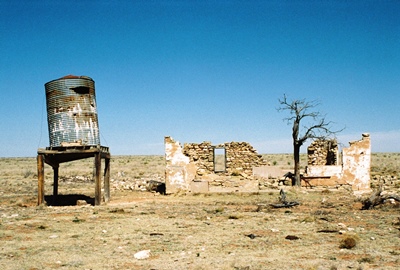
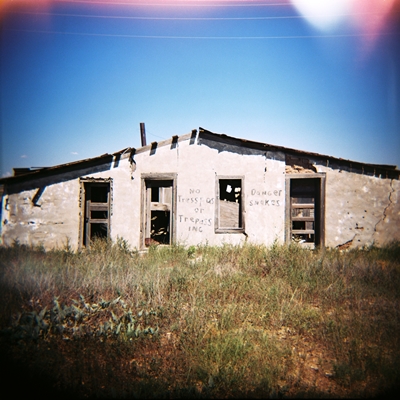
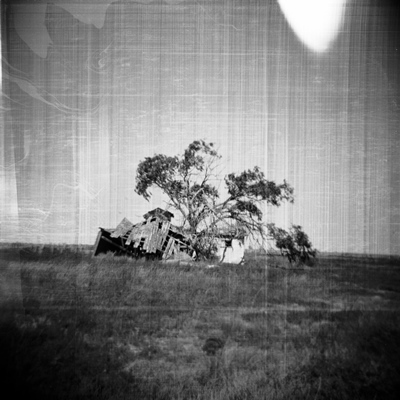
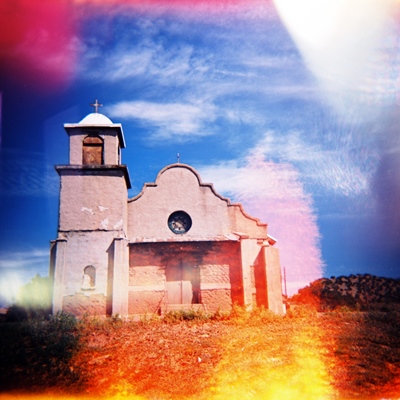
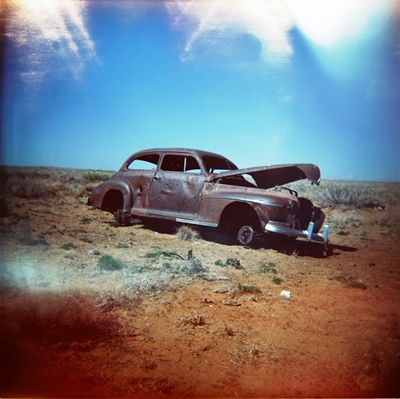
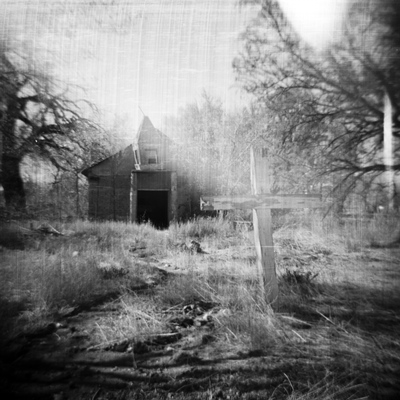
Despite the photo from Cedarvale, New Mexico above, this isn't a ghost town piece. Instead it's yet another story to fill in the time between my all-too-infrequent posts. This one is called...
THE WAR CORRESPONDENT
“You’re married? You’re fucking married?!”
I’m nearly—finally—asleep when suddenly a girl yelling in the room above mine jolts me back awake. My first reaction is one of pure anger. I haven’t slept in a very long time, and for the last 12 hours I’ve been nearly frantic to close my eyes. I’d driven over 36 hours straight with only a couple of quick naps at rest stops along the way. Out of nowhere Monday morning we needed to get a load immediately from our warehouse in Provo, Utah down to near Miami and my regular rig, which I could at least sleep in comfortably, was getting transmission work. All that was left to drive was a beat-up box truck, and between that and the tight deadline, decent sleep had not been in the cards. But I’d dropped off the load, gotten a quick bite, and checked into some place called the American Economy Inn not far from the beach to get my head down before starting the long haul back in the morning. So, I’m pissed to be awake. However, in another instant, curiosity takes hold.
“Oh my God!” yells the girl. Then an octave higher: “Oh! My! God!”
The man’s voice is deep and hard to understand through the floor. It sounds even and steady though. He’s trying to calm her down. There’s some stomping and another “Oh my God!” My stomach tightens and I’m ashamed of myself. Why should I feel anything for these people? I just want to be asleep. I hear the man again and make out a few words. “Baby.” “Her.” “You.” “Sorry.” I could fill in the rest myself if I wanted to.
Then there’s a crash and I wait for the inevitable. Real screaming. Harder stomping. All followed by a door slamming and then, maybe, a chance to get some shut-eye. I hope it won’t drag on too long, but then minutes pass with no sound at all. I listen harder, which only increases my wakefulness. Still nothing. Then there’s the unmistakable slow, rhythmic squeak of the bedsprings of a cheap motel mattress. Listening to other people have sex can be infuriating or depressing and in this case it’s both. So I turn on the light and put on my jeans and boots. The clock says 1:43AM. “Unbelievable,” I mutter, though there’s nothing remotely unbelievable about it. I wish I could call the guy’s wife. Not that I’m overly concerned about morality here, mind you, I just want some sleep.
There’s nowhere else to go so I get in the truck and turn on the radio. Two men are discussing ISIS in serious, somber tones. Where they come from, what they believe, how much money they have. In my exhaustion I’m struck by the thought that the modern world of dingy motels and run-of-the-mill adultery is going to have its hands full for quite some time battling the ancient world of religious martyrdom and apocalypse.
I listen to the radio for a while and must somehow eventually fall asleep because when I open my eyes I can see a thin paling of the darkness along the horizon just above the ocean. The clock on the radio says 4:52AM and a different man is talking about the weekend’s upcoming football games. My back and neck are stiff and I struggle to move as the blood painfully returns to my numb left arm, which has been pressed against the door. I turn the key, worried that the radio will have killed the battery, but the truck fires right up. So I cut the ignition, switch off the radio, and haul myself out of the cab. I’m too disoriented now to properly focus my anger on the couple upstairs as I stumble through the pre-dawn humidity back to my room where I sit on the bed, pull off my boots and jeans, and at last tumble into sweet oblivion.
Only the oblivion doesn’t stay sweet for long. Soon I’m dreaming that I’m wandering on a darkened battlefield amongst smoldering craters and mangled military equipment. Yet I can see no one either alive or dead. In my left hand is a camera and in my right a microphone but there’s nobody to speak to or document. I am too late for the war. The sense of failure is shattering, like I’ve let the entire world down. All those who might’ve fought here will go unnoticed and unremembered. As I walk slowly through the wreckage a hard, cold rain starts to fall, and the muddy ground begins to run with what looks like blood. But just as I’m about to scream I’m awoken yet again, this time by a knock on the door.
“Housekeeping!” I raise myself off the pillow and for a moment can’t recall where I am. Another knock: “Housekeeping!” The clock on the stand says 9:41AM.
“Not yet,” I answer, hardly recognizing my own wracked voice. “Half an hour, please.”
“Okay, sir,” is the reply through the door. “Sorry to disturb you, sir.”
I listen to the cart move further down the hall and then get out of bed and into the shower. In less than 30 minutes I’m walking across a sand-strewn parking lot toward the Flamingo Restaurant, a run-down 60’s-era joint next to the motel, with a voucher for a $5 breakfast. I sit on a faded pink stool at the blue and gold spangled counter, drink some coffee, and eat two runny eggs while I try to pull myself together. I think about how I didn’t plan on being a truck driver. I know plans don’t really mean much in life, but I never even made it to college. Then Cody came along before I’d turned 23 and that was that. I don’t mean to make it sound like Cody was the end of anything though. Really, he was the beginning. At 17, a junior in high school, he’s already a better man that I’ll ever be and I can’t claim any credit for that. He’s his own person, thankfully. For the last 10 years he’s lived with his mother and I’ve helped out as best I could. At first I’d visit only when I felt able to face him and his mom. It was harder when he was small, but it feels like it’s getting easier now. I’m grateful for that.
After breakfast I get in the truck and am about to hit the road when my phone rings. It’s my boss, Lindy.
“Dan, that was nice driving the last couple days. Damn heroic.”
“Thanks,” I reply. “I guess it was one for the books.”
“Sure enough. You made everyone happy.”
I almost laugh at that, but don’t.
“Listen,” continues Lindy, “take your time getting back. Find a couple places to stay. Some nice places. But, you know, maybe not too nice.” I do laugh at that. It doesn’t seem like there could possibly be a nice place between where I’m sitting and home. “And take the weekend off. In fact, I don’t want to see you ‘til Tuesday.”
I’ve worked for Lindy for eight years, often putting in six day weeks—sometimes even seven—and he’s always been good to me in return. It means something these days. It’s why I’ve stuck around.
“Thanks,” I tell him. “I appreciate that.” And I do.
“I know,” he says. “And I appreciate you handling this run. Now get back here safe.”
I tell Lindy I will and hang up. With the weekend free I figure I should give Cody a call and see what he’s up to. I make a mental note to do that later, telling myself not to let it slip like I have so many times before.
There’s a lot of road ahead of me. I’m still tired and I’d like to put in at least 10 hours before taking Lindy up on his offer. The sun sits low out over the water, gathering power. Happily, traffic is very light and moving fast. I get up to 80, about as fast as the old box truck will go, and start making good time. I’m fiddling with the radio, trying to avoid the news, when a car up ahead changes to the right lane without looking, pushing the car next to it off the highway. Then the first driver overcorrects in an attempt to get back into the left lane, slides sideways, and flips completely over, landing upside down at the bottom of an overgrown embankment. The other car has also flipped, but landed right side up on a flat spot near a swampy depression off the road farther back, its roof crushed.
I pull onto the shoulder and jump out of the cab. I smell the acrid tang of burned rubber. A puff of black smoke hangs in the air. A woman is screaming from the car that’s upright, but everything seems strangely quiet and still. I call 911 and tell them there’s been a serious accident. I give my best guess at the mile marker number and even though the operator tells me to stay on the line I hang up. The woman continues screaming, but I’m closer to the other car, so I run to that one, already breaking a sweat. At first I can see no movement inside. In the driver’s seat a man is strapped into his safety belt, hanging upside down against the roof. I kneel in the tall grass and yank on the door. It opens and I reach for him. He’s dazed and bleeding badly but alive. Then he opens his eyes wide and yells, “My son! My son!” He waves his hand toward the passenger seat but the child is actually lying on the roof, near the rear window, completely still. So much blood covers the man’s face that he can’t see his boy.
“He’s here, sir,” I say, surprised at how calm I sound. “I’m going to help him first.”
I run around the back of the car and smell gas. I know cars don’t usually blow up like you see on TV, but if there are fumes then the fuel system might no longer be sealed, and it occurs to me that maybe the vehicle is combustible. I kneel to get at the rear door handle and pull. The door is jammed, but I feel it give slightly so I try harder. It finally opens and I gently pick up the boy. He is perhaps six or seven and there is no blood on him at all. I think he must be dead but then his chest rises weakly. With the man’s son in my arms I run from the car to the grassy slope of the embankment by the highway and gently set him down in a patch of sparse vegetation. Some people have gathered and a middle-aged woman crouches beside me. She says she’s a nurse and begins to look at the boy. Without saying a word I get up to return to the man and it’s only then that I realize the woman in the other car is still screaming. Another man is trying to get her out of her vehicle, but I run back to the upside-down car and a third man follows me. This man and I work together to extricate the driver, whose scalp I now see has been partly torn from his skull, likely after hitting the spider-webbed windshield. He lapses in and out of consciousness as we undo the seatbelt carefully so he does not tumble onto the roof. The smell of gas is much stronger.
Quickly covered in the driver’s blood we slide him from the car. His left arm hangs limply from his side and it looks like his collarbone has been broken. We slowly carry him to the grassy slope and, as we do, I see the other man carrying the woman in his arms. She has not stopped screaming, but somehow it has become mechanical, the sound almost disembodied. The ground is wet in that direction and the man lifts his legs high to free them from the mud with each step as he moves towards us. We all converge on the slope and the woman is also covered in blood, a white stump of bone sticking through her thigh below her torn dress.
Finally I hear sirens growing closer and the state patrol arrives. Next come ambulances and a firetruck. We all step aside and let the paramedics get to work. Some firemen inspect the vehicles and then the firetruck begins to douse the car that’s upside-down. The injured woman suddenly goes quiet and is loaded into an ambulance. The man and his son are put in other ambulances. Bystanders begin to wander back to their cars. With traffic reduced to one lane, a line of vehicles snakes into the distance. Having seen the entire accident, I’m asked by the state patrol to provide a report. The officer goes through some questions and since there isn’t all that much to tell it’s over quickly. I’m given some forms to fill out with my contact information and it’s hard to keep the pen steady. Investigators arrive with measuring tools and tow trucks ease their way off the highway toward the crumpled vehicles. No one says, “Good work,” or “Nice job.” I’m not certain that I’ve done the right thing. Should I have done more? Should I have done less? I simply don’t know.
Then I walk to my truck and find the man who helped the woman doubled over behind it, vomiting. I try to light a cigarette but begin shaking and have difficulty getting the lighter to flame. The man straightens, wiping his chin with a sleeve, and I ask him if he wants a smoke. “I quit years ago,” he says, but an instant later reaches for the outstretched pack. Somehow I manage to light us both up and we stand there silently watching the wreckers and policemen. I’m quickly down to the filter and then all I can think to say is, “Be safe.” The man nods and replies, “You, too.” I climb into the truck and ease slowly into traffic that stretches far back along the highway, where tragedy comes fast and often.
It doesn’t take too many miles before I know that I need to get off the road. I’m halfway across the parking lot of a Super 8 when I remember there’s a lot of blood on my clothes. The woman at the front desk eyes me warily until I explain that I was just at the scene of an accident.
“Oh my god!” she exclaims. “A couple ambulances went past half an hour ago. That’s an awful stretch out there. Wrecks all the time. Bad ones.”
I ask if she’s heard anything about the people that were injured, but she hasn’t. She gives me a room for half price and even though it’s on Lindy anyway I don’t dismiss the gesture.
I take a long, hot shower and get dressed. I walk outside to the dumpster and toss my bloody clothes inside. Then I call Cody. The sun is setting and the steady woosh of cars off Interstate 75 mixes with the voices of travelers around me.
“Hey, Dad,” answers Cody after a few rings.
“Hi, buddy. How are you?”
“Pretty good. What’s up?”
“Well, you know, I just got the, uh, weekend off.” My voice is unsteady, all adrenaline now completely drained from my system. “You wanna go to the football game Sunday?”
“Sure,” he says. “Sounds good.”
“Alright, I’ll, um, try to get us some tickets and, uh, call you Saturday.”
A few seconds pass.
“Dad?”
“Yeah?”
“Are you okay? You sound kinda funny.”
All at once I’m afraid I might start crying. Hard. Like maybe I won’t be able to stop. I take a breath. “It’s been a tough day.”
“A bad one?”
“Yeah.” I press my fingers to my eyes. “Pretty bad.”
“You want to talk about it?”
“I do.” And that’s the truth. Still, I can’t. Not just then. “But I’ll tell you about it when I see you. Give you the full report.”
“Okay. Where are you, anyway?”
“Florida.”
Cody laughs. “Florida?! No wonder you’ve had a bad day. Florida sucks.”
I smile. “Yeah.” Then I hesitate, like I always do, a weakness inherited from my own father. But I make sure I get the words out: “Love ya, buddy.”
“Love you, too, Dad.”
I walk back to my room and lie down on the bed. I listen to the clock radio—the oldies station—as a patch of sunlight travels across the carpet. Then the room is filled with shadows, and finally it goes dark as Carole King sings me to sleep. Never once do I hear so much as a peep from upstairs.
The next morning I wake up starving. I have plenty of carbohydrates and a cup of scalded coffee at the continental breakfast and then I’m back on the road. It’s still early and I turn the radio on. Overnight there have been mass killings in three more countries. Suicide attacks. Car bombs. Retaliations upon retaliations. I think about the tragedies within those tragedies, the battles waged in individual lives, no less important because they go unrecorded. Could anybody’s god stand to bear witness to them all? I turn off the radio and get ready for a long piece of I-75. I give the rattling box truck a little more gas. I’m heading for home, the fighting over for now.
If you like this kind of thing, there's more HERE. And HERE. And HERE, too.
The photos were all taken over the last couple years with a WOCA 120G that does what it wants no matter how much Gorilla Tape I put on it.


