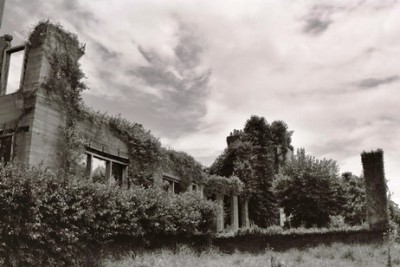
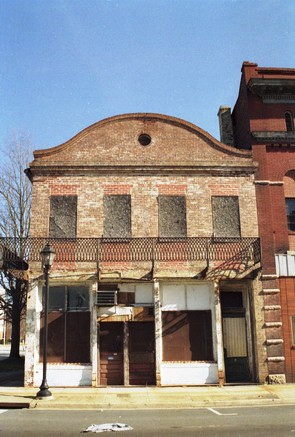
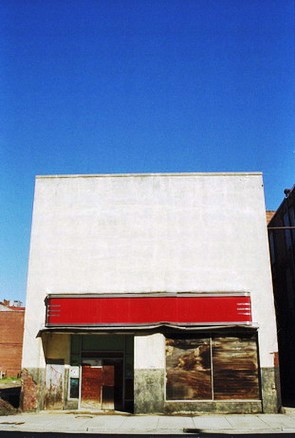
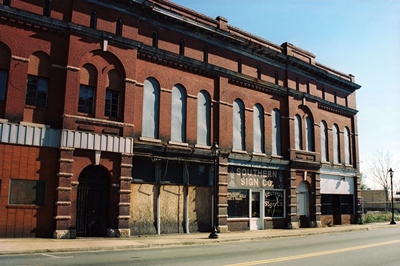
 I hear ya. You're saying, "Oh geez, how many pictures of dilapidated buildings and empty streets can a person take?" But bear with me. This post, in combination with the previous and I Feel Good!, will result in what I believe to be the most extensive photographic record of this end of James Brown Boulevard currently extant. No kidding! You're thinking, "So, are people e-mailing you, pleading that you document the hell out of one half-block of a largely forgotten street from a slightly-above-horizontal perspective using quickly scanned photos off negatives developed at a drugstore?" I concede, no. However, consider this, as I type, tens of thousands of people are pouring into Augusta for the Master's Golf Tournament. How many will see this street? I'd estimate seven. How many of those, finding themselves on JB Blvd., will NOT think: a.) "Whoops, wrong turn!"; or b.) "I wonder if we can find some drugs down here?" I believe zero. I'm not saying thousands upon thousands of golf fans are wrong, that's just the way it is. And I don't think what you see here is going to last long. This block has even been considered as a site for the new courthouse, if they could just get around the pesky trains nearby. So, this one is for me and James. About the man...
James Joe Brown, Jr. was born May 3, 1933 (1928?) in Barnwell, SC. Or was it Macon, GA? Pulaski, TN? In any case, when James was 4 years old, his mother left his father for another man. His father told her, "Take your child." "You keep him," was her response. James didn't see her again for 20 years. The going got even tougher and the family, without a dime to their name, moved to Augusta, GA. James was quickly sent to live in a brothel with his Aunt Honey, the madam, at 944 Twiggs St. The boy shined shoes outside the "Shoeshine King," delivered whiskey, and buck-danced for soldiers--anything for a few coins. At the age of 16, he was picked up for armed robbery and sentenced to 8-16 years' hard labor.
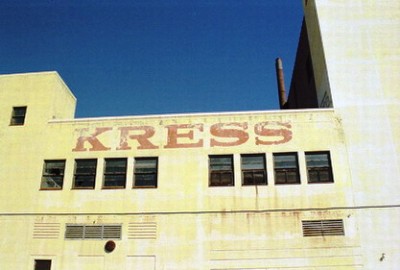
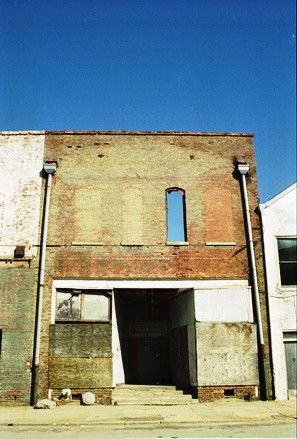
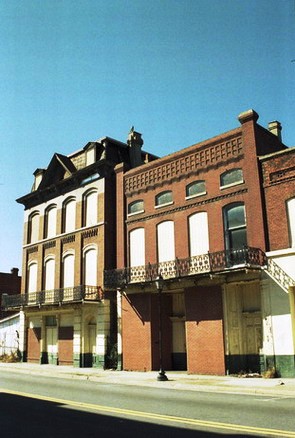
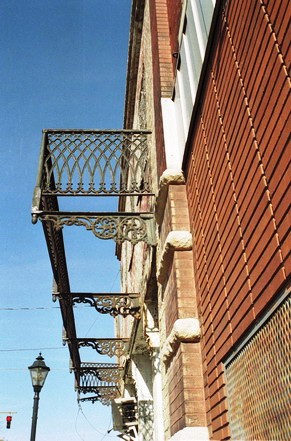 He spent the next four years in the county jail, on a juvenile work farm, and in a group home. Upon release, he joined the Gospel Starlighters, a vocal group led by Bobby Byrd. Soon, the group changed their name to the Famous Flames, shifted from gospel to r & b tunes, and moved James out front. James married his first wife, Velma, and, in 1956, after recording "Please, Please, Please" at WIBB in Macon, GA, the Famous Flames signed to Federal/King Records for $200. "Please, Please, Please" went to #5 on the r & b charts. In 1957, Little Richard renounced rock and roll for that other religion. Namely, religion. James and the Famous Flames picked up all the dates Little Richard had booked and also picked up a few of Richard's band members. Things really got rolling and "Try Me" was released in the fall of 1958, hitting #1 in the r & b charts, where it became the best-selling single of the year. This is the balcony of the above building. Another rare recurrence, this building also appears in b & w in I Feel Good!.
Constantly in demand, Brown booked seven nights at the Apollo in NYC in 1962. The midnight show of 10/14/62 was recorded and released as--yup--Live at the Apollo. A few months later, "Papa's Got a Brand New Bag" was issued, dominating the r & b charts for 8 weeks and even cracking the mainstream Top Ten. In 1965, another smash hit, "I Got You (I Feel Good)," was released. In 1969, James played Richard Nixon's inauguration. It probably seemed like a good idea at the time, much like his second marriage, to Deirdre Jenkins, in 1970.
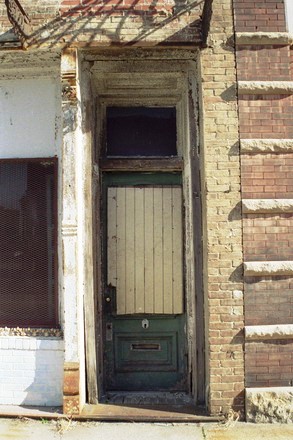 Later that year, he signed with Polydor and shortly afterward released "Get on the Good Foot," which reached #18 in the Top 40 and eventually sold a million copies. James started to call himself "The Godfather of Soul," a title which appeared not unwarranted. In 1973, James' eldest son, Teddy, was killed in an auto accident. The following year, The Payback was issued, featuring long, dense jams, the shortest of which was 5:52. (The longest, "Time is Running Out Fast," clocked in at 12:47.) It became Brown's only gold album, selling over 500,000 copies. That same year, James played "The Rumble in the Jungle," the music festival-cum-Ali/Foreman fight held in Zaire. I guess that was Don King's idea. Oh, and the IRS wanted $4.5 million in back taxes, ensuring that the Hardest Working Man in Show Business remained so. Here's a thin green door. I do not know what's behind it.
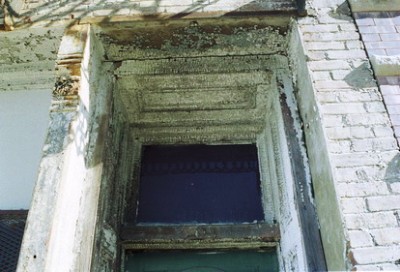
Enter the Disco Era. James responded by releasing "The Original Disco Man." This was probably not a good idea. He did show up in the Blues Brothers movie though. In 1984, he married his third wife, Adrienne. In 1987, he got an audience with the Pope. James was considering the Ministry, but the Pope advised that he not quit his day job. In early 1986, "Living in America," the theme to Rocky IV, reached #4 on the Hot 100, and James was back in action. Sort of. Was Rocky IV really that long ago? Anyway, in 1988, following a troubling period of drug abuse and arrests, James was picked up on a domestic assault charge. Music fans of conscience really wished he wouldn't have hit his wife. Soon after, Brown took a shotgun into an insurance-licensing seminar being held next door to his offices in downtown Augusta, believing that an attendee had used his personal toilet. He then hopped in his jeep and was chased back and forth across the SC/GA state line on Interstate 20 by police, who fired 23 shots at the vehicle. Brown drove back to Augusta on tire rims before being pulled over, and was found to be on angel dust. Brown denied being on PCP, and claimed he'd fled police to protect himself. Nope, no way over the thin green door either.
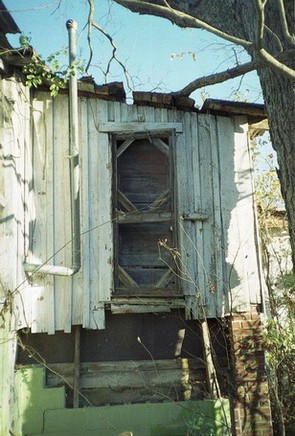
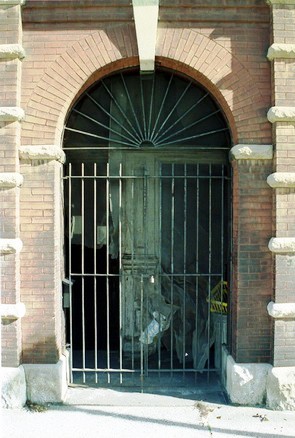 In December 1988, James Brown was sentenced to 8 years in prison. He was paroled on February 21, 1991 for good behavior, and immediately had new eyebrows tattooed onto his face. (Not so strange, really. Donald Trump had similar work done.) The eyebrows were completed just in time for James to be given a Lifetime Achievement Award at the 1992 Grammy Awards. The next year, MC Hammer presented James with a Lifetime Achievement Award at the 4th Annual Rhythm & Blues Foundation Pioneer Awards. In November 1993, 9th St. became James Brown Blvd. and November 20 was declared James Brown Day in Augusta because, among other things, "James Brown is a musical phenomenon affectionately known as `The Godfather of Soul.'" Here's another door. See, there's just no way inside these buildings.
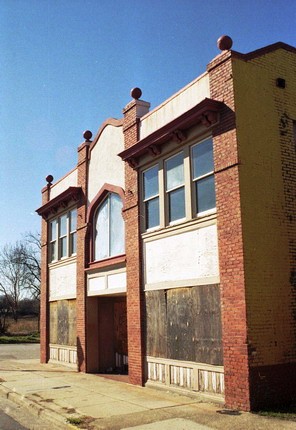 In 1996, Adrienne died from complications while having liposuction surgery. James received a star on the Hollywood Walk of Fame in 1997, but in 1999 a former employee, Lisa Agbalaya-Ross, claimed he'd told her he had powerful testicles which he'd received from the government. She promptly sued him for sexual harassment to the tune of $1 million. In January 2002, Brown married wife #4, Tomi Rae Hynie, and was also cleared of the harassment charges. On January 28, 2004, Brown was arrested once again for domestic violence, causing the city of Augusta to cancel his appearance that spring, a performance that was to coincide with the unveiling of a statue (subsequently re-veiled), and the re-naming of the Garden City Music Fest to the James Brown Music Fest (subsequently un-renamed). James' dishevelled mug shot was shown nationally. We could see inside this old church-like building from the roof of The Meathouse. What we saw was that the whole 2nd floor had caved in.
The Godfather of Soul, the Hardest Working Man in Show Business, is undoubtedly a legend. Some of his recent acts are indefensible, others laudable, some baffling. Until a bout with prostate cancer last December, he was still playing 50 dates a year. He continues to hand out free Thanksgiving turkeys and Christmas presents each year to the poor in the neighborhoods near where these photos were taken. But JB Blvd. saddens the Godfather of Soul. Among the few people that roam this ruined stretch, one is Brown's daughter by a former mistress. Of her, he's said, "She's got worse than a habit. When a person is just spooked, we say she got a monkey on her back. She got a gorilla on her back."
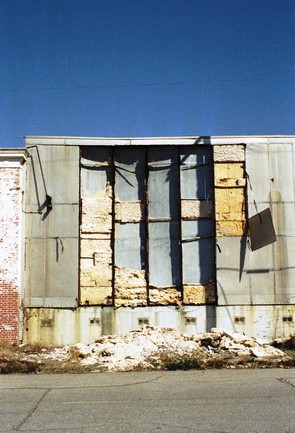 The man may have banned computers from his office because he believes they can watch him, but only Elvis Presley has had more hit records. Until recently, Brown used to hang around his radio station downtown, which, I believe, is now defunct. One day, a friend of mine saw him hanging a display in the window and waved. James pointed back, smiled, and did a little spin and shuffle. James Brown: "I fear God. I fear a man with a gun. I fear a man with a knife. I fear a fool behind the wheel. That's what I fear. I fear death. Death may come to me. I may not run from it like a lot of people if my rights is there. I put my rights first, 'cause if I can't live then I'm already dead." And so we leave JB Blvd., and head down Walker St., never to return. Info for this post came from the Hall of Fame biography and Cosmopolis. If you only read one James Brown story, make it The Trip of a Lifetime, a driving tour through downtown and along JB Blvd. with James Brown himself. The quotes included here are from that story. The original proclamation regarding JB Blvd. and James Brown Day in Augusta is here....somewhere. See ya next time.


 Okay, I've returned from my little jaunt through the South. The weather was beautiful in New Orleans, we stopped by
 Now, the Augusta Arsenal used to be near the river and, consequently, soldiers were always turning yellow, getting enlarged spleens, and dying like flies. Captain Matthew Payne visited Freeman Walker in his house up on The Hill in an attempt to regain his own health afer a bout of fever. While there, the Captain realized that the men at the Arsenal might not die so often if they were up on the hill too. So, construction of a new Augusta Arsenal began, right beside Bellevue. This was in the mid-late 1820's. Now, having dodged some construction equipment and a few stray dogs, we're just a bit further down Ellis St.
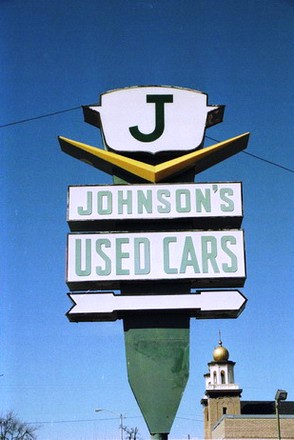 Just as the Civil War was on the horizon, the Federal Government sent 22,000 muskets and rifles up to the Arsenal under the guard of Captain Arnold Elzey. In January of 1861, Elzey surrendered the Arsenal and its arsenal to Colonel W.H. Walker of the Confederate Army. Elzey then joined the Confederacy and was promptly promoted to Colonel himself. By this time, Freeman Walker was long dead and John Galt lived at Bellevue with his two daughters, Emily and Lucy. I'm assuming both daughters were very beautiful and prone to swooning, but I can't verify that. We've taken a left turn and walked down the street to Telfair. I rarely take more than one shot of something, but I've got at least three of this sign. I dunno why. I guess I just like it. There's another
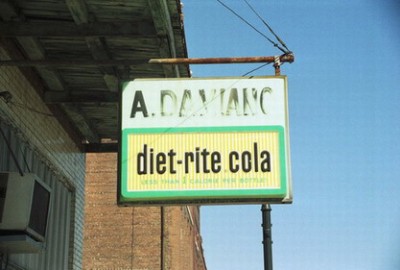
 You can bet that I went on a mission one day to look for this window, even if I had to pretend I was an ASU student in need of counselling. Yes, I know, possibly not a stretch. However, it took me awhile to get around to it. Just before I left Augusta I figured I better finally have a look see and, would you believe it, the whole place was closed for renovation. I'm pretty adept at getting into old buildings, but not secure contruction sites in the middle of the day. Or even the middle of the night. So, as they say, I can neither confirm nor deny the veracity of the claims. But, you know, I believe it! Other side of James Brown Blvd. Not much livelier than across the street.
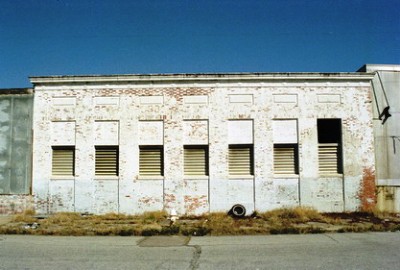

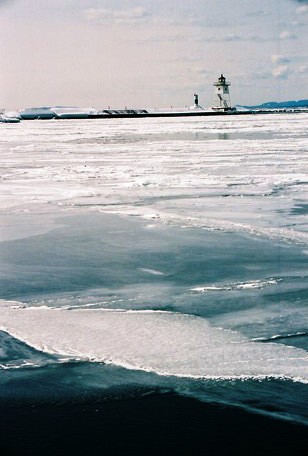 The person who correctly guesses the location of these shots will win their choice of an 8" x 12" enlargement of the 1st photo in

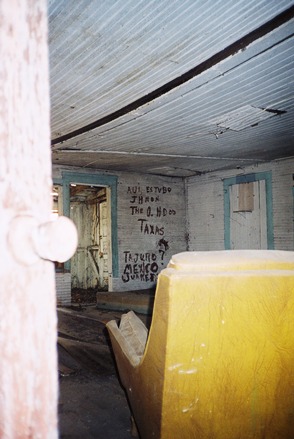 Back when I was finishing up the four-post saga on
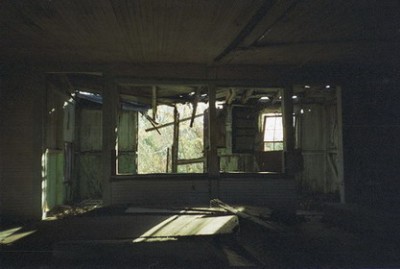
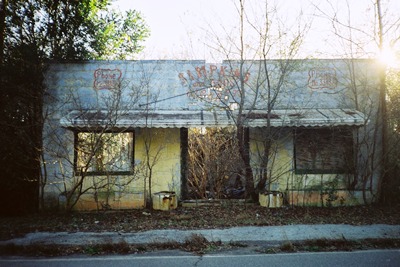
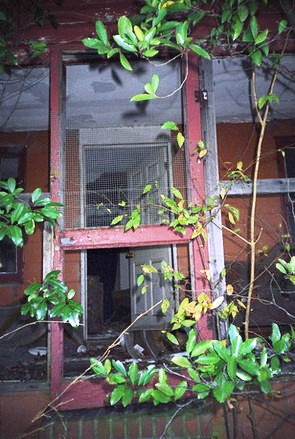 For seven or eight years. The resulting goo, filled with broken glass and oozing mildew, simply cannot be walked across in any sane way. There's not many buildings I won't go into, but garbage houses are definitely one. Most of the homes on this block were garbage houses, with nearly all the belongings left behind. That always creates an odd feeling. Where'd these folks go so fast? And why? Back in the original post, you can see the
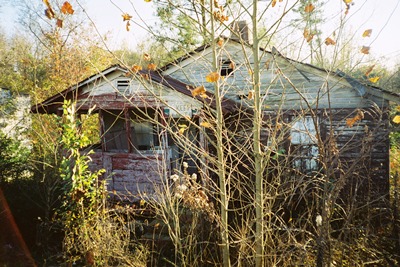
 You'd never know it from City of Dust, but I really love the desert. I've always wanted to live in the Southwest and, if I can find a reason (even a small one, like a job!), I might try to do so fairly soon. Desert Dream is doing nothing to change my mind, that's for sure. Beautiful photos of that big sky and rolling open landscape. Well worth taking a look at. You know, they say people that like the desert also like the sea. Hmm, I do like 'em both. Finally, many of the finest photos I've seen on the web have been on
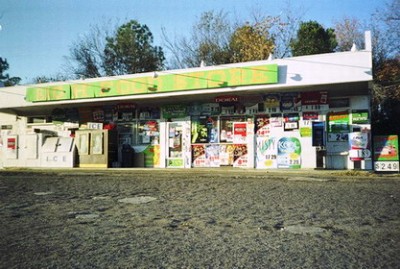
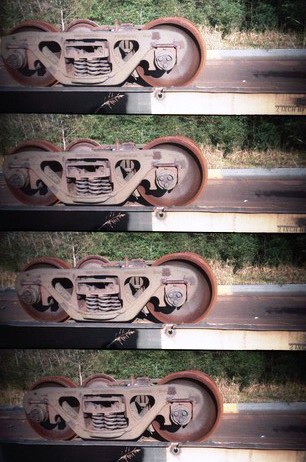 We interrupt this broadcast to bring you...LOMOGRAPHY! We left Cumberland Island, then drove down a residential block in St. Mary's to look at where the first pecan trees in Georgia were planted. The seeds were found floating in the Atlantic Ocean by Captain Samuel F. Flood, who brought them home. Flood's wife, Rebecca, and a neighbor planted the seeds around town in about 1840, setting the stage for the making of many tasty pies. After a quick peek from outside the gates of the Kings Bay Naval Submarine Base, where nuclear subs are made, it was back to the CSRA. We arrived to find that we saw the world much as a housefly might. Normally a cause for alarm, in this case it's just the result of cheap cameras and expired film. Here's some flat car wheels, the flat car itself soon to become a bridge in the
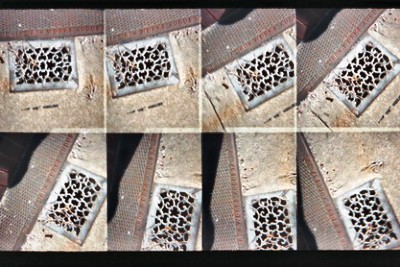
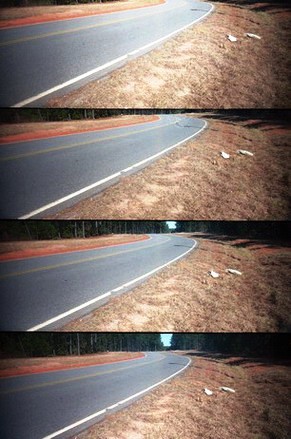 The LOMO LC-A was an immediate hit. Millions of the little inexpensive cameras were sold throughout the Soviet Union and other Communist countries, such as Viet Nam, East Germany, and even Cuba. And Communist photography flourished. But Communism hit some hard times in the late 1980's, and by 1991, with the Berlin Wall a memory, the LOMO LC-A was heading toward the dustbin of history. Then, the story goes, some Viennese students found a few cheap relics in a camera shop. They bought them and started taking pictures of everything they could find. Upon developing the film, they were fascinated with the strange colors, shading, and depth of focus (or lack thereof) that the cameras provided. Word spread, and, by the mid-1990's, LOMO's were being smuggled in from the former Eastern Bloc. In 1994, LOMO exhibits were held in Moscow and New York. A Lomographic Embassy was established in Berlin, with more soon springing up around the world. Waiting to see what's around the bend,

 People really started to get obsessive about lomography. Contests were started, exhibits held, and, in 2000, the first LOMOLYMPICS. By now, the Lomographic Society International had been around for years, with the stated objective "to study and document the world's surface by taking millions of snapshots of it." New cameras were created, galleries opened, shops stocked equipment, and rules were drawn up. Yup, there's 10 Rules of Lomography. They include things like, "Take Your Camera Everywhere," "Don't Think," "Be Fast," and, of course, "Don't Worry About Any Rules." Kinda silly, maybe. But you can't deny the energy and passion these people bring to photography. If you don't believe me, go to the website of
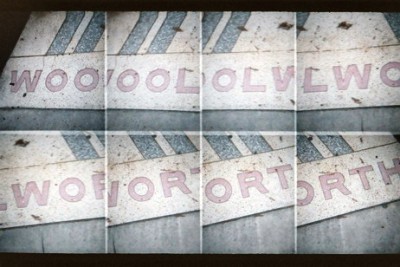
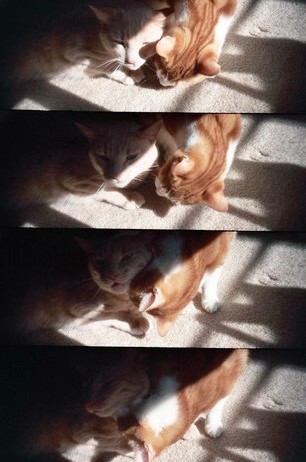 The shutters on the lenses open and close over a 2-second interval, allowing you to capture action (or make your own). In fact, lomographic cameras are frequently used to examine golf-swing technique. I soon found out that moving the camera was tricky; it was easy to move too fast and blur the image. Eventually, I stopped moving at all, or moved only slightly, as you can see from most of these shots. Here, the first instance of live creatures on this site, a South Carolina tabby attacks (unprovoked) his long-suffering housemate. And that's lomography. Again, I recommend going to the
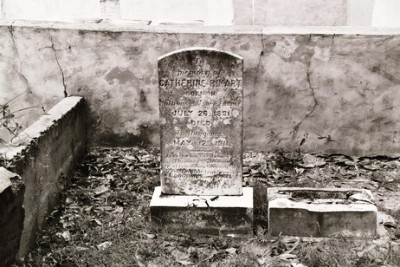
 In 1798, Lee was elected to Congress and, a year later, upon Washington's death, delivered his most famous words after being asked to compose a tribute: "First in war, first in peace, first in the hearts of his countrymen." But the next year Henry was out of the legislature with creditor's knocking. To escape, he tried to get a foreign appointment, but the new Jeffersonian government would have none of it. On January 19, 1807, Ann gave birth to the couple's fifth (and last to survive) child. She named him Robert Edward Lee, after two of her favorite brothers. Robert E. Lee. Robert was just a toddler when Light Horse went off to debtor's prison. Indeed, Robert would rarely see his father, and assumed control of the household at age 12. With nothing but time while living in a 12' x 15' foot cell, Henry wrote "Memoirs of the War in the Southern Department of the United States," a still-popular text on the Revolutionay War. In 1810, when Henry got out of prison, the Lee's scaled-down and moved to Alexandria, finally able to use some of Ann's inheritance. Henry left prison just as France and England were starting to mix it up. By 1811, support for declaring war on Great Britain was building, a move Lee was against, believing England's forces were superior.
 At first, Henry Lee tried to be a diplomat in Barbados and work for peace between England and America. But no one wanted to hear from him. So, he gave up. The Caribbean wasn't improving his condition, and he decided to come back to America to die. He made it all the way to Cumberland Island, where he sought refuge at Dungeness, dream home of Nathanael Greene, Lee's former commander and namesake of his deceased first-born. He died a few days later on March 25, 1818 and was buried nearby. Robert E. Lee visited his father's grave in 1862 and 1870, and the grave was moved to the Lee family crypt in Virginia on May 30, 1913. A broken failure at his death, considered
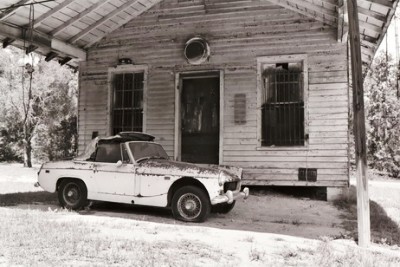
 From 1885 to WWII all these cats hung out together, but toward the end of the war the US government decided it didn't want so many captains of industry in one place at one time (bombing target!), so the party broke up and never really returned. Where were the Carnegie's in all this, you ask? Well, it was Thomas Carnegie, Andrew's brother, who bought up large bits of Cumberland Island in the 1880's. Just before I took this shot of a building at a deserted intersection I noticed a woman on a riding lawnmower heading toward me. She was wearing a motorcycle helmet, but I could tell from the speed of the mower that things were going to get interesting. I snapped this picture since, well, I was gonna get in trouble anyway. After a few minutes of tense "discussion," during which I refused to hand over my film (?!), we managed to get out of the situation. My friend Chris XT235 was once threatened with a shotgun for accidentally riding his bike into someone's backyard. Trust me, these folks aren't kidding. I'm not saying people shouldn't protect their property, but, geez, let's not lose our heads. I still wonder if she actually owned this place...
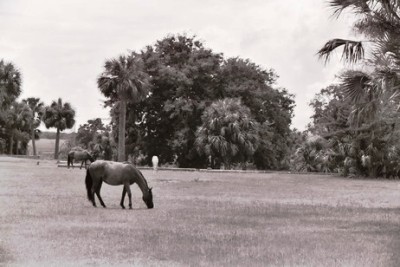
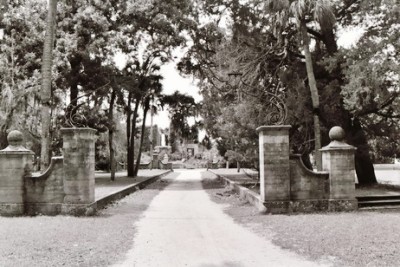
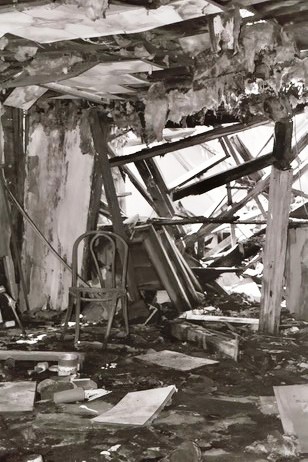
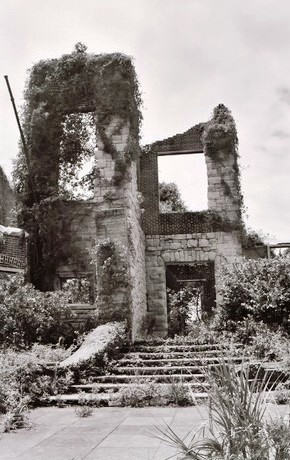 The Carnegie house was used for three generations of balls, banquets, and soirees, but by 1950 it had become impractical to live on an island, so Dungeness was literally abandoned. Nine years later, vandals snuck onto the island and into the deserted mansion. This picture shows the result. The fire was so bright it could be seen across the inlet in St. Mary's. But, the question remained, what to do with the island? Develop the hell out of it, like any reasonable person would do? Or something else? Surprisingly enough, the answer was "something else." At least it has been.
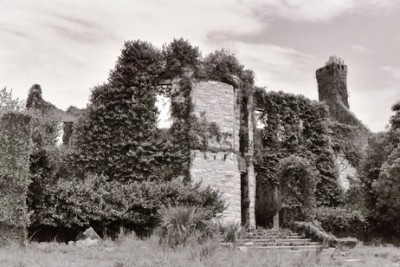
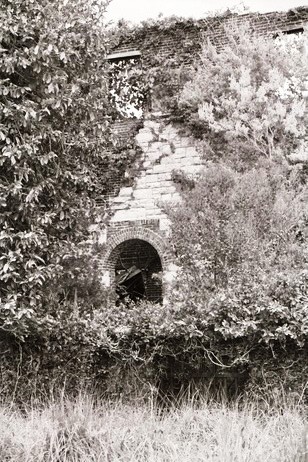 At the time the Carnegie's finally decided to sell all their holdings to the National Park Service in 1972, Fraser owned 3,000 acres. Seeing the writing on the tabby, Fraser finally decided to throw in his hand and sold to the Park Service. That made 36,415 acres, 16,850 of which are marsh, mud flats, and tidal creeks. Should I just steal from the
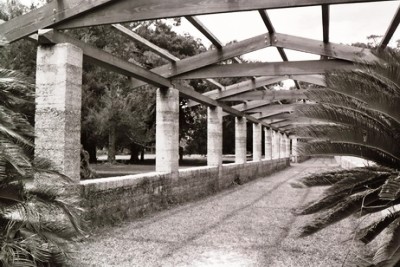
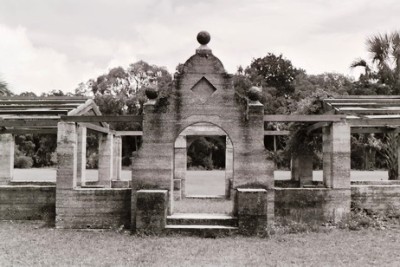
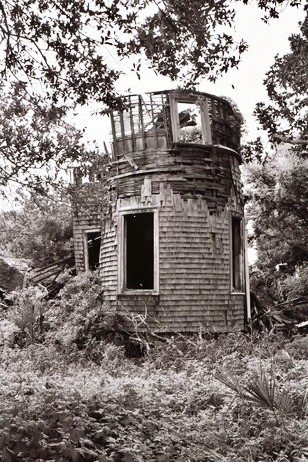 Just don't mistake the cisterns for garbage cans. That's really frowned upon. You can't actually go IN Dungeness, which accounts for all my exterior photos. This is a shot of the guest digs next to Dungeness. For the discerning associate of the Carnegie's, who needed a thatch tower all to themselves, this was the preferred option. Obviously, it met much the same fate as the mansion. Cumberland is so nice we're gonna stay for a bit. Oh, I got bits of info for this post from Kap Stann's Georgia Moon Travel Handbook and The New Georgia Guide, by a whole bunch of people. Both are good references. More next time.